
1. Introduction: The Critical Gap in Modern Network Visibility
Global enterprise IT and industrial OT infrastructure faces an unprecedented cybersecurity challenge: organizations cannot mitigate network threats they cannot fully observe. As industrial control systems (ICS) such as the ILO-41 fiber ring bus architecture expand to integrate cloud-connected application buses, unmonitored network links create blind spots for ransomware, lateral threat movement, protocol anomalies, and unauthorized device access. Traditional monitoring methods—including switch SPAN mirror ports and host-based monitoring agents—fail to deliver lossless, bidirectional network traffic capture under peak bandwidth loads, introducing unacceptable risk for mission-critical operations.
This technical guide breaks down the gold-standard visibility solution: Copper Tap (Ethernet Tap / Passive Tap) hardware. These inline Test Access Point devices deliver 100% accurate, zero-impact network traffic capture for network monitoring, threat hunting, forensic analysis, and compliance auditing. Focused on the industry-leading Mylinking ML-TAP-2401B multi-port Gigabit copper Ethernet TAP, we analyze real industrial deployment topologies for fiber ring bus ILO-41 application networks, compare passive copper and optical TAP architectures, and outline how dedicated hardware TAPs eliminate the limitations of legacy monitoring tools to strengthen end-to-end network security.
Across energy, manufacturing, finance, and critical infrastructure sectors, IT/OT security engineers prioritize passive TAP hardware for one non-negotiable reason: passive copper Ethernet TAPs copy full-duplex network packets without dropping frames, introducing latency, or creating exploitable attack surfaces on production network segments. This article serves as a definitive SEO resource for engineers researching network traffic capture hardware, evaluating passive tap deployment, and designing robust network security visibility pipelines aligned with industrial and enterprise compliance mandates.
Primary Search Intent Alignment
This blog targets high-conversion Google search queries:
○ Informational: What is a copper tap? Passive tap vs SPAN port, Ethernet tap industrial monitoring
○ Commercial: Best copper ethernet tap for OT network security, multi-port passive network tap for traffic capture
○ Transactional: Mylinking ML-TAP-2401B network tap datasheet, industrial ring bus monitoring tap deployment
2. What Is a Copper Tap, Ethernet Tap & Passive Tap? Core Technical Definitions
To eliminate terminology confusion for network security practitioners, we formalize each core keyword with hardware and operational context:
2.1 Copper Tap (Ethernet Tap)
A Copper Tap, interchangeably named Ethernet Tap, is a physical inline network visibility appliance built for BASE-T copper Ethernet links (10/100/1000M Gigabit electrical cabling). Deployed directly between two network endpoints—such as industrial ring bus switches and security monitoring servers—copper taps split bidirectional traffic into two identical streams:
○ Primary live traffic stream: Forwarded unmodified to the downstream production network device
○ Duplicated monitoring stream: Sent to dedicated analysis hardware (security servers, NOZOMI NG-500R industrial threat sensors, packet capture probes)
Unlike software-based mirroring, copper tap hardware uses dedicated PHY layer circuitry to regenerate electrical signals, guaranteeing full bandwidth throughput with no packet loss during traffic spikes. The Mylinking ML-TAP-2401B is a modular copper tap supporting 16x Gigabit BASE-T copper ports, making it ideal for aggregating multiple industrial and enterprise copper links into a single unified monitoring feed.
2.2 Passive Tap
A Passive Tap is a subclass of network TAP hardware defined by its zero-firmware, minimal-electronics design. Two distinct passive tap variants exist for modern infrastructure:
○ Passive Optical TAP: Power-free optical splitter hardware for fiber optic links (F.O. in our ILO-41 topology diagrams). Uses purely passive light refraction to copy fiber traffic without electrical components; no power supply required, zero risk of link failure from hardware power loss.
○ Copper Ethernet Tap: While copper links require active PHY signal regeneration, enterprise-grade copper taps implement passive security architecture: no IP address, no management web interface, no remote access capabilities. This air-gapped design prevents threat actors from compromising the tap itself to tamper with captured traffic or pivot into production networks.
Critical distinction: All passive taps eliminate attack vectors present on managed switches, firewalls, or monitoring agents, a core requirement for zero-trust network security frameworks.
2.3 Network Traffic Capture & Network Monitoring Core Use Cases
Network Traffic Capture describes the process of recording full raw Ethernet packets traversing network links for post-event forensics, real-time threat detection, and performance troubleshooting. Network Monitoring is the broader operational workflow leveraging captured traffic to continuously audit protocol behavior, detect abnormal connection patterns, and validate network security policy enforcement. Copper Ethernet passive taps form the foundational data collection layer for both workflows, feeding complete, unaltered traffic to SIEM servers, industrial IDS sensors, and network performance analytics platforms.
3. Passive TAP vs. SPAN/Mirror Ports: Why Hardware TAPs Dominate Mission-Critical Monitoring
Many organizations initially rely on switch SPAN (Switched Port Analyzer) mirror ports for low-cost traffic visibility, but this approach creates catastrophic blind spots in high-traffic industrial and enterprise environments. Below is a technical breakdown comparing passive copper tap hardware to SPAN mirroring, with direct implications for network security and reliable network traffic capture:
| Evaluation Metric | Copper Ethernet Passive Tap (Mylinking ML-TAP-2401B) | Switch SPAN/Mirror Ports |
| Packet Capture Fidelity | 100% lossless bidirectional packet capture; all frames copied regardless of bandwidth load | Severe packet drop during traffic bursts; switch ASIC buffer overflow discards critical threat packets |
| Link Latency Impact | Near-zero PHY-layer insertion delay (<0.1µs); no disruption to real-time industrial ICS communications | No direct link latency, but consumes limited switch CPU/ASIC resources, degrading production throughput |
| Security Attack Surface | No IP/MAC address, no remote management, no firmware vulnerabilities; air gap between production and monitoring zones | Managed switch carries full attack surface; attackers can modify mirror configurations to hide lateral movement traffic |
| Full-Duplex Support | Natively captures both transmit (Tx) and receive (Rx) traffic simultaneously on every copper link | Many low/medium-grade switches only mirror one traffic direction, missing critical threat communication flows |
| Industrial OT Compatibility | Designed for constant uptime industrial ring bus topologies; hardware bypass relays maintain link continuity during tap power loss | Switch SPAN reconfiguration requires production network downtime; firmware updates risk disrupting ILO-41 bus automation workflows |
| Aggregation Scalability | ML-TAP-2401B aggregates 16x copper links + 8x fiber SFP ports into unified monitoring outputs | Limited to 2–4 mirror sessions per switch chassis; cross-switch traffic aggregation requires complex routing workarounds |
| Forensic Compliance | Captures complete raw packet payloads, unaltered by switch filtering logic | Switch ASICs truncate large packets and filter low-priority frames, invalidating audit trail compliance evidence |
For industrial ICS networks like the ILO-41 fiber ring application bus, packet loss from SPAN mirror ports creates irreversible operational risk: missed Modbus, Profinet, or EtherNet/IP protocol anomalies can lead to unplanned factory downtime or industrial ransomware breaches. Passive copper taps eliminate this risk by delivering guaranteed full-traffic visibility without taxing production switching hardware.
4. Optical Passive TAP vs. Copper Ethernet Tap: Industrial Ring Bus Deployment Comparison
Our two reference topology diagrams illustrate dual deployment strategies for the ILO-41 fiber optic ring bus infrastructure, highlighting when to select optical passive taps versus Mylinking copper Ethernet taps for network monitoring and network security pipelines:
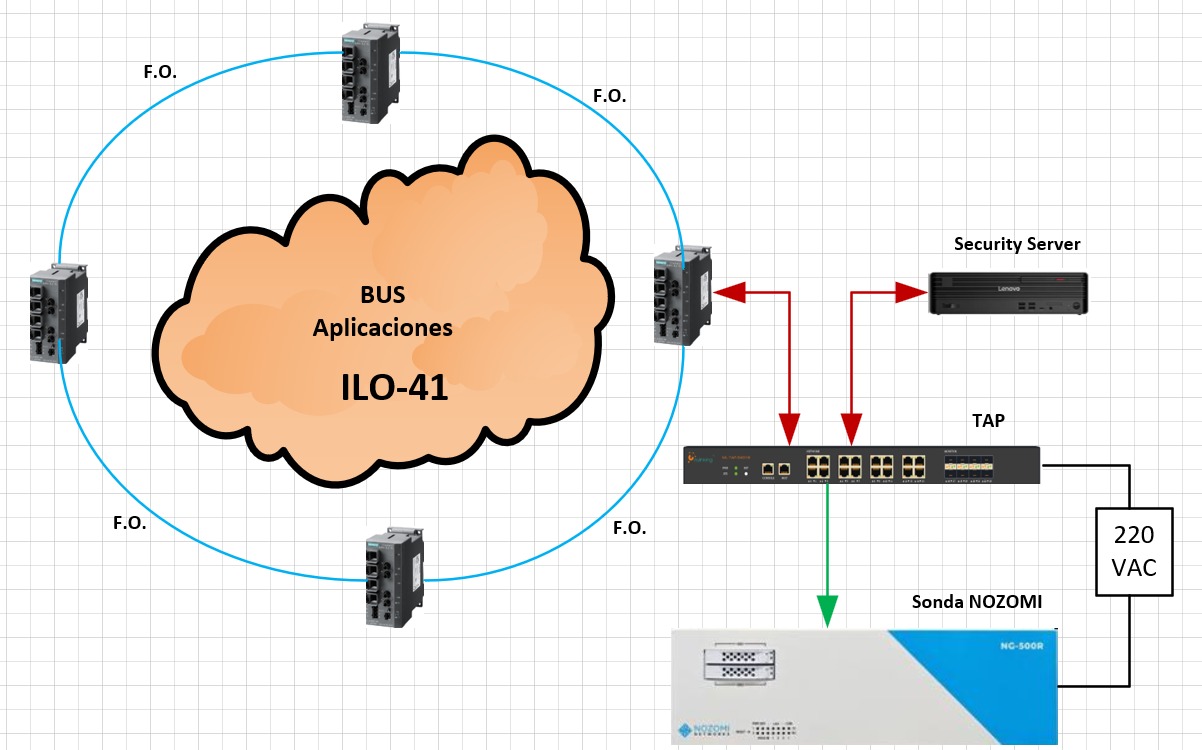
Topology 1: Direct Copper Tap Deployment (Reference Diagram 1)
○ Architecture Overview: The primary fiber ring bus switch connects directly to the Mylinking ML-TAP-2401B copper tap via Gigabit BASE-T electrical cabling. The copper tap splits traffic to two downstream monitoring endpoints:
- Lenovo Security Server (enterprise IT threat analysis, SIEM ingestion)
- NOZOMI NG-500R industrial OT sensor (ICS protocol anomaly detection)
○ Ideal Use Case: Sites where the ring bus core switch has spare copper RJ45 ports, and engineering teams prioritize simplified single-stage traffic aggregation without intermediate fiber splitting hardware.
○ Core Benefits: Fewer physical deployment components, unified copper-based monitoring feed for both IT and OT security tools, simplified cabling maintenance for on-site industrial technicians.
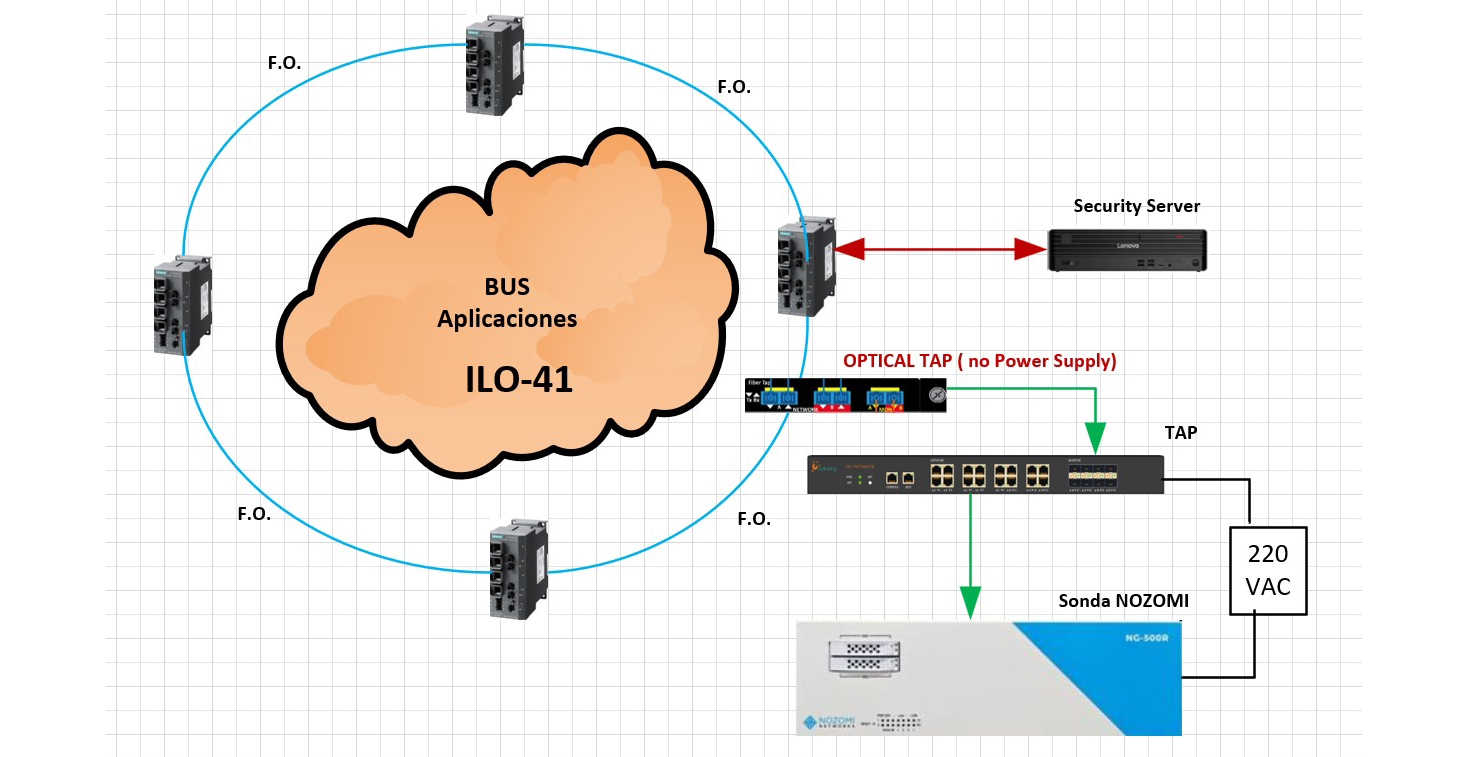
Topology 2: Hybrid Optical Passive TAP + Copper Tap Stack (Reference Diagram 2)
○ Architecture Overview: A power-free Optical Passive TAP is inserted inline on the fiber optic (F.O.) trunk connecting the ILO-41 ring bus switch. The split fiber monitoring feed converts to Gigabit copper, feeding into the Mylinking ML-TAP-2401B aggregation tap, which duplicates traffic to the security server and NOZOMI industrial sensor.
○ Ideal Use Case: Industrial sites where the fiber ring trunk carries critical automation traffic, and engineering teams cannot interrupt copper switch ports for inline tap deployment. The optical passive tap operates with zero power supply, eliminating single points of failure on the primary fiber bus.
○ Core Benefits: Complete isolation of the production fiber ring from powered monitoring hardware; passive optical splitter introduces no electrical failure risk; supports long-distance fiber trunk monitoring before traffic converts to copper Ethernet.
Decision Framework: Optical Passive TAP vs. Copper Tap
○ Deploy standalone Mylinking Copper Tap (ML-TAP-2401B): When monitoring copper BASE-T links, aggregating multiple electrical endpoints, or combining IT/OT monitoring tools in a single rack-mounted visibility stack.
○ Deploy Hybrid Optical + Copper Tap Stack: When the primary production transport medium is fiber optic, zero-power passive hardware is required for critical automation trunks, or long-distance fiber links require splitting before copper conversion.
5. Deep Dive: Mylinking ML-TAP-2401B Multi-Port Copper Ethernet TAP Technical Architecture
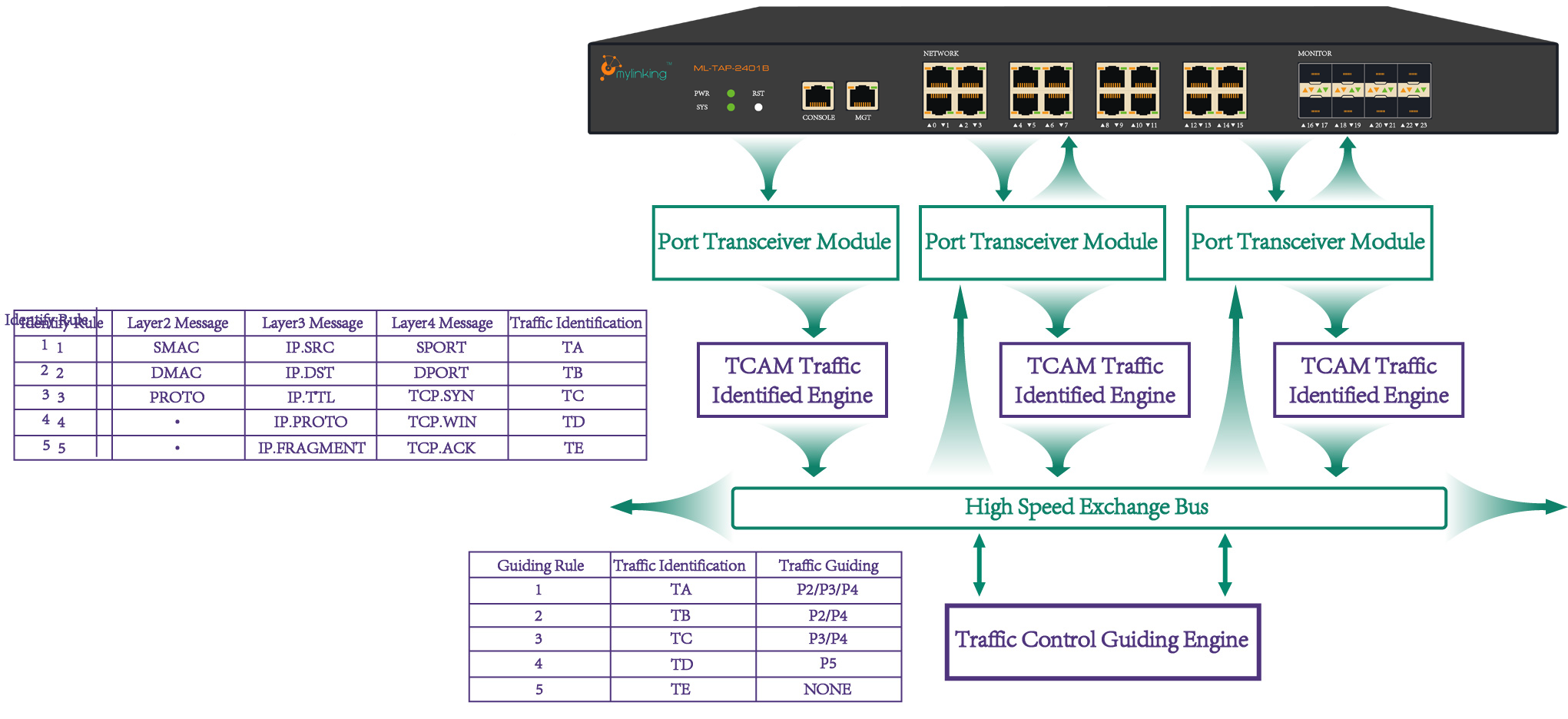
As the central hardware component in both reference industrial monitoring topologies, the Mylinking ML-TAP-2401B Copper Ethernet Tap delivers enterprise and industrial-grade passive network traffic capture with a maximum throughput capacity of 24 Gbps full-duplex. Built to resolve the scalability limitations of single-port basic copper taps, the unit integrates modular copper and fiber interfaces for unified cross-media network monitoring.
5.1 Core Hardware Specifications
○ Port Configuration: 16 x 10/100/1000M BASE-T Copper Tap Ports + 8 x Gigabit SFP Fiber Slots
○ Total Bandwidth Capacity: 24 Gbps bidirectional traffic processing
○ Critical Passive Security Design: No onboard IP stack, no web management portal, zero attack surface for threat actors
○ Hardware Fail-Safe Bypass Relays: Every inline copper port includes mechanical bypass relays. In the event of tap power loss, relays instantly short-circuit the production link, maintaining uninterrupted ILO-41 ring bus automation traffic—an essential feature for industrial OT uptime requirements.
○ Power Input: Standard 220 VAC rack-mount power supply, compatible with global industrial facility electrical standards (matches the power infrastructure shown in our deployment topologies)
○ Deployment Form Factor: 1U rack-mount chassis for standard industrial server cabinets, compact footprint for space-constrained control rooms
○ Supported Monitoring Workflows: Traffic aggregation, bidirectional packet duplication, cross-fiber/copper link consolidation, multi-tool traffic distribution to security servers, IDS sensors, and forensic capture appliances
5.2 Key Differentiators vs. Competing Copper Tap Hardware
○ Dual Media Support: Unique combination of 16 copper tap ports + 8 SFP fiber slots eliminates the need for separate optical splitters and copper tap appliances in hybrid IT/OT environments. Competitor copper taps are limited exclusively to RJ45 BASE-T interfaces.
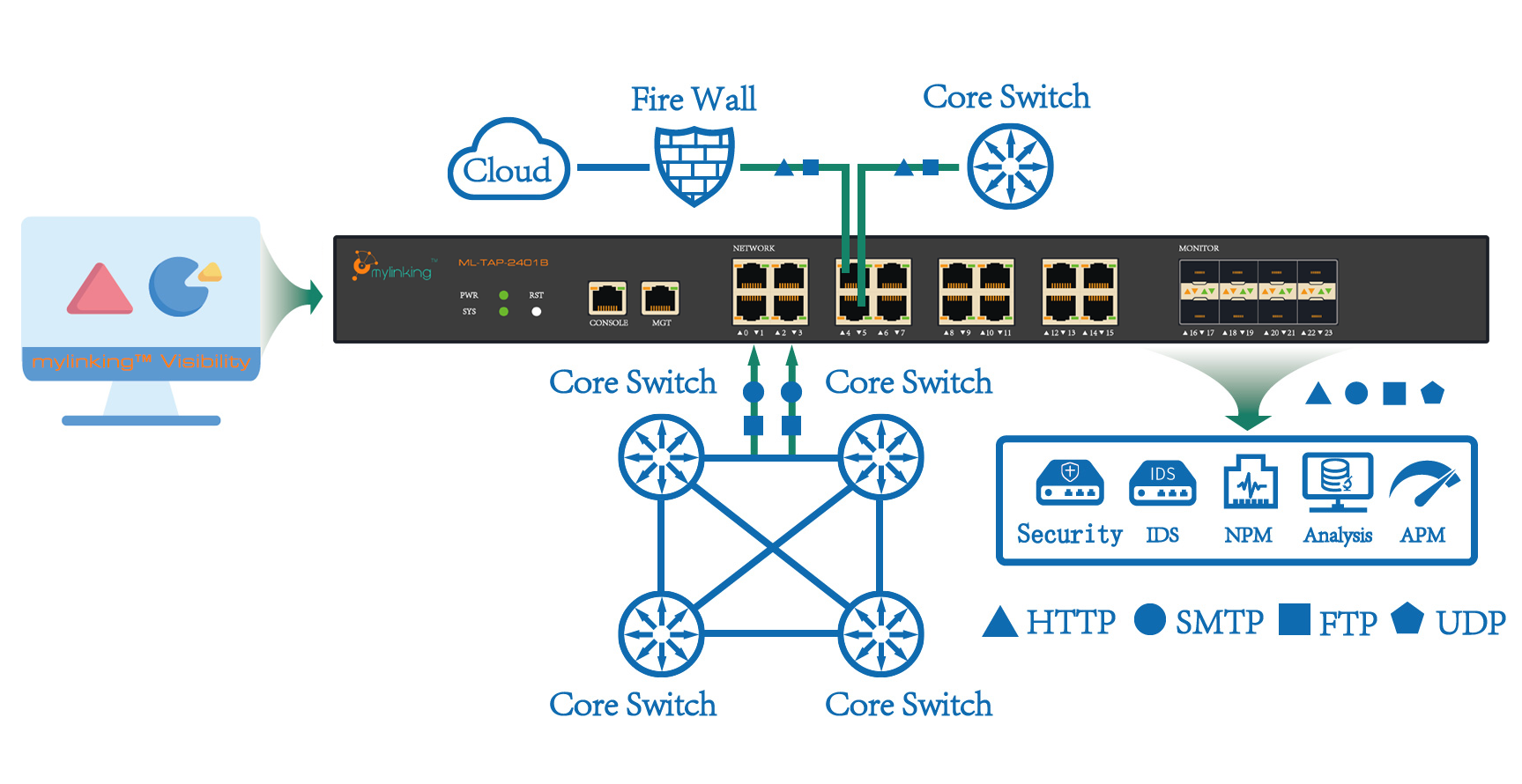
○ Multi-Tool Traffic Distribution: A single ML-TAP-2401B copper tap can simultaneously feed traffic to multiple monitoring tools (security server + NOZOMI OT sensor in our topology) without additional aggregation hardware, reducing rack space and deployment costs.
○ Industrial-Grade Reliability: Hardened PHY circuitry tolerates voltage fluctuations common in manufacturing and energy facilities; mechanical bypass relays exceed industry standard uptime requirements for ICS automation networks.
○ Scalable Passive Visibility: Modular port design allows incremental expansion of monitored links as the ILO-41 ring bus application network grows, avoiding full hardware replacement during infrastructure upgrades.
5.3 Copper Ethernet Tap Security Engineering
While copper Ethernet taps require power for PHY signal regeneration, Mylinking’s ML-TAP-2401B implements strict passive security principles:
○ No configurable operating system, firmware update channels, or remote access protocols
○ Physical one-way traffic separation between production input ports and monitoring output ports, creating a permanent logical air gap
○ No packet modification, filtering, or frame truncation; every captured packet is delivered to monitoring tools in its original unaltered state for valid network security forensics
6. Real-World Industrial OT Deployment Topology: ILO-41 Ring Bus Monitoring Case Study
The attached two network diagrams document end-to-end network security visibility deployments for an ILO-41 fiber optic ring bus, a widely deployed industrial application bus architecture for manufacturing, water treatment, and energy critical infrastructure. Below we break down every component’s role in the network traffic capture pipeline, and how the Mylinking ML-TAP-2401B copper tap unifies IT and OT monitoring workflows.
6.1 Core Production Network Layer: ILO-41 Fiber Ring Bus
○ Four industrial managed switches form a redundant fiber optic (F.O.) ring topology carrying the BUS Aplicaciones (Application Bus) industrial automation traffic. Protocols traversing the ring include real-time ICS communications (Profinet, Modbus TCP, OPC UA) alongside standard enterprise TCP/IP application traffic.
○ Redundant fiber ring design eliminates single points of failure for production operations, making lossless, zero-impact monitoring via passive tap hardware non-negotiable—any monitoring hardware failure cannot disrupt the ring bus.
○ The primary ring bus aggregation switch acts as the single egress point for traffic split to the Mylinking copper tap monitoring stack.
6.2 Mylinking ML-TAP-2401B Copper Tap Aggregation Layer
This central copper tap is the critical visibility bridge between production OT infrastructure and downstream security analysis tools, performing two core functions:
○ Receiving full bidirectional traffic copied from the ILO-41 ring bus (either direct copper connection or via upstream optical passive tap)
○ Duplicating identical traffic streams to two specialized monitoring appliances simultaneously:
a. Lenovo Security Server: Enterprise IT network security workflow host, running SIEM software, threat hunting tools, and packet forensic storage for TCP/IP threat detection (ransomware C2 communication, unauthorized remote desktop access, data exfiltration)
b. NOZOMI NG-500R Sonda Industrial Sensor: OT-specific IDS platform that parses industrial automation protocols to detect ICS-specific threats: unauthorized PLC modification, abnormal bus latency, compromised field device communications, and industrial malware payloads.
6.3 Power Infrastructure
The full monitoring stack (Mylinking copper tap, NOZOMI industrial sensor) operates on standard 220 VAC industrial facility power, matching global factory electrical standards and eliminating costly power conversion hardware for cross-border industrial deployments.
6.4 Topology Deployment Tradeoffs Recap
○ Direct Copper Tap Topology (Diagram 1): Simplified hardware stack, ideal for facilities with spare copper ports on the ring bus aggregation switch, reduces physical cabling and hardware count.
○ Hybrid Optical Passive Tap Stack (Diagram 2): Zero-power optical splitter inserted inline on the fiber trunk before copper conversion, eliminates electrical hardware risk on the primary production fiber ring, suited for high-risk critical infrastructure sites where powered inline hardware is prohibited on core automation trunks.
7. Step-by-Step Workflow: End-to-End Network Traffic Capture & Threat Detection Pipeline
Using our ILO-41 ring bus industrial topology as a reference, we outline the complete operational workflow enabled by Mylinking copper Ethernet passive taps for comprehensive network monitoring and network security:
○ Production Traffic Generation: Industrial field devices, HMIs, and application servers transmit bidirectional ICS and enterprise traffic across the redundant ILO-41 fiber ring bus.
○ Traffic Splitting Stage (Two Deployment Paths):
- Path A (Direct Copper Tap): Aggregation switch forwards full traffic stream via RJ45 copper cable to the ML-TAP-2401B copper tap’s inline input port.
- Path B (Hybrid Optical TAP): Passive power-free optical splitter copies fiber bus traffic; converted to Gigabit copper to feed the Mylinking aggregation tap.
○ Passive Copper Tap Duplication: ML-TAP-2401B regenerates the unmodified production traffic stream for downstream ring bus operation, while creating two identical monitoring copies via passive tap circuitry.
○ Parallel Security Analysis Feeds:
- Feed 1: Duplicated traffic routed to the enterprise Security Server for IT threat detection, full packet capture archival, and compliance audit log generation.
- Feed 2: Identical traffic stream sent to the NOZOMI NG-500R industrial sensor for real-time OT protocol parsing and industrial anomaly alerting.
○ Unified Threat Response Workflow: Both appliances correlate captured network traffic data to generate cross-domain IT/OT security alerts, enabling security teams to remediate threats before production bus disruption occurs.
○ Forensic Retrospective Analysis: Raw, lossless packet data captured via the copper tap is retained for post-breach forensic investigation, meeting regulatory requirements for immutable network traffic audit trails.
This workflow demonstrates why copper Ethernet passive taps are foundational to zero-trust industrial network security: every packet traversing the critical ILO-41 application bus is fully captured without compromise to production uptime or data integrity.
8. Key Advantages of Mylinking Passive Copper TAPs for Enterprise & Industrial Network Security
This section expands on high-intent SEO search queries focused on copper tap, passive tap, and network security benefits, organized for readability by IT and OT operational value:
8.1 100% Lossless Network Traffic Capture, Even Under Peak Bandwidth Loads
Unlike switch SPAN mirror ports that drop critical threat packets during traffic surges, Mylinking copper tap hardware uses dedicated PHY-layer circuitry to copy every frame traversing monitored copper links. For industrial ILO-41 ring bus environments, this eliminates blind spots for time-sensitive automation protocol anomalies and malware communication bursts that trigger catastrophic operational incidents. Complete bidirectional Tx/Rx capture delivers full context for network monitoring and forensic analysis workflows.
8.2 Passive Security Architecture Eliminates Attack Surfaces
As a passive tap variant, the ML-TAP-2401B copper tap contains no IP address, no firmware management interfaces, and no remote access capabilities. Threat actors cannot target the tap hardware to tamper with captured traffic, disable monitoring feeds, or pivot from the security analysis zone back into the production ILO-41 application bus—an irreplaceable feature for zero-trust network security frameworks and compliance with strict industrial cybersecurity regulations (NIS2, IEC 62443, CCPA).
8.3 Fail-Safe Hardware Bypass Relays Guarantee Industrial Uptime
All inline copper tap ports integrate mechanical fail-safe bypass relays. If the ML-TAP-2401B loses 220 VAC power supply, metal contacts instantly short-circuit the production Ethernet link, removing the tap from the data path entirely. This design eliminates the single point of failure risk that plagues active monitoring hardware, a mandatory requirement for redundant industrial fiber ring bus infrastructure like the ILO-41 architecture, where any link downtime incurs costly manufacturing or energy production losses.
8.4 Unified Multi-Media Traffic Aggregation Reduces Deployment Complexity
The ML-TAP-2401B’s unique combination of 16x Gigabit copper tap ports and 8x SFP fiber slots consolidates monitoring for both copper and fiber network links within a single 1U rack unit. Organizations deploying hybrid IT/OT infrastructure (fiber ring automation buses + copper enterprise server segments) eliminate the need to deploy separate optical passive splitters and single-port copper taps, cutting hardware capital expenditure, rack space usage, and on-site maintenance overhead.
8.5 Parallel Multi-Tool Traffic Distribution Optimizes Network Monitoring Infrastructure
A single Mylinking copper tap simultaneously distributes identical full-traffic copies to multiple independent analysis appliances—evidenced in our topology feeding both an enterprise security server and a dedicated NOZOMI industrial OT sensor. This capability removes the requirement for secondary traffic aggregation switches or packet brokers for basic multi-tool deployments, simplifying small-to-medium industrial facility monitoring stacks and reducing latency between traffic capture and threat alert generation.
8.6 Long-Term Compliance Readiness for Global Cybersecurity Mandates
Regulatory frameworks governing critical infrastructure (IEC 62443 industrial cybersecurity standard, EU NIS2 Directive, North American CIP standards for energy utilities) mandate complete, unaltered network traffic logging for breach response and audit validation. Copper Ethernet passive taps deliver immutable raw packet capture without frame truncation or modification, generating admissible forensic evidence that SPAN mirror port logs cannot match due to inherent packet loss and ASIC filtering limitations.
9. Deployment Best Practices: Copper TAP Sizing, Cabling & High-Availability Configuration
Drawing from our ILO-41 fiber ring bus real-world topology, we compile actionable technical best practices for network engineers designing copper Ethernet passive tap monitoring deployments:
9.1 Tap Sizing Calculation Guidelines
○ Count total monitored copper BASE-T links on the industrial ring bus aggregation switch to select port density: ML-TAP-2401B’s 16 copper tap ports support mid-to-large industrial facilities with multiple application bus egress links.
○ Reserve minimum 2 SFP fiber slots for future expansion of optical passive tap hybrid monitoring stacks as the ILO-41 ring bus scales to additional manufacturing zones.
○ Calculate total aggregate bandwidth of monitored links: The 24 Gbps full-duplex capacity of the ML-TAP-2401B supports up to 16 concurrent Gigabit copper links operating at 100% peak throughput with zero packet loss.
9.2 Cabling & Physical Deployment Standards
○ Direct Copper Tap Topology (Diagram 1): Deploy Cat6 shielded RJ45 cabling between the ring bus aggregation switch and ML-TAP-2401B input ports to resist electromagnetic interference common in industrial control rooms.
○ Hybrid Optical + Copper Tap Stack (Diagram 2): Specify low-loss single-mode fiber patch cords for the passive optical splitter upstream of the copper tap to maintain signal integrity across long-distance fiber ring trunks.
○ Rack Mounting: Install the Mylinking copper tap in a climate-controlled industrial server rack alongside security servers and NOZOMI OT sensors; position the unit within 5 meters of monitored production switches to minimize cabling attenuation.
9.3 High-Availability Monitoring Configuration
○ Dual Monitoring Tool Feeds: Mirror our reference topology by configuring parallel output streams to separate IT and OT analysis appliances to avoid single-tool visibility outages.
○ Redundant Power Supply: Deploy dual 220 VAC power feeds to the ML-TAP-2401B copper tap chassis for facilities with zero-downtime production requirements; hardware bypass relays serve as secondary failover protection.
○ Ring Bus Monitoring Redundancy: For ultra-critical energy utility ILO-41 deployments, deploy a secondary copper tap on a redundant fiber ring aggregation switch to maintain full visibility if the primary bus switch undergoes maintenance.
9.4 Maintenance Minimization for Passive Tap Hardware
○ Passive copper tap hardware requires zero regular firmware updates or configuration changes—eliminate scheduled maintenance windows required for managed switch SPAN port reconfiguration.
○ Perform quarterly physical cable integrity checks on inline copper tap ports to prevent intermittent link faults that disrupt network traffic capture feeds.
○ No remote management access reduces attack surface; all hardware diagnostics are performed via local physical LED status indicators on the ML-TAP-2401B front panel, eliminating remote attack vectors.
10. Frequently Asked Technical Questions (FAQ) for Network Monitoring Engineers
This FAQ section targets long-tail Google SEO search queries for copper tap, passive tap, and industrial network traffic capture, answering common engineer pain points:
Q1: What is the difference between a Copper Tap, Ethernet Tap, and Passive Tap?
A Copper Tap (also called Ethernet Tap) describes the hardware’s media type: it monitors Gigabit BASE-T copper Ethernet links via inline RJ45 ports. A Passive Tap refers to the security architecture: the hardware has no IP stack, remote management, or exploitable firmware, creating an air gap between production and monitoring zones. The Mylinking ML-TAP-2401B combines both classifications as a passive copper Ethernet tap for unified IT/OT network monitoring.
Q2: Can a Copper Ethernet Tap replace switch SPAN mirror ports for industrial ICS monitoring?
Yes, and it is strongly recommended for mission-critical ILO-41 ring bus environments. SPAN mirror ports drop packets during traffic spikes, introduce CPU load on production switches, and carry exploitable management attack surfaces. Copper Ethernet Taps deliver guaranteed lossless full-duplex traffic capture without disrupting industrial automation latency or exposing production networks to additional cybersecurity risk.
Q3: Does the Mylinking ML-TAP-2401B copper tap require power to operate? What happens if power is lost?
Copper Ethernet signals require PHY layer regeneration, so the unit uses standard dual 100~240 VAC industrial power supplies. In the event of power failure, integrated mechanical bypass relays instantly short-circuit the inline production Ethernet link, removing the tap hardware from the data path entirely to maintain unbroken ILO-41 ring bus automation traffic. Pure passive optical fiber taps require no power supply and are used upstream in hybrid deployments for core fiber trunk monitoring.
Q4: Can one ML-TAP-2401B copper tap feed multiple security monitoring appliances simultaneously?
Yes, as demonstrated in our industrial topology. The copper tap duplicates identical full-traffic copies to separate output ports, supporting parallel feeding of enterprise security servers, industrial OT sensors, packet capture storage appliances, and SIEM ingestion hardware without additional aggregation equipment.
Q5: Is a Copper Ethernet Tap compliant with industrial cybersecurity standards like IEC 62443?
Fully compliant. The passive air-gap design eliminates cross-zone lateral movement risk, lossless raw packet capture meets continuous bus monitoring mandates, and power-fail bypass relays eliminate inline hardware downtime hazards for industrial control zones such as the ILO-41 application ring bus.
Q6: When should I deploy a hybrid optical passive tap + copper tap stack instead of a standalone copper tap?
Select the hybrid stack when monitoring core fiber optic (F.O.) ring bus trunks where powered inline hardware cannot be inserted directly onto production switches. The zero-power optical splitter copies fiber traffic before conversion to copper Ethernet, isolating the powered Mylinking copper tap hardware from the primary automation fiber bus to minimize operational risk.
11. Conclusion: Future-Proof Your Network Visibility Infrastructure with Mylinking TAP Solutions
As industrial OT networks like the ILO-41 fiber ring application bus continue converging with cloud-connected enterprise IT infrastructure, blind spots in network traffic capture represent the single largest cybersecurity vulnerability for manufacturing, energy, and critical service organizations. Legacy monitoring tools—including switch SPAN mirror ports and host-based agents—cannot deliver the lossless, zero-risk visibility required to detect industrial malware, ransomware lateral movement, and protocol anomalies before costly production outages or data breaches occur.
Mylinking’s ML-TAP-2401B multi-port Copper Ethernet Passive Tap resolves these critical gaps by combining scalable cross-media traffic aggregation, passive security architecture, industrial-grade fail-safe bypass technology, and multi-tool parallel traffic distribution in a single rack-mountable appliance. Our dual industrial deployment topologies validate two flexible integration paths for ILO-41 fiber ring bus environments: direct inline copper tap deployment for simplified small-scale monitoring, and hybrid optical passive tap stacking for ultra-critical fiber trunk visibility with zero-power splitters.
For network security and OT engineering teams prioritizing complete network traffic capture, uncompromised production uptime, and regulatory compliance, passive copper Ethernet taps are no longer optional infrastructure—they form the irreplaceable foundation of modern zero-trust network monitoring programs. Mylinking’s full portfolio of copper tap, optical passive tap, and network visibility hardware delivers tailored solutions for enterprise data centers, industrial ICS ring bus architectures, and critical infrastructure facilities worldwide.
To evaluate the ML-TAP-2401B copper tap for your IT/OT monitoring pipeline, download the full technical datasheet via the official product page: https://www.mylinking.com/mylinking-network-tap-ml-tap-2401b-product/
Post time: Jun-25-2026


