
As enterprise infrastructure accelerates toward high-speed 100G and 400G architectures, IT operations and Security Operations Center (SOC) teams face an unprecedented challenge: How do you monitor high-throughput traffic without missing critical packets?
While network bandwidth continues to scale exponentially to accommodate AI workloads, cloud applications, and massive video traffic, backend security and performance tools—such as Intrusion Detection Systems (IDS), Network Performance Monitoring (NPM), and Web Application Firewalls (WAF)—often struggle to process traffic at full line rates.
This bandwidth mismatch creates severe monitoring blind spots, degraded security responsiveness, and compromised compliance. In this guide, we break down why traditional monitoring fails at high speeds and how a dedicated Network Packet Broker (NPB) and TAP architecture solves the zero-packet-loss challenge.
The Challenge: Why Traditional Traffic Monitoring Fails at 100G/400G
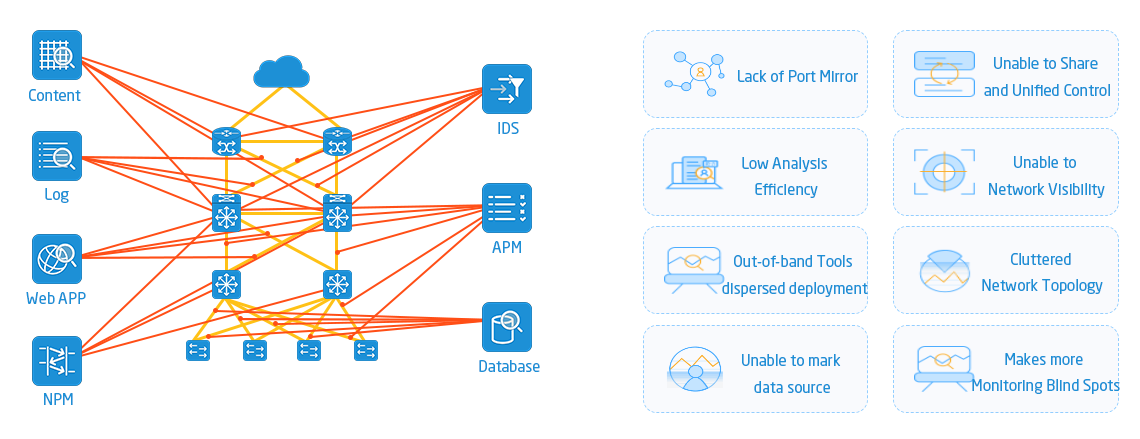
Many organizations initially attempt to monitor high-speed networks using existing switch features like SPAN (Switched Port Analyzer) or mirror ports. However, at 100G/400G scales, this approach quickly reveals several critical flaws:
Overloaded Backend Tools: A standard 10G or 25G security appliance simply cannot ingest an unfiltered 100G stream. Unprocessed bursts lead to dropped packets at the tool's Network Interface Card (NIC).
Switch Performance Penalties: Utilizing SPAN on high-density data center switches consumes valuable CPU and ASIC resources, often resulting in packet drops right at the switch level during peak load times.
Loss of Packet Integrity: In financial trading, telecom billing, or real-time threat detection, even a 0.1% packet loss rate can lead to missed malware signatures, inaccurate metrics, or regulatory compliance failures.
Three Steps Strategy for Zero-Loss 100G/400G Traffic Visibility
To achieve full network visibility without sacrificing monitoring tool performance, modern data centers require a decoupled, dedicated traffic visibility layer.
Step 1: Utilize Hardware Optical TAPs for Non-Intrusive Access
Instead of relying on switch SPAN ports, deploy passive Optical TAPs (Test Access Points) directly on critical 100G/400G fiber links.
○ Zero Latency: Hardware TAPs split light signals passively, introducing virtually zero latency.
○ 100% Data Copy: Unlike SPAN ports that drop packets during high CPU usage, optical TAPs capture every single bit, including corrupted packets and error frames.
○ Fault-Tolerant: Passive TAPs do not require power, ensuring network traffic continues unaffected even during power outages.
Step 2: Implement Advanced Network Packet Brokers (NPB) for Intelligent Traffic Optimization
Once the raw 100G/400G traffic is tapped, it flows into a Network Packet Broker (NPB). The NPB acts as an intelligent traffic manager, processing raw data before passing it to specialized monitoring tools. Key capabilities include:
○ Speed Conversion & Load Balancing: An NPB can aggregate multiple 100G feeds and load-balance the traffic evenly across a farm of lower-cost 10G or 25G analysis tools using session-aware hashing (IP, MAC, or Port-based).
○ Hardware-Based Packet Filtering: Eliminate noise by filtering out harmless traffic (e.g., trusted video streams or internal backup data) using L2-L7 filtering criteria, passing only relevant packets to your security tools.
○ Packet Deduplication: In redundant network topologies, duplicate packets are common. An NPB removes duplicates at line rate, preventing backend tools from processing the same packet twice.
○ Header Stripping & Truncation: For performance monitoring tools that only require packet headers, the NPB can slice away payload data (packet truncation). This reduces data throughput volume by up to 80% while retaining full diagnostic value.
Advanced Feature Focus: VXLAN Stripping & Sensitive Data Masking for Compliance
As enterprise networks migrate to multi-tenant Software-Defined Data Centers (SDDC), encapsulation protocols like VXLAN, NVGRE, and GTP add heavy headers to original packets. Traditional monitoring tools often fail to inspect encapsulated payloads, rendering security tools ineffective.
○ Encapsulation Stripping at Line Rate: Modern Network Packet Brokers must offer hardware-assisted VXLAN/GTP header stripping. By removing encapsulation headers before forwarding packets to security appliances, backend tools can analyze raw payload data natively without performance overhead.
○ Data Masking for Data Privacy Compliance (GDPR/HIPAA): To comply with strict international privacy regulations, sensitive information—such as Credit Card Numbers (PAN), Social Security Numbers (SSN), or Personal Identifiable Information (PII)—must not be stored in plain text within NPM or PCAP repositories. An advanced NPB can automatically detect and mask sensitive payload fields at 100G wire speed before handing off data to analysis tools.
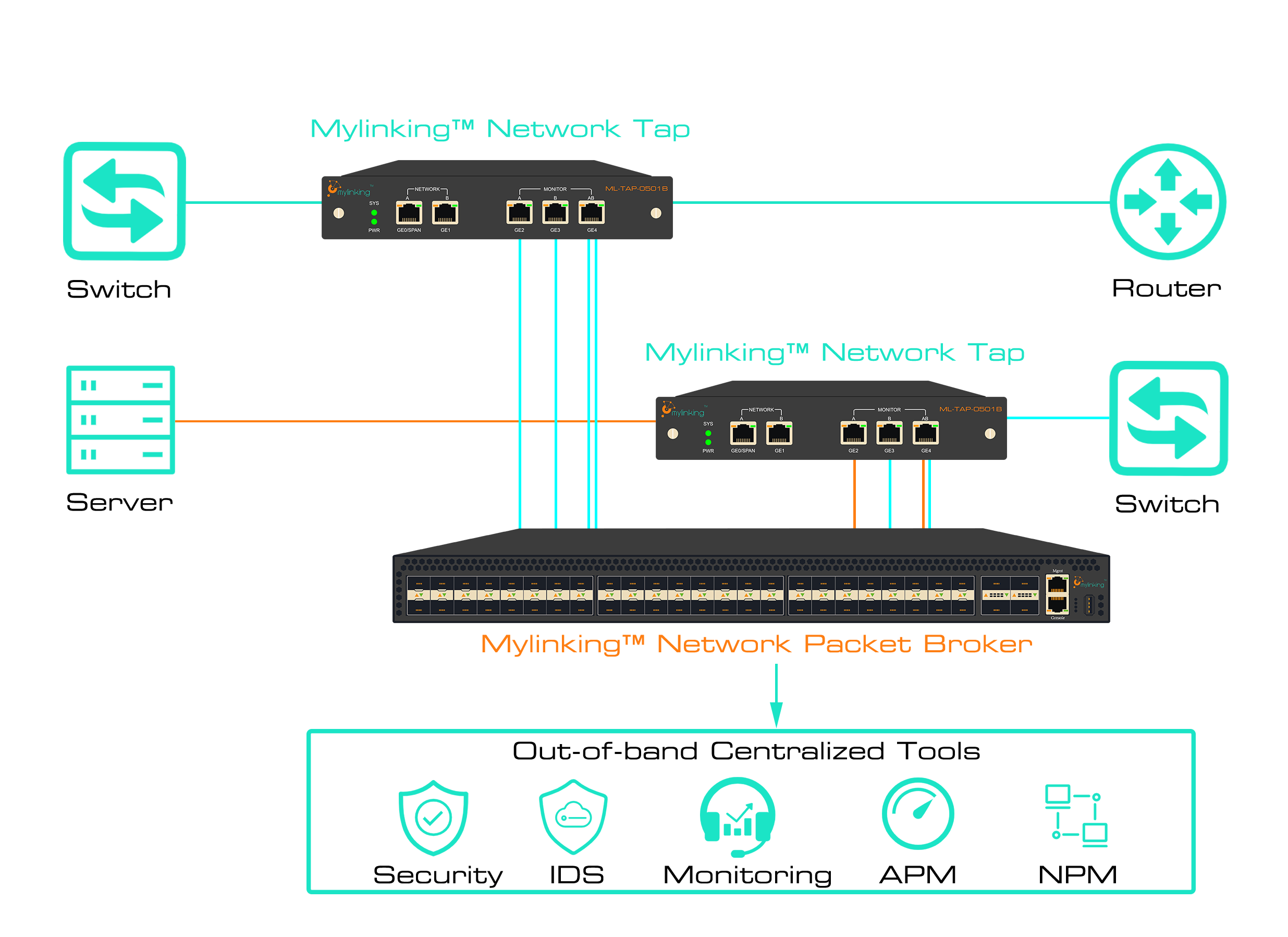
Recommended Deployment Topology
To visualize how this architecture fits into a high-speed data center, consider the following traffic flow:
SPAN Port vs. Hardware Optical TAP vs. Network Packet Broker: Feature Comparison
To help network architects make informed infrastructure decisions, here is how the primary traffic access methods compare across high-density 100G/400G environments:
| Feature / Capability | Switch SPAN / Mirror Port | Passive Optical TAP | Mylinking™ Network Packet Broker (NPB) |
| Primary Function | Basic Port Mirroring | Raw Physical Layer Copy | Intelligent Traffic Processing & Routing |
| Impact on Switch CPU | High (Potential performance drop) | Zero Impact | Zero Impact |
| Packet Loss Risk | High during traffic spikes | Zero Packet Loss | Zero Packet Loss |
| Handling Physical Errors | Drops corrupted frames | Captures 100% of layer-1/2 errors | Filters/Forwards layer-1/2 errors as needed |
| Traffic Optimization | None (All or nothing) | None (Raw copy) | Filtering, Deduplication, Truncation, Load Balancing |
| Tool Port Density | Limited by switch interfaces | 1-to-1 link mapping | Many-to-Many aggregation & matrix routing |
Key Business & Operational Benefits
By implementing a dedicated TAP and NPB visibility matrix, enterprises achieve immediate ROI and long-term infrastructure resilience:
○ Maximize Tool ROI: Extend the lifespan of existing 10G/25G monitoring tools without forcing premature hardware upgrades when backbone speeds increase to 100G or 400G.
○ Eliminate Security Blind Spots: Ensure SOC teams have complete visibility across every segment of the network to catch advanced persistent threats (APTs).
○ Simplified Maintenance: Network engineers can add, upgrade, or remove monitoring tools seamlessly without interrupting live production network links.
Frequently Asked Questions (FAQ)
Q1: Why can't I just upgrade my monitoring software to natively handle 100G feeds?
A: While upgrading software licenses is possible, processing un-filtered 100G raw traffic requires immense CPU and Memory resources on the analysis appliance, often leading to astronomical hardware costs. Using an NPB to filter out irrelevant traffic (e.g., streaming media) reduces throughput by up to 60–80%, allowing your existing tools to perform efficiently without costly license upgrades.
Q2: What is the difference between a Network TAP and a Network Packet Broker (NPB)?
A: A Network TAP is a passive hardware device inserted directly into a network link to create a zero-loss duplicate copy of physical light/electrical signals. A Network Packet Broker (NPB) is an active device that receives mirrored traffic from TAPs, processes the data (filtering, deduplicating, load balancing), and intelligently delivers optimized packet streams to specific monitoring tools.
Q3: Does deploying an NPB introduce latency into the production network?
A: No. TAPs and NPBs are deployed out-of-band (out of the live transaction path). Optical TAPs mirror light signals passively, and NPBs process the mirrored copy independently. Your production network traffic remains untouched, with zero added latency to live transactions.
Upgrade Your Network Visibility with Mylinking
Navigating high-speed network visibility doesn't have to mean compromising on data accuracy or incurring exorbitant tool upgrade costs.
Mylinking provides enterprise-grade Network TAPs and high-density Network Packet Brokers (NPB) engineered specifically for 10G, 40G, 100G, and 400G environments. Whether you need line-rate packet filtering, session-aware load balancing, or advanced packet manipulation, Mylinking delivers robust, loss-free data capture for your security and monitoring stack.
Post time: Sep-23-2026


