
Discover Mylinking™ ML-NPB-3440L — a 320Gbps Network Packet Broker (broker switch) unifying 1G, 10G, 40G and 100G network monitoring. Hardware traffic filtering, tunnel stripping, nanosecond timestamping and data slicing in a 1U appliance for enterprise visibility. Reference: https://www.mylinking.com/mylinking-network-packet-brokernpb-ml-npb-3440l-product/
1. Introduction: The Mixed-Speed Visibility Challenge in Modern Data Center Network Monitoring
Enterprise data centers today rarely run on a single link speed. Core fabrics converge on 40G and 100G uplinks, server access layers operate at 10G and 25G, while legacy business systems, branch gateways and out-of-band infrastructure still communicate over 1G copper. For NetOps and SecOps teams responsible for network monitoring, this mixed 1/10/40/100G network reality creates a fundamental problem: no single, cost-effective capture device natively handles all of these speeds while delivering lossless, tool-ready traffic to downstream analysis platforms.
Traditional approaches fail under this heterogeneity. Switch SPAN port mirroring is constrained by session-count limits, competes with production forwarding for switch resources, and drops packets under traffic bursts. Passive optical TAPs deliver clean physical-layer copies but leave operators with chaotic point-to-point cabling, no intelligent filtering, and a hard ceiling on how many monitoring tools can be fed. When organizations must capture everything from legacy 1G copper segments to 100G core links, the result is a sprawling, siloed visibility architecture that is expensive, difficult to maintain, and riddled with blind spots.
This is where a purpose-built Network Packet Broker — often called a Broker Switch in enterprise procurement language — becomes the central orchestration layer of a modern network monitoring stack. Acting as intelligent visibility middleware between capture sources (TAPs, SPAN ports, Virtual Taps) and monitoring/security tools (IDS, NPM, APM, SIEM, Packet Recorders), a Broker Switch aggregates, cleanses, filters, and redistributes traffic so every downstream tool receives exactly the data it needs, at exactly the right speed, without packet loss.
This article presents the Mylinking™ ML-NPB-3440L, a 1U 320Gbps Network Packet Broker engineered specifically for heterogeneous 1/10/40/100G network environments. We will examine its port architecture, hardware-accelerated traffic processing capabilities, validated application topologies, and the tangible Network Monitoring and Network Security benefits it delivers to enterprise, carrier and colocation customers worldwide.

2. Meet the Mylinking™ ML-NPB-3440L: A 320Gbps Broker Switch for Heterogeneous 1/10/40/100G Networks
The ML-NPB-3440L is Mylinking's mid-range, high-port-density Network Packet Broker, purpose-built to unify traffic capture across the full enterprise speed spectrum. Housed in a compact 1U rackmount chassis, the device integrates a domestic (Chinese) chip solution paired with a multicore intelligent CPU to deliver a total bidirectional traffic processing capacity of 320Gbps, guaranteeing line-rate performance for all built-in packet manipulation functions.
At its heart, the ML-NPB-3440L is designed to close three persistent gaps in enterprise network monitoring:
● Speed Heterogeneity: Native support for 1G copper, 1G/10G SFP+, 40G QSFP and 40G/100G QSFP28 interfaces, eliminating the need to deploy separate capture appliances per link speed.
● Tool Overloading: Hardware-accelerated filtering, deduplication, slicing and load balancing prevent monitoring tools from being overwhelmed by noisy, redundant raw traffic.
● Visibility Blind Spots: Tunnel identification and header stripping expose east-west flows hidden inside VXLAN, GRE, MPLS and GTP encapsulation, which basic mirroring cannot decode.
The result is a single, manageable visibility hub that consolidates all network monitoring capture workflows — from legacy 1G segments to modern 100G core fabrics — into one device.
3. Port Architecture: Comprehensive 1/10/40/100G Network Interface Coverage
The ML-NPB-3440L provides a uniquely balanced interface matrix designed to bridge high-speed core capture with abundant low-to-medium speed tool distribution, all within a single 1U rack unit:
3.1 16× 10/100/1000M RJ45 Copper Ports
Sixteen auto-negotiating RJ45 copper ports ingest legacy network traffic from branch office switches, management networks, legacy application servers and out-of-band monitoring segments. These ports are essential for organizations that must capture 1G traffic without adding media-conversion hardware, ensuring full coverage of the 1G tier of a mixed 1/10/40/100G network.
3.2 16× 1/10GE SFP+ Fiber Ports
Sixteen SFP+ slots support both 1G and 10G optical transceivers, providing the primary distribution and aggregation layer for modern access switches and mid-speed capture links. Dual-speed native support means the same slots terminate both legacy 1G fiber segments and contemporary 10G server access uplinks, maximizing interface flexibility and matching the port speeds of virtually all mainstream monitoring tools.
3.3 1× 40G QSFP Port + 1× 40G/100G QSFP28 Port
One 40G QSFP slot and one 40G/100G QSFP28 slot handle high-speed core fabric capture. The QSFP28 slot auto-detects and supports both 40G and 100G transceivers, enabling the device to ingest full 100G core uplink traffic while remaining backwards-compatible with existing 40G optics. This high-speed ingress layer is what makes the ML-NPB-3440L a true broker switch for modern 100G-era data center network monitoring.
3.4 Port Breakout & Single-Fiber Transmission for Cost-Efficient Scaling
Two port-flexibility features dramatically reduce deployment costs across large-scale capture environments:
Port Breakout: The 100G and 40G QSFP ports can be logically split into 4×25GE or 4×10GE sub-interfaces, multiplying available capture/output ports without additional hardware investment.
Single-fiber Transmission: 10G, 40G and 100G ports support single-fiber bidirectional transceivers, cutting required fiber cable quantities in half for environments where hundreds of capture links must be deployed — a significant operational saving for colocation and carrier-scale network monitoring.
4. Core Traffic Processing Capabilities: Full-Hardware Network Monitoring Intelligence
Every traffic manipulation function on the ML-NPB-3440L runs at the full 320Gbps line rate through its dedicated hardware processing pipeline. Below are the mission-critical capabilities that directly improve network monitoring outcomes.
4.1 Data Replication, Aggregation & Intelligent Distribution
As a foundational broker switch function, the ML-NPB-3440L supports flexible many-to-many traffic orchestration:
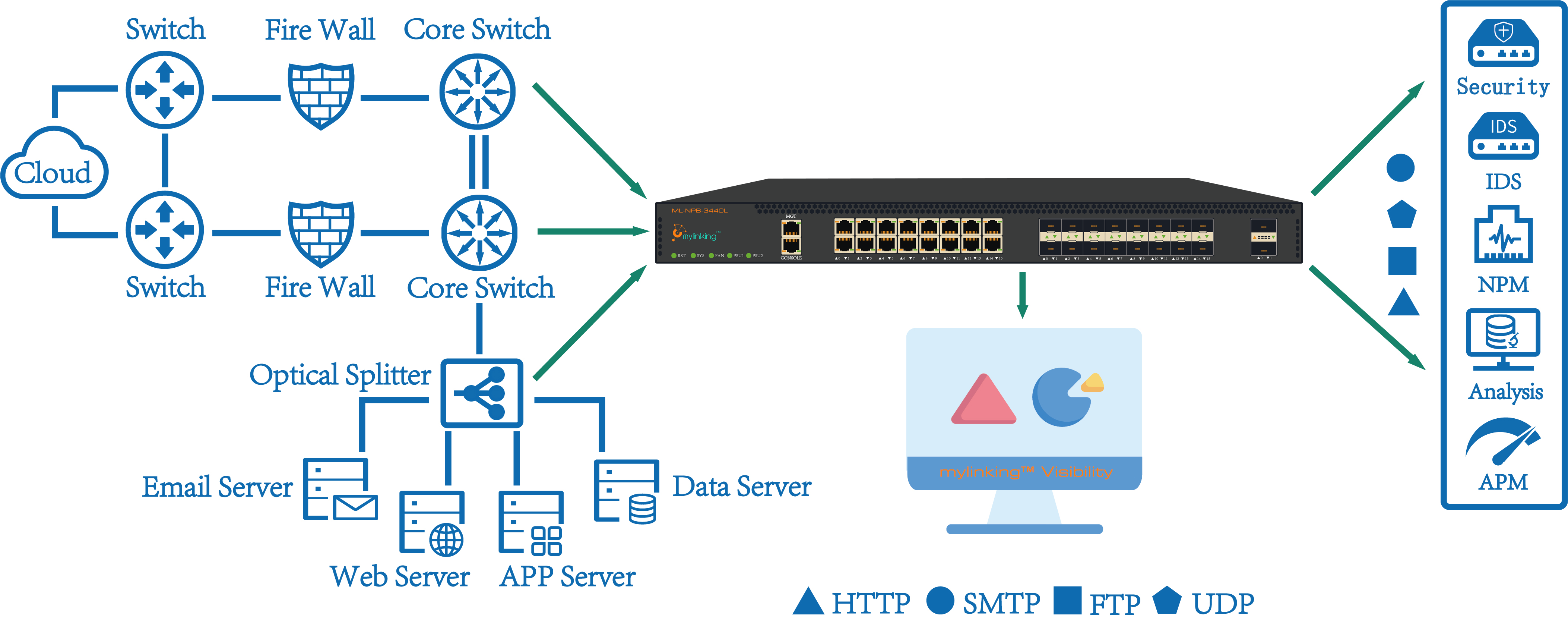
● Replication: Copy packets from one ingress port to multiple egress ports, delivering identical flows to IDS, NPM, APM and compliance tools in parallel without consuming extra SPAN sessions.
● Aggregation: Consolidate mirrored traffic from dozens of distributed TAPs and SPAN ports into unified filtered streams, eliminating fragmented siloed visibility across multi-rack fabrics.
● Distribution/Forwarding: Classify incoming metadata and forward or discard different service flows to multiple interface outputs according to whitelist, blacklist or user-defined rules, ensuring each monitoring tool receives only its relevant traffic subset.
4.2 Multi-Dimensional Traffic Filtering for Tool Load Reduction
Input traffic is accurately classified, and different service flows are discarded or forwarded to multiple interface outputs using whitelist or blacklist rules. Filtering flexibly combines Ethernet type, VLAN tag, TTL value, IP seven-tuple, IP fragmentation flags, TCP flag identification and message characteristics, meeting the deployment requirements of diverse network security, protocol analysis, signaling analysis and traffic monitoring equipment. Administrators can also match any key field within the first 128 bytes of a packet, customizing offset value, key-field length and content to capture proprietary protocols or custom tunnel headers native to their business environment.
4.3 Hardware Load Balancing Across Multi-Tool Clusters
To prevent individual monitoring appliances from being oversubscribed during peak traffic, the ML-NPB-3440L supports two complementary load-balancing algorithms:
● Hash-based Load Balancing using L2-L7 packet attributes for consistent flow pinning.
● Session-aware Weighted Sharing that allocates more capacity to high-priority security tools such as threat-hunting NDR platforms.
This ensures dynamic, even distribution of 100G core traffic across clusters of lower-speed monitoring interfaces, extending the service life of legacy 1G/10G tools in a 1/10/40/100G network.
4.4 Tunnel Identification, Termination & Header Stripping
Virtualized data centers and carrier networks rely heavily on overlay tunneling protocols, which create severe visibility blind spots for tools unable to parse outer headers. The ML-NPB-3440L delivers hardware-level tunnel intelligence:
● Tunnel Protocol Identification: Automatically identifies VXLAN, GRE, ERSPAN, MPLS, IP-in-IP and GTP tunnels, with traffic output policies applicable to either the inner or outer layer of the tunnel.
● Tunnel Packet Termination: Configure IP address/mask on ingress ports to terminate GRE, GTP and VXLAN tunnels directly, collecting remote traffic sent to the device via encapsulation.
● Header Stripping: Remove VXLAN, VLAN, MPLS, GTP and GRE headers to expose the original inner payload for full inspection, making east-west virtual-fabric traffic visible to monitoring tools and security platforms.
This capability is indispensable for organizations implementing Zero Trust security architectures, which mandate complete inspection of every encapsulated internal flow.
4.5 Data Slicing & Packet Encapsulation Output for Storage Optimization
For network monitoring use cases that only require header metadata for bandwidth trending and latency analysis, the ML-NPB-3440L supports policy-based Data Slicing (64–1518 bytes configurable), truncating full payloads and forwarding only header segments. Slicing cuts downstream bandwidth and storage consumption by up to 90% for low-priority flows, while full-packet capture remains available for high-risk internet border and payment VLANs. Conversely, Packet Encapsulation Output wraps selected captured traffic with ERSPAN headers for delivery to back-end systems or network switches that expect encapsulated input, ensuring compatibility with diverse monitoring architectures.
4.6 Nanosecond Timestamping & Packet Forwarding Priority
Precise, synchronized timing and reliability safeguards complete the traffic-processing suite:
● Nanosecond Hardware Timestamping: The device synchronizes to NTP servers and writes a relative timestamp tag at the frame end of every packet with nanosecond accuracy, enabling reliable cross-fabric event correlation for forensic incident reconstruction — a capability native capture architectures lack.
● Packet Forwarding Priority: Operators define packet priority based on service importance at the ingress port; high-priority packets are forwarded first, followed by medium- and low-priority flows, preventing monitoring-system alarm loss caused by missing critical data packets.
● Output Port Redundancy: Primary/secondary redundancy on traffic output ports automatically switches to a backup port when the primary output fails or goes link-down, guaranteeing continuous, highly reliable traffic delivery to monitoring tools.
5. Built-In Visibility, Monitoring & Management for 24/7 Operations
The ML-NPB-3440L is not only a packet processor but a self-contained network monitoring visibility platform, delivering real-time observability and enterprise-grade management without reliance on external tooling:
● Real-time Traffic Visibility: Through a friendly interactive interface, the device transforms invisible data signals into visible, manageable entities via multi-dimensional presentation of traffic composition structure, network traffic distribution, packet identification status, traffic trends, and traffic-time/business relationships.
● On-demand Packet Capture: Port-level and policy-level packet capture from source physical ports with five-tuple filtering enables rapid fault and threat root-cause analysis; captured data can be exported as standard PCAP files for Wireshark review.
● Multi-access Management: Full-featured console CLI, IP/Web graphical UI, SNMP, Telnet/SSH, SYSLOG event logging, and RADIUS/TACACS+ centralized authorization provide complete remote management, monitoring integration and audit capability for enterprise IT governance.
● Mylinking Matrix-SDN Integration: The device connects to Mylinking’s centralized Visibility Control Platform for unified, end-to-end traffic orchestration across multiple NPB appliances.
● 1+1 Redundant Power (RPS): Hot-swappable redundant power supplies support AC 100–240V or DC -48V input, with maximum 200W power draw, ensuring continuous operation in data center and carrier colocation environments. Operating temperature of 0–50°C and 10–95% non-condensing humidity tolerance suit standard rack deployments.
6. Validated Application Topologies for 1/10/40/100G Network Monitoring
Mylinking’s official documentation defines four reference deployment architectures that showcase the ML-NPB-3440L’s versatility as a broker switch:
6.1 Centralized Collection, Replication & Aggregation
The ML-NPB-3440L consolidates mirrored traffic from core switches, border firewalls, BRAS routers and optical TAPs distributed across multiple server racks. Traffic from 1G legacy segments, 10G access links and 40G/100G core uplinks aggregates into the device, which then replicates unified filtered streams to a complete stack of IDS, NPM, APM and big-data analysis platforms. This topology eliminates visibility silos and simplifies NOC/SOC traffic management across the entire mixed-speed network.
6.2 Unified Scheduling for Distributed Security & Monitoring Tool Stacks
Organizations running parallel security and observability tools leverage the ML-NPB-3440L’s intelligent distribution to send customized traffic subsets to each platform: full internet border flows to intrusion-detection systems, business-application flows to APM tools, and payment-VLAN traffic exclusively to compliance-audit analyzers. Load balancing across identical tool instances prevents bottlenecks during traffic surges, maximizing ROI on existing monitoring hardware.
6.3 Data Slicing for Storage & Bandwidth Optimization
Hyperscale environments generating petabytes of daily capture data deploy slicing policies: baseline office traffic is truncated to 64–128 byte headers for capacity planning and anomaly detection, while high-risk DMZ and internet-ingress traffic retains full payloads for deep forensics. This reduces total exported traffic volume by up to 90%, cutting cloud-storage and inter-data-center transfer costs.
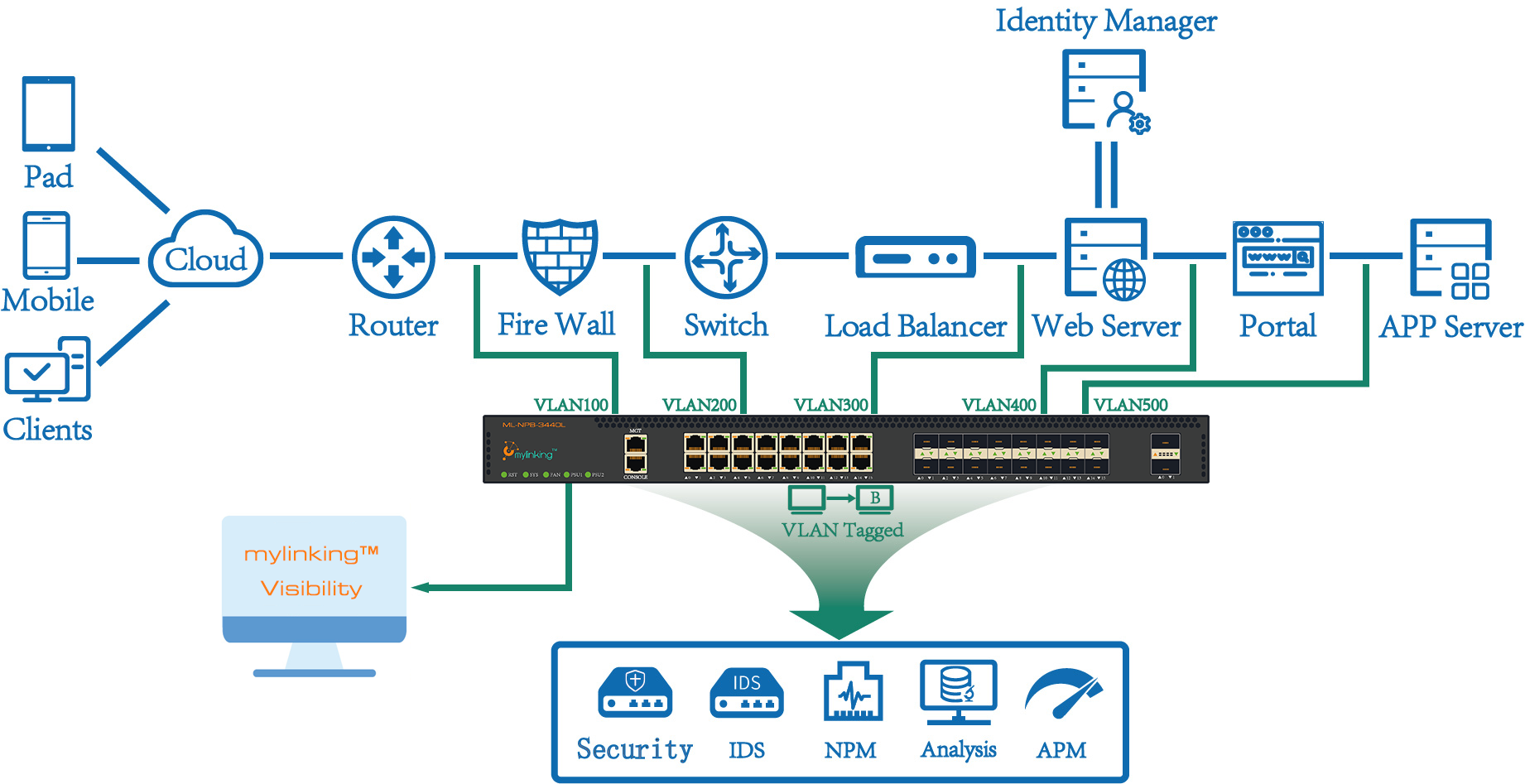
6.4 VLAN Tag Management for Tool-Specific Segmentation
Using VLAN tag/untag/replace operations, operators normalize traffic streams to match each monitoring tool’s fixed VLAN segmentation requirements, enabling clean traffic delivery across tools with incompatible tagging schemes in a single unified visibility fabric.
The ML-NPB-3440L as the Foundation of Complete 1/10/40/100G Network Monitoring
As enterprise networks continue their irreversible migration toward 100G core fabrics while retaining 1G and 10G legacy segments, basic SPAN mirroring and passive TAP wiring can no longer deliver the reliable, lossless, tool-ready visibility that modern network monitoring and network security demand. A dedicated Network Packet Broker — a true broker switch — is the central layer that turns raw, noisy, heterogeneous traffic into clean, relevant, time-synchronized data for every observability and security platform in your stack.
The Mylinking™ ML-NPB-3440L resolves every core challenge of 1/10/40/100G network monitoring in a single compact 1U appliance: 320Gbps line-rate processing, 16×1G copper plus 16×1/10G SFP+ plus 40G/100G QSFP port coverage, full-hardware filtering, load balancing, data slicing, nanosecond timestamping, and VXLAN/GRE/MPLS/GTP tunnel identification and stripping. Combined with port breakout, single-fiber transmission, 1+1 redundant power and seamless Matrix-SDN platform integration, the ML-NPB-3440L delivers a cost-effective, scalable and future-proof broker switch foundation for enterprise, carrier, colocation and regulated-industry network monitoring environments.
For network architects, SOC leads and data center managers planning a unified visibility upgrade across mixed-speed fabrics, the ML-NPB-3440L is the high-performance answer. Review the complete datasheet, application topology diagrams and custom quotation options at Mylinking's official product page: https://www.mylinking.com/mylinking-network-packet-brokernpb-ml-npb-3440l-product/
Post time: Oct-27-2026


