
In modern data centers and enterprise networks, Network Monitoring Infrastructure has become as critical as the switching and routing layers themselves. As hybrid cloud, virtualization, microservices, and 40G/100G high-speed links become standard, legacy monitoring architectures—built on SPAN ports, unmanaged TAPs, and ad-hoc tool connections—are collapsing under three crippling pain points:
(1) Tool Oversubscription: Monitoring tools are flooded with more aggregated traffic than they can ingest, leading to dropped packets, incomplete analysis, and wasted security investments.
(2) Blind Spots in East-West Traffic: Lateral server-to-server traffic (often 70–80% of total data center traffic) goes unseen, hiding lateral attacks, performance bottlenecks, and application issues.
(3) Packet Loss During Monitoring: SPAN sessions drop traffic under load; unmanaged aggregation creates congestion; and missing traffic processing leads to incomplete forensics, false negatives, and compliance failures.
To solve these challenges at scale, Mylinking introduces the ML‑NPB‑3440L Network Packet Broker—a powerful, domestically chip-based Network Visibility Solution engineered for 320Gbps full-duplex traffic processing, multi-rate interface flexibility (1G/10G/40G/100G), and deep L2–L7 intelligence. It unifies traffic collection, aggregation, filtering, load balancing, tunneling processing, and intelligent distribution to eliminate monitoring inefficiencies, deliver end-to-end visibility, and guarantee zero unnecessary packet loss for security, performance, compliance, and analytics tools.
This technical whitepaper provides an in-depth review of the ML‑NPB‑3440L, including its architecture, core capabilities, traffic processing engine, interface design, deployment use cases, and measurable business outcomes. Designed for Google SEO and enterprise technical buyers, this document positions the platform as the foundational layer for modern 40G/100G Network Monitoring and resilient Network Monitoring Infrastructure.
1. Executive Overview: Mylinking ML‑NPB‑3440L Network Packet Broker
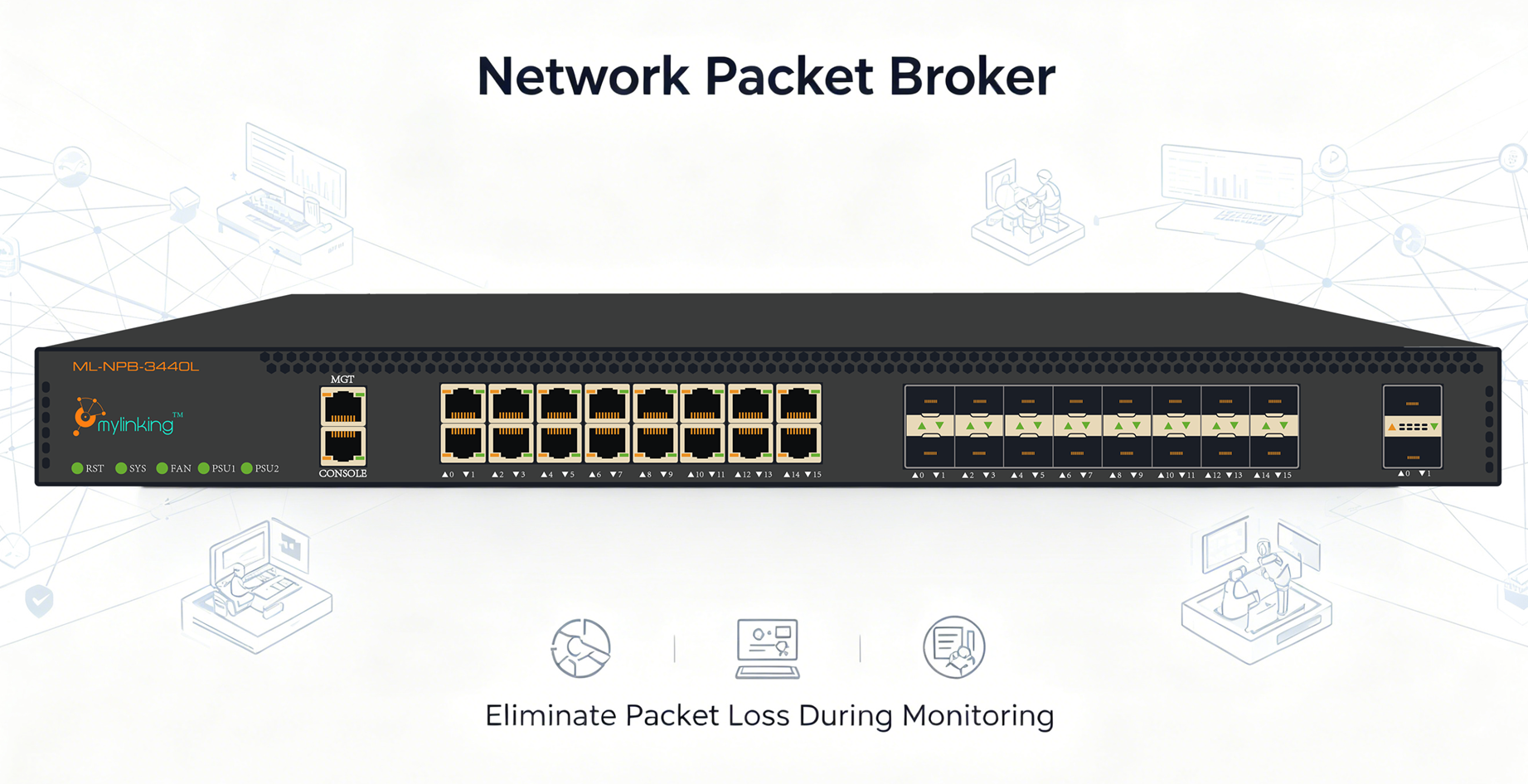
The Mylinking ML‑NPB‑3440L is a 1U rackmount, high-density Network Packet Broker (NPB) purpose-built to unify, optimize, and distribute traffic from any network segment to any monitoring or security tool. It supports a fully mixed interface set:
○ 16× 10/100/1000M RJ45 copper ports
○ 16× 1/10GE SFP+ fiber ports
○ 1× 40GE QSFP port
○ 1× 100GE QSFP28 port (compatible with 40GE)
○ Dedicated out-of-band management port
With a non-blocking switching capacity of 320Gbps full-duplex, the ML‑NPB‑3440L supports true line-rate processing even under full traffic load. Powered by a domestic high-performance chipset and multi-core CPU architecture, it delivers wire-speed traffic replication, aggregation, filtering, load balancing, packet slicing, VLAN rewriting, tunneling protocol processing (VXLAN, GRE, ERSPAN, MPLS, GTP, IPinIP), nanosecond timestamping, and dynamic traffic distribution.
As a converged Network Visibility Solution, the ML‑NPB‑3440L centralizes traffic from TAPs, SPAN/mirror ports, optical splitters, and virtual environments. It pre-processes raw packets to match tool requirements and forwards only necessary traffic to the right tools at the right rate. This eliminates Tool Oversubscription, removes Blind Spots in East-West Traffic, and eradicates Packet Loss During Monitoring—the three most costly failures in modern network operations.
The device supports both Fiber TAP and SPAN/Mirror deployment modes, making it equally effective for greenfield data center designs and retrofits of existing enterprise networks. It provides a web-based GUI, CLI, SSH, TELNET, SNMP, and SYSLOG for full lifecycle management, plus RADIUS/TACACS+ for secure role-based access control.
For organizations building stable, scalable, and observable Network Monitoring Infrastructure, the Mylinking ML‑NPB‑3440L is not just an accessory—it is the foundational switching layer for visibility.
2. The Three Critical Pain Points in Modern Network Monitoring
Before exploring the ML‑NPB‑3440L’s technical capabilities, we define the urgent operational and security crises that this Network Packet Broker resolves.
2.1 Tool Oversubscription: Wasted Investment & Incomplete Analysis
Tool Oversubscription occurs when the combined input bandwidth to a monitoring tool exceeds its real-time processing capacity. Common root causes include:
○ Aggregating multiple 10G or 40G links into a single 10G tool port
○ Replicating full traffic streams to many tools simultaneously
○ Sending all traffic (including noise) to tools designed for specific analysis
○ Missing traffic filtering, load balancing, or slicing capabilities
The result is catastrophic:
○ Packets dropped at the tool ingress
○ IDS/IPS misses threats
○ Forensic tools lose session context
○ APM/NPM tools produce distorted performance metrics
○ Security teams operate with blind optimism
According to industry research, organizations using SPAN-only or unmanaged TAP architectures typically experience 15–40% effective tool oversubscription during peak hours. This renders expensive security and monitoring investments partially ineffective.
2.2 Blind Spots in East-West Traffic: The #1 Cause of Lateral Breach Damage
Modern data centers are defined by East-West Traffic—server-to-server, container-to-container, and VM-to-VM communication inside the perimeter. Industry data consistently shows:
○ East-West traffic represents 70–85% of total data center traffic
○ 80% of advanced cyberattacks use lateral movement after initial compromise
○ 90% of organizations lack complete visibility into lateral traffic
Legacy architectures focus monitoring at the internet perimeter (north-south), leaving internal traffic invisible. Attackers exploit these Blind Spots in East-West Traffic to:
○ Move laterally across servers
○ Escalate privileges
○ Steal and stage data
○ Deploy ransomware
○ Persist undetected for weeks or months
Even when TAPs or SPAN sessions are deployed, the lack of a centralized Network Packet Broker means traffic cannot be aggregated, filtered, or load-balanced efficiently across internal segments. The result is a network that appears monitored but is riddled with invisible risk.
2.3 Packet Loss During Monitoring: Compliance Failure & Invisible Outages
Packet Loss During Monitoring is often misunderstood as harmless or unavoidable. In practice, it destroys trust in monitoring data:
○ SPAN ports drop packets under switch congestion
○ Aggregation without backpressure causes buffer overflow
○ Missing timestamping and replication break session integrity
○ Tunneled traffic is unreadable and dropped by standard tools
Consequences include:
○ Inability to perform full incident forensics
○ Failed PCI DSS, HIPAA, GDPR, and SOX audits
○ Unobserved microbursting and performance issues
○ Security tools missing attack sequences
○ Network teams unable to validate SLAs
For industries like finance, healthcare, e-commerce, and government, Packet Loss During Monitoring is not an operational nuisance—it is a business and compliance liability.
The Mylinking ML‑NPB‑3440L Network Packet Broker eliminates all three pain points through purpose-built hardware, intelligent traffic processing, and end-to-end visibility architecture.
3. Core Value Proposition: How ML‑NPB‑3440L Solves Critical Monitoring Challenges
The ML‑NPB‑3440L is architected to directly resolve the three industry crises while building a future-proof Network Visibility Solution.
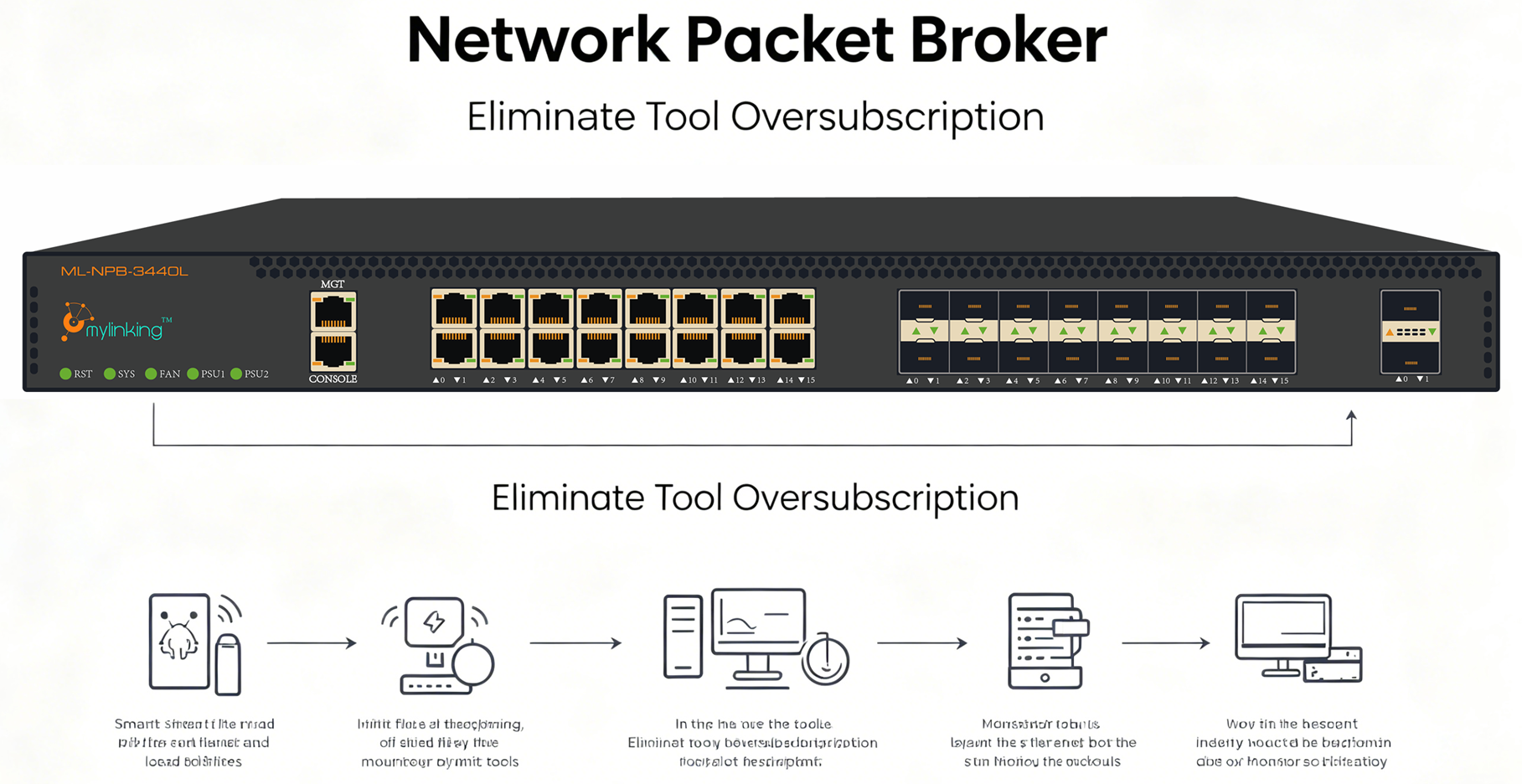
3.1 Eliminate Tool Oversubscription
○ Intelligent L2–L7 filtering sends only relevant traffic to each tool
○ Dynamic load balancing distributes sessions across tool clusters
○ Packet slicing reduces payload bandwidth without losing header intelligence
○ Traffic aggregation & replication control prevent tool flooding
○ Port breakout (100G → 4×25G, 40G → 4×10G) matches traffic rate to tool capacity
○ Priority forwarding ensures critical traffic reaches tools first
3.2 Eliminate Blind Spots in East-West Traffic
○ Centralizes collection from top-of-rack (ToR), aggregation, and core layers
○ Supports copper, fiber, 1G/10G/40G/100G mixed rates for full coverage
○ Decapsulates VXLAN/GRE/GTP/MPLS to expose inner payloads
○ Provides end-to-end traffic visibility for lateral server-to-server flows
○ Enables security and performance monitoring across virtual and physical workloads
○ Maps application dependencies hidden in East-West Traffic
3.3 Eliminate Packet Loss During Monitoring
○ 320Gbps non-blocking switching fabric eliminates congestion
○ Hardware-based forwarding guarantees zero packet loss under line-rate load
○ Built-in traffic buffering and microburst measurement
○ Nanosecond timestamping preserves sequence and timing integrity
○ Fail-safe output port redundancy prevents tool-side loss
○ Single-fiber transmission support expands reliable coverage
○ Lossless replication, aggregation, and distribution
By resolving these issues, the ML‑NPB‑3440L transforms Network Monitoring Infrastructure from a fragmented, lossy afterthought into a reliable, high-performance observability backbone.
4. Hardware Architecture & Interface Design
The ML‑NPB‑3440L uses a 1U short-depth chassis (445mm × 505mm × 44mm) for high-density data center deployment. It is built for continuous 24/7 operation with redundant power, industrial-grade environmental tolerance, and a domestic high-performance chipset.
4.1 Interface Configuration (Full Mixed-Rate Design)
The ML‑NPB‑3440L supports true multi-rate flexibility to unify monitoring across old and new infrastructure:
○ 16× 10/100/1000M RJ45: Copper access for legacy, campus, and branch links
○ 16× 1/10GE SFP+: Fiber for server farms, virtualization clusters, and mid-speed core links
○ 1× 40GE QSFP: High-speed aggregation and uplink
○ 1× 100GE QSFP28: Ultra-high-speed 100G capture (compatible with 40G)
○ 1× 10/100/1000M Mgmt: Dedicated out-of-band management
This interface mix enables the ML‑NPB‑3440L to act as a universal Network Packet Broker for:
○ Legacy 1G copper
○ Virtualized 10G server areas
○ 40G aggregation layers
○ 100G core and backbone links
4.2 Performance & Switching Capacity
○ Total Processing Capacity: 320Gbps full-duplex
○ Architecture: Domestic chip + multi-core CPU
○ Forwarding Method: Hardware-accelerated, line-rate, non-blocking
○ Power: 1+1 redundant AC/DC (AC 110–240V or DC -48V)
○ Max Power Consumption: 200W
○ MTBF: Optimized for carrier-grade data center operation
4.3 Reliability Features
○ 1+1 Redundant Power Supplies (RPS)
○ Port Redundancy: Primary/backup failover for tool ports
○ Interface Oscillation Protection
○ Traffic Microburst Measurement
○ Operating Temperature: 0°C – 50°C
○ Humidity: 10–95% non-condensing
○ Hardened chassis for rack-dense environments
This hardware platform ensures the ML‑NPB‑3440L can serve as the permanent foundation of any Network Monitoring Infrastructure.
5. Deep-Dive: Intelligent Traffic Processing Capabilities
The ML‑NPB‑3440L’s most powerful advantage is its comprehensive, wire-speed traffic processing engine. All functions run simultaneously at full line rate without performance degradation.
5.1 Core Traffic Manipulation Functions
5.1.1 Traffic Replication
○ 1-to-N replication: One input → many tools
○ N-to-M aggregation: Merge multiple inputs → many tools
○ Lossless copy for IDS, NPM, APM, SIEM, forensics, and compliance
5.1.2 Traffic Aggregation
○ Merge low-speed links into high-speed tool feeds
○ Reduce tool port count requirements
○ Simplify cabling and architecture
5.1.3 Traffic Distribution
○ Policy-based delivery using whitelist / blacklist / custom rules
○ Distribute by protocol, application, IP, port, VLAN, or packet signature
○ Ensure tools only receive traffic they are designed to analyze
5.1.4 Intelligent Filtering (L2–L7)
The ML‑NPB‑3440L supports ultra-granular filtering to eliminate noise and reduce tool load:
○ Ethernet type, VLAN, TTL
○ IP 7-tuple, fragmentation, TCP flags
○ Packet characteristics and payload patterns
○ First 128-byte custom offset key matching
○ Application-layer identification (L7)
Filtering is the primary mechanism to eliminate Tool Oversubscription.
5.1.5 Load Balancing
○ Hash-based load balancing (L2–L7 characteristics)
○ Session-aware, weight-based distribution
○ Ensures session integrity across tool clusters
○ Dynamically adjusts to link status
○ Prevents any single tool from being overwhelmed
5.1.6 VLAN Tag / Untag / Replace
○ Add, remove, or rewrite VLAN tags
○ Map multiple sources into logical monitoring domains
○ Simplify tool parsing and correlation
5.1.7 Packet Slicing
○ Slice packets from 64–1518 bytes
○ Preserve L2–L4 headers while truncating payloads
○ Dramatically reduce tool bandwidth consumption
○ Critical for high-volume environments
5.1.8 Packet Forwarding Priority
○ Prioritize traffic by business importance
○ Protect monitoring of critical applications
○ Prevent analysis gaps during congestion
5.1.9 Output Port Redundancy
○ Automatic failover between primary and secondary tool ports
○ Prevent tool-side packet loss during maintenance or failure
○ Ensure continuous compliance and security visibility
5.2 Tunneling Protocol Processing (Critical for East-West Visibility)
Modern data centers use overlay tunnels to virtualize and scale networks—but tunnels create Blind Spots in East-West Traffic. The ML‑NPB‑3440L exposes inner traffic with full decapsulation and intelligence:
5.2.1 Supported Tunnel Protocols
○ VXLAN
○ GRE
○ ERSPAN
○ MPLS
○ GTP
○ IPinIP
5.2.2 Tunnel Functions
○ Tunnel Protocol Identification: Auto-detect tunnel type
○ Inner/Outer Layer Matching: Filter based on inner or outer header
○ Tunnel Header Stripping: Remove VXLAN/GRE/MPLS/GTP headers
○ Tunnel Termination: Accept encapsulated traffic directly from network
○ Tunnel Encapsulation Output: Re-encapsulate to ERSPAN for remote tools
By processing tunnels at the Network Packet Broker layer, the ML‑NPB‑3440L makes encrypted and virtualized East-West Traffic fully visible to standard tools.
5.3 Time Stamping & Precision Forensics
○ Nanosecond-precision timestamping
○ Synchronization with NTP servers
○ Timestamps inserted into packets
○ Critical for fault analysis, attack tracing, and performance measurement
○ Solves timing errors caused by Packet Loss During Monitoring
5.4 Real-Time Packet Capture
○ Port-level and policy-level live capture
○ Five-tuple filtering
○ Immediate troubleshooting
○ Forensic-grade recording
5.5 Single‑Fiber Transmission
○ Support 10G/40G/100G single-fiber transmit/receive
○ Reduce fiber deployment costs
○ Extend monitoring to areas with limited fiber infrastructure
5.6 Port Breakout
○ 100G QSFP28 → 4×25GE
○ 40G QSFP → 4×10GE
○ Match high-speed links to lower-speed tool capacity
○ Eliminate tool bottlenecks
5.7 Full Traffic Visibility & Visualization
The ML‑NPB‑3440L provides end-to-end Network Visibility Solution dashboards:
○ Traffic composition
○ Real-time throughput
○ Packet distribution
○ Processing state
○ Traffic trends over time
○ Visual flow mapping
This turns invisible traffic into actionable insights.
6. Management & Orchestration
The ML‑NPB‑3440L supports enterprise-grade management for stable, secure operation:
○ Web GUI (HTTP/HTTPS)
○ CLI via Console (RS232, 115200, 8, N, 1)
○ TELNET / SSH
○ SNMP v1/v2c
○ SYSLOG
○ RADIUS / TACACS+ authentication
○ Username/password security
○ Integration with Mylinking Matrix‑SDN Visibility Control Platform
All configuration is intuitive, repeatable, and designed for large-scale Network Monitoring Infrastructure.
7. Typical Deployment Architectures
The ML‑NPB‑3440L supports nearly every enterprise and data center monitoring use case.
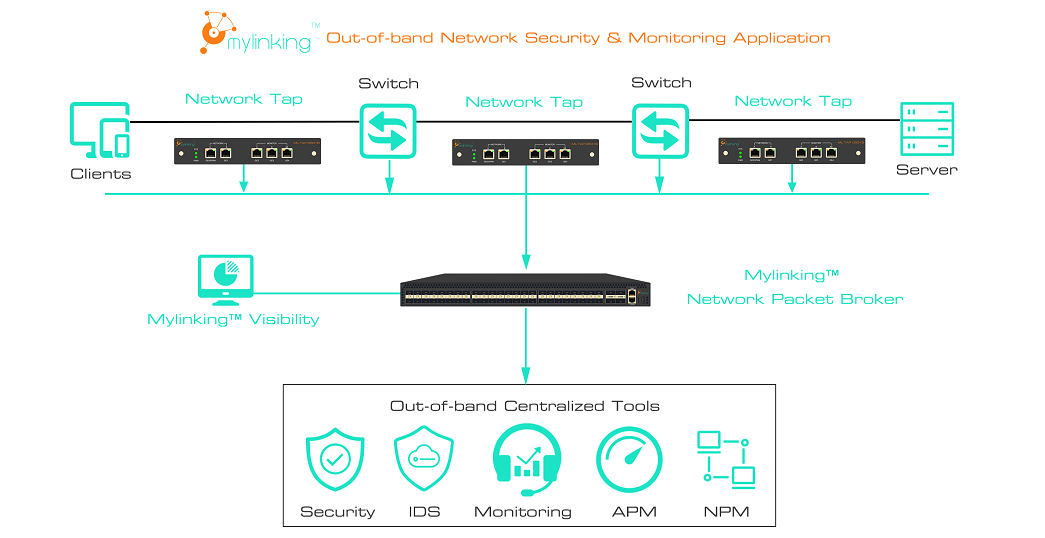
7.1 Centralized Aggregation & Replication
○ Collect from TAPs / SPAN across multiple switches
○ Aggregate to 40G/100G uplinks
○ Replicate to IDS, NPM, APM, SIEM, forensics
○ Eliminates cabling chaos and tool oversubscription
7.2 Unified Traffic Scheduling
○ Multi-rate input (1G/10G/40G/100G)
○ Filter, slice, load balance
○ Distribute to appropriate tools
○ Create a single observability backbone
7.3 East-West Traffic Visibility
○ Deploy at ToR / aggregation / core
○ Capture lateral server-to-server traffic
○ Decapsulate VXLAN/GRE
○ Filter and forward to security tools
○ Eliminate blind spots
7.4 Packet Slicing & Tool Optimization
○ Slice high-volume traffic
○ Reduce tool load by 40–70%
○ Preserve forensic integrity
○ Extend tool life and performance
7.5 High-Speed 40G/100G Network Monitoring
○ Full line-rate 100G capture
○ Load balance across 10G/25G tool clusters
○ Guarantee no Packet Loss During Monitoring
○ Ideal for core and backbone visibility
8. Technical Specifications Summary
| Item | Specification |
| Total Capacity | 320Gbps full-duplex |
| RJ45 Ports | 16× 10/100/1000M |
| SFP+ Ports | 16× 1/10GE |
| QSFP | 1× 40GE |
| QSFP28 | 1× 100GE (40GE compatible) |
| Management | 1× 10/100/1000M |
| Deployment | TAP + SPAN/Mirror |
| Key Functions | Replication, Aggregation, Distribution, Filtering, Load Balancing, Slicing, Timestamping, Tunnel Termination/Stripping, VLAN, Priority, Redundancy |
| Tunnel Support | VXLAN, GRE, ERSPAN, MPLS, GTP, IPinIP |
| Power | 1+1 RPS AC/DC optional |
| Dimensions | 1U, 445mm × 505mm × 44mm |
| Temperature | 0–50°C |
9. Conclusion: The Foundation of Modern Network Visibility
The Mylinking ML‑NPB‑3440L Network Packet Broker redefines what is possible in Network Monitoring Infrastructure. By solving Tool Oversubscription, Blind Spots in East-West Traffic, and Packet Loss During Monitoring, it transforms fragmented, lossy, incomplete monitoring into a reliable, high-performance, full-visibility backbone.
With 320Gbps capacity, mixed-rate 1G/10G/40G/100G interfaces, deep L2–L7 intelligence, and full tunnel processing, the ML‑NPB‑3440L is the ideal Network Visibility Solution for:
○ Enterprise data centers
○ Carrier-grade networks
○ Financial services
○ Healthcare
○ Government
○ Education
○ E-commerce and cloud platforms
If you are ready to eliminate blind spots, stop packet loss, eliminate tool oversubscription, and build a truly resilient observability architecture, the Mylinking ML‑NPB‑3440L Network Packet Broker is your foundational platform.
Post time: May-26-2026


