
Discover Mylinking ML-NPB-5690 1.8Tbps high-density Network Packet Broker, purpose-built for hyperscale data centers, 100G network monitoring, end-to-end network visibility, and enterprise-grade cyber security traffic processing.
Global enterprise and hyperscale data center architectures have undergone an unprecedented transformation over the past five years. Driven by cloud migration, microservices, AI computing, 5G backhaul, and massive encrypted business traffic, network bandwidth demands have surged from 10GE/25GE to ubiquitous 40GE and 100GE uplinks, creating an enormous blind spot for IT and security teams: the lack of complete, lossless network visibility across every east-west and north-south data flow.
For cyber security operations centers (SOCs), network monitoring teams, and data center administrators, partial visibility equals unmitigated risk. Traditional SPAN port mirroring, standalone network taps, and basic traffic splitters fail to address core pain points plaguing modern 100G networks: duplicated packets overwhelming IDS/NDR tools, unfiltered tunnel-encapsulated traffic hiding lateral movement threats, unmanageable full packet payloads consuming storage, unmarked high-speed flows lacking precise timestamps, and fragmented traffic collection across distributed switching, routing, and BRAS nodes. Without a unified Network Packet Broker orchestrating all traffic capture, preprocessing, and intelligent distribution, organizations waste massive capital on underutilized security monitoring hardware while leaving critical attack surfaces uninspected.
Industry cyber security research confirms that over 70% of network breaches exploit lateral movement within data center fabrics, hidden inside VXLAN, MPLS, GRE, and GTP tunnel encapsulation layers that basic mirroring tools cannot decode or extract for analysis. To combat these evolving threats, enterprises require a high-throughput, hardware-accelerated Network Packet Broker capable of line-rate processing of multi-terabit mixed-speed traffic, delivering actionable network visibility to every security, analytics, and observability tool in their stack.
This blog introduces the Mylinking ML-NPB-5690, Mylinking’s flagship 1.8Tbps high-density Network Packet Broker engineered exclusively for hyperscale data centers, 100G network monitoring, and enterprise-grade cyber security visibility. Built on P4 programmable ASIC architecture paired with multi-core intelligent processing CPUs, the ML-NPB-5690 consolidates all traffic preprocessing workflows—aggregation, replication, filtering, decapsulation, deduplication, slicing, and decryption—into a single 1U rackmount appliance, eliminating the need for stacks of disjointed traffic capture hardware while drastically improving tool ROI. As a leading manufacturer of professional network visibility infrastructure, Mylinking designs the ML-NPB-5690 to resolve every core visibility pain point facing modern data center operators, positioning this NPB as the foundational layer for complete, zero-trust aligned network observability.
Throughout this article, we will break down the ML-NPB-5690’s hardware specifications, patented hardware-level traffic processing features, seven validated production deployment architectures, comprehensive remote management tooling, and the tangible business and security benefits it delivers to organizations managing multi-100G data center fabrics. This guide serves as a technical reference for network architects, SOC engineers, data center infrastructure leads, and procurement teams researching enterprise Network Packet Broker solutions to upgrade their network visibility and cyber security posture.
What Is a Network Packet Broker (NPB) & Why It Is Indispensable for Cyber Security & Network Monitoring?
Before diving deep into the Mylinking ML-NPB-5690 product, it is critical to establish the core function of a Network Packet Broker and its non-negotiable role in modern network monitoring and cyber security ecosystems—foundational context for understanding how this 100G-capable NPB solves critical visibility limitations.
A Network Packet Broker (NPB) acts as a centralized traffic orchestration hub deployed inline within the data center visibility layer, positioned between network taps, switch SPAN mirror ports, and downstream security/analytics tools (IDS, NPM, APM, SIEM, protocol analyzers, big data traffic platforms). Unlike simple passive splitters that merely copy raw traffic, enterprise-grade NPBs deliver hardware-accelerated preprocessing to refine, filter, and intelligently route captured packets before delivery to monitoring tools, addressing six fundamental limitations of raw mirroring:
1- Uncontrolled traffic volume: Unfiltered full packet streams overload expensive analysis appliances, crippling throughput and missing threat signals under peak load.
2- Duplicated packet noise: Cross-switch mirroring generates identical packets from multiple collection points, wasting tool CPU and storage resources.
3- Encapsulated tunnel blindness: VXLAN, MPLS, GRE, ERSPAN, and GTP tunnel headers obscure inner-layer threat traffic invisible to basic monitoring tools.
4- Lack of traffic segmentation: Mixed-speed 10G/25G/40G/100G traffic cannot be dynamically split, aggregated, or load-balanced across multi-speed tool ports without an NPB.
5- No built-in compliance controls: Raw payloads transmit unredacted PII, financial card data, and regulated personal information to monitoring systems, violating GDPR, PCI-DSS, HIPAA, and SOX mandates.
6- Absence of precise flow metadata: Standard mirroring lacks nanosecond timestamps, application-layer protocol tagging, and customizable packet offset matching for deep forensics.
Network Packet Broker as the Backbone of End-to-End Network Visibility
Network visibility—the ability to capture, inspect, correlate, and analyze every packet traversing data center north-south and east-west links—is the bedrock of effective cyber security. Without granular, lossless visibility, security teams cannot detect lateral malware spread, DDoS attack precursors, unauthorized data exfiltration, misconfigured VLAN segmentation, or abnormal application traffic spikes. A high-performance NPB like the Mylinking ML-NPB-5690 transforms raw, unstructured tap traffic into curated, tool-ready data streams, ensuring every security and monitoring platform receives only relevant, high-value packets without bandwidth waste.
For 100G network environments, this capability becomes exponentially more critical. Hyperscale fabrics carrying multi-terabit daily traffic cannot rely on low-density, low-throughput NPBs that introduce packet loss or bottleneck line-rate processing. Only hardware-accelerated NPBs with terabit-class switching capacity can sustain full 100G port line speed while executing dozens of simultaneous traffic manipulation policies in parallel.
The Mylinking ML-NPB-5690 represents the pinnacle of Mylinking’s NPB product line, purpose-built for hyperscale data centers, carrier-grade network monitoring, enterprise SOC visibility stacks, and cloud hybrid infrastructure requiring mixed 10GE/25GE/40GE/100GE traffic aggregation and processing. Hosted on Mylinking’s official product page (https://www.mylinking.com/mylinking-network-packet-brokernpb-ml-npb-5690-product/), this 1U rackmount Network Packet Broker integrates a P4 programmable ASIC switching fabric paired with a multi-core dedicated intelligent traffic processor, delivering a total bidirectional switching throughput of 1.8Tbps with a dedicated 200Gbps hardware pipeline for advanced DPI, decryption, and policy-based traffic manipulation. 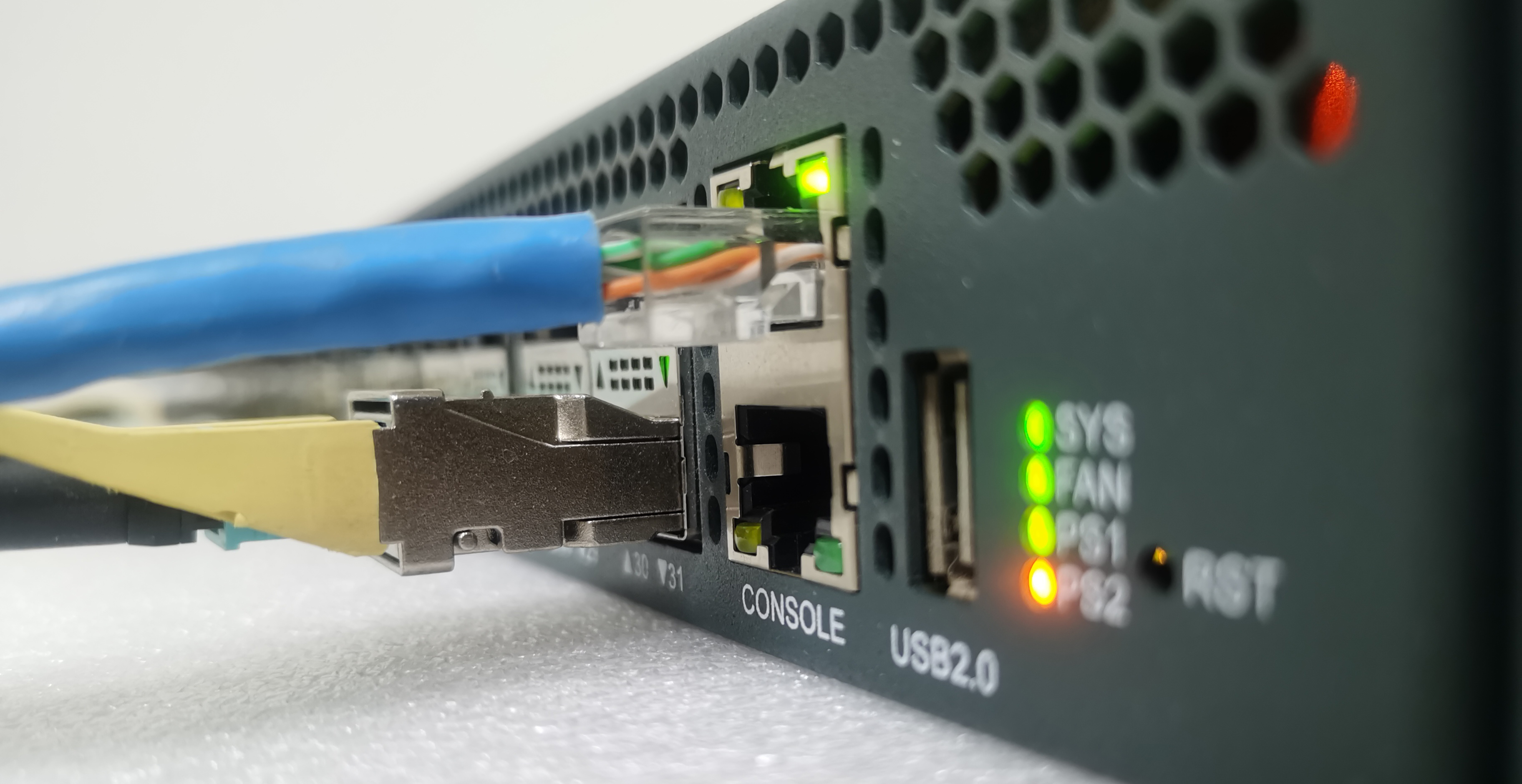
Full-Spectrum Intelligent Traffic Processing Capabilities Built into Mylinking ML-NPB-5690
The core competitive advantage of the Mylinking ML-NPB-5690 lies in its comprehensive suite of hardware-accelerated traffic processing functions, all executed at full line rate without introducing packet loss or latency. These capabilities are grouped into basic line-rate traffic orchestration, advanced intelligent manipulation, compliance-focused data sanitization, and DPI security analysis modules, each detailed below with real-world cyber security and network monitoring use cases.
1. Basic Line-Rate Traffic Routing, Replication, Aggregation & Load Balancing
Foundational NPB operations form the backbone of all network visibility workflows, fully hardware offloaded on the ML-NPB-5690’s switching ASIC:
1- Traffic Replication: Copy ingress packets from a single source port to multiple destination monitoring ports, enabling simultaneous delivery of identical traffic streams to IDS, NPM, and compliance audit tools without duplicating physical tap hardware.
2- Multi-Source Traffic Aggregation: Consolidate mirrored traffic from dozens of disparate switch SPAN ports, optical taps, and BRAS nodes into unified filtered streams, eliminating fragmented siloed visibility across distributed data center segments.
3- Policy-Based Load Balancing: Two configurable load balancing algorithms distribute traffic across multiple egress tool ports to prevent individual appliance overload:
○ Hash-based load balancing utilizing L2-L7 packet metadata (MAC, IP seven-tuple, TCP flags, VLAN tags) for consistent flow pinning.
○ Session-aware weighted load balancing to allocate more bandwidth capacity to high-priority security tools such as threat hunting NDR platforms.
4- Multi-Dimensional Packet Filtering: Create granular traffic matching rules combining Ethernet type, VLAN tags, TTL values, full IP seven-tuple (source IP, destination IP, source port, destination port, protocol, TCP flags, IP fragmentation), and customizable offset fields within the first 128 bytes of any packet. Administrators define custom offset length and value matching to capture proprietary protocol traffic, custom tunnel headers, or application-specific payload signatures native to their business environment.
5- VLAN Tag Management: Hardware-level VLAN operations including tag insertion, tag removal, and VLAN ID rewriting to normalize traffic streams before forwarding to monitoring tools with fixed VLAN segmentation requirements.
All these basic operations run at the full 1.8Tbps switching throughput limit, with zero packet loss even under sustained 100G full line-rate traffic loads.
2. Hardware-Accelerated Tunnel Decapsulation & Multi-Layer Traffic Filtering
Modern cloud and virtualized data centers rely heavily on overlay tunneling protocols to build multi-tenant fabric, which creates critical blind spots for security tools unable to parse outer tunnel headers to inspect inner threat traffic. The ML-NPB-5690 delivers native hardware-level tunnel identification and header stripping for all dominant enterprise tunneling standards, eliminating the processing burden from downstream security appliances:
○ Supported tunnel decapsulation: VXLAN, ERSPAN, GRE, MPLS, GTP, IPIP, PPTP, L2TP, PPPOE
○ Custom user-defined decapsulation: Administrators configure custom header offset rules to strip proprietary encapsulation layers within the first 128 bytes of packets, supporting emerging niche tunnel protocols without waiting for firmware updates.
Once outer tunnel headers are stripped, the NPB executes L2-L7 filtering rules against the inner original packet payload, enabling SOC teams to detect lateral movement ransomware, cross-VLAN data exfiltration, and encrypted tunnel-based attack traffic that standard mirroring systems would completely conceal. This hardware decapsulation feature is a mandatory capability for organizations implementing Zero Trust network security architectures, where complete inspection of every encapsulated east-west flow is required for continuous traffic verification.
3. Nanosecond Precision Timestamping, Packet Slicing & Data De-Duplication
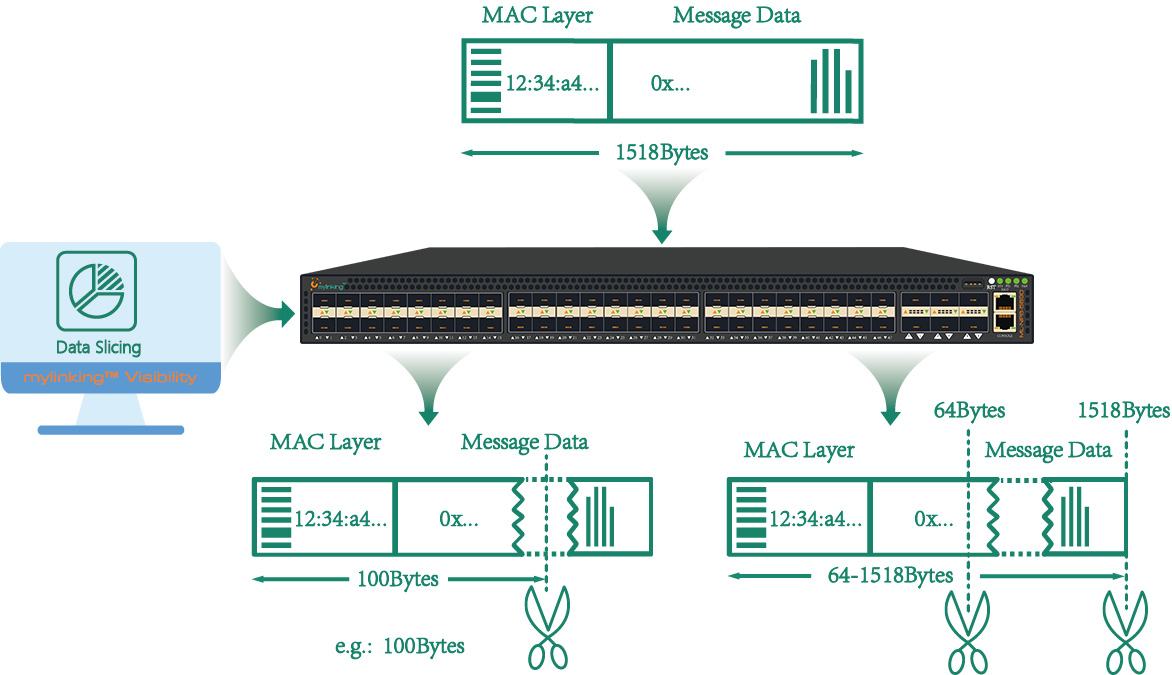
Three high-value traffic optimization features drastically reduce monitoring tool resource consumption and improve forensic incident investigation accuracy; all hardware accelerated on the ML-NPB-5690’s dedicated 200G intelligent processing pipeline:
1- Nanosecond Hardware Timestamping: Synchronize the NPB’s internal clock to enterprise NTP servers, then embed precise nanosecond-resolution timestamps at the frame trailer of every captured packet. This metadata enables cross-fabric correlation of threat events across multiple data center switches, routers, and security tools, eliminating millisecond-level timing inaccuracies that break incident reconstruction workflows. Timestamp marking operates at full line rate with no throughput degradation.
2- Policy-Based Packet Slicing: Truncate raw packet payloads to a configurable fixed length (64 bytes to 1518 bytes) per traffic policy. For baseline network monitoring use cases, administrators slice packets to retain only L2-L4 header data while discarding full application payloads, cutting storage bandwidth consumption by 70%–90% for big data traffic analysis clusters. Full payload capture remains available for high-risk security policy groups such as internet border uplinks and payment processing VLANs.
3- Multi-Granularity Data De-Duplication: Eliminate redundant identical packets collected from overlapping tap/SPAN sources to reduce monitoring tool CPU load. De-duplication rules operate at either physical port level or custom policy group level, with configurable matching identifiers including destination IP, source port, destination port, TCP sequence number, and TCP acknowledgment values. Organizations with large-scale cross-switch mirroring deployments typically see a 40%–60% reduction in total traffic volume delivered to downstream tools after enabling de-duplication policies.
4. Policy-Based Data Masking for Compliance & Sensitive Traffic Desensitization
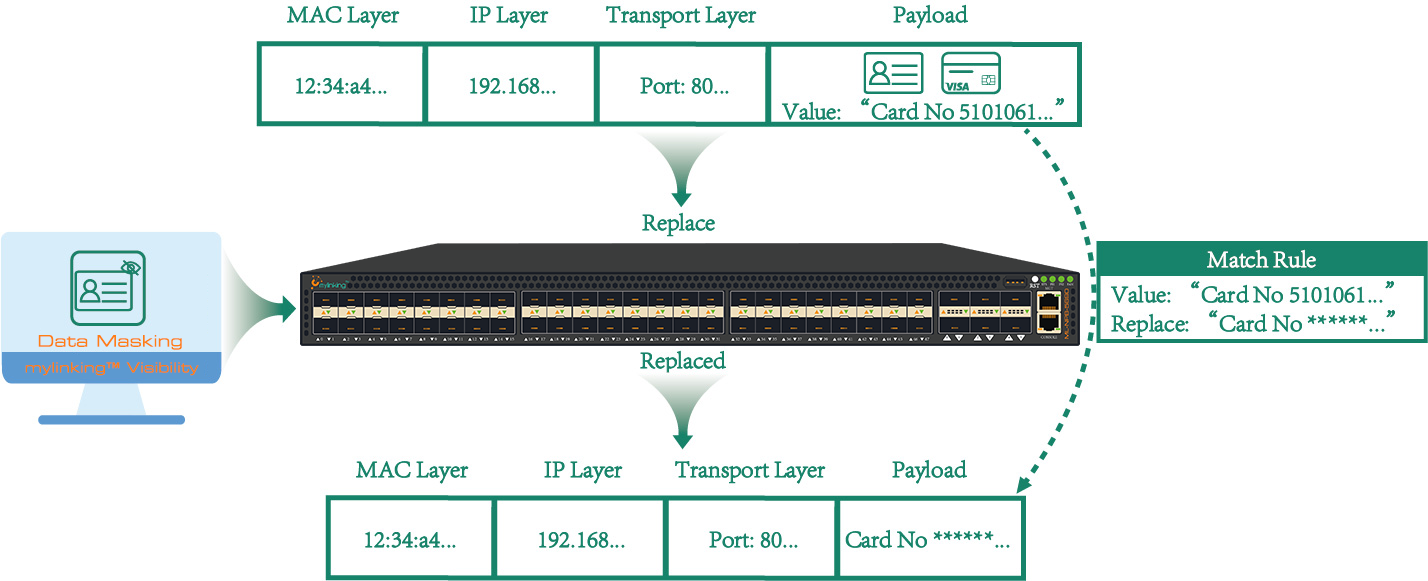
Global regulatory frameworks including PCI-DSS (payment card data), HIPAA (healthcare patient records), GDPR (EU personal data), and SOX mandate strict redaction of sensitive personally identifiable information (PII) before transmitting captured traffic to third-party monitoring or cloud analytics platforms. The Mylinking ML-NPB-5690 integrates native hardware data masking functionality to fulfill compliance requirements without post-processing overhead on external servers:
○ Masking operates at configurable policy granularity, matching custom payload strings within packet data (e.g., credit card numbers, national ID identifiers, patient medical record numbers).
○ Administrators define replacement static values to overwrite matched sensitive fields, rendering PII unreadable to anyone accessing stored traffic capture logs.
○ Masking rules can target MAC layer, IP layer, transport layer, or deep application payload fields within the first 128 bytes of any packet, with separate masking policies applied to different business VLANs or traffic source ports.
This built-in desensitization capability removes the need for standalone traffic scrubbing appliances in regulated industries, consolidating compliance workflows onto the ML-NPB-5690 visibility layer and reducing total data center hardware footprint.
5. DPI Deep Packet Inspection, SSL Decryption & Multi-Version NetFlow Export
Advanced security and observability workflows rely on deep application-layer traffic intelligence, delivered via the ML-NPB-5690’s integrated DPI analysis engine running on the dedicated 200Gbps intelligent traffic processor:
1- Comprehensive Application Layer Protocol Identification: Natively fingerprint hundreds of common enterprise application protocols, including FTP, HTTP, POP, SMTP, DNS, NTP, BitTorrent, Syslog, MySQL, and Microsoft SQL Server. Custom protocol signatures can be uploaded to identify proprietary internal business applications. The DPI engine also detects video streaming traffic patterns, enabling selective filtering of non-business video streams to prioritize mission-critical traffic for security analysis.
2- Hardware-Accelerated SSL/TLS Decryption: Upload enterprise SSL inspection certificates to the NPB to decrypt HTTPS encrypted payload traffic on-demand, supporting TLS 1.0, TLS 1.2, and legacy SSL 3.0 cipher suites. Decrypted plaintext packets are forwarded to IDS and threat hunting tools to expose malware hidden inside encrypted HTTPS sessions, a critical cyber security capability as over 95% of modern internet traffic operates over TLS encryption. Offloading decryption to the NPB avoids crippling the CPU capacity of expensive security appliances.
3- Multi-Version NetFlow/IPFIX Generation: Convert raw captured traffic into standardized flow records for export to SIEM, network observability, and capacity planning platforms. The ML-NPB-5690 supports NetFlow V5, NetFlow V9, and IPFIX formats with fully customizable sampling rates to balance flow record granularity and bandwidth overhead. Flow export data provides high-level traffic trend statistics for long-term data center capacity forecasting and baseline security anomaly detection.
Why Choose Mylinking as Your Trusted Network Packet Broker & Network Visibility Solution Vendor?
In a crowded marketplace of generic NPB hardware vendors, Mylinking differentiates itself as a specialized manufacturer exclusively focused on network visibility infrastructure—including Network Packet Brokers, optical network taps, traffic analyzers, and unified visibility management platforms—with decades of engineering experience serving enterprise data center, carrier, financial, healthcare, and government cyber security customers globally. Key competitive advantages of selecting Mylinking ML-NPB-5690 for your 100G network visibility stack include:
1- Hardware-First Engineering for Terabit 100G Workloads: Unlike software-heavy NPB competitors that offload advanced processing to shared CPU resources (creating packet loss under peak load), Mylinking designs all core traffic manipulation features into dedicated ASIC hardware pipelines, guaranteeing lossless line-rate performance at the full 1.8Tbps throughput ceiling of the ML-NPB-5690.
2- P4 Programmability for Future-Proof Visibility: The ML-NPB-5690’s P4 programmable chip architecture eliminates hardware obsolescence risk. As new tunneling protocols, encrypted traffic standards, and proprietary enterprise application formats emerge, Mylinking engineers deploy custom packet identification rule sets via firmware updates without requiring costly hardware appliance replacement.
3- All-Inclusive Feature Licensing: No tiered add-on licensing fees for critical capabilities including SSL decryption, data masking, deduplication, port breakout, or NetFlow export—every feature detailed in this article ships standard with the ML-NPB-5690 base unit, eliminating hidden long-term ownership costs common with competing enterprise NPB vendors.
4- Global Technical Support & Customization Services: Mylinking provides 24/7 remote engineering support for overseas enterprise customers, alongside custom hardware and firmware modification services for carrier-grade, classified government, and hyperscale cloud deployments requiring specialized traffic processing rule development.
5- Unified Visibility Ecosystem Compatibility: The ML-NPB-5690 seamlessly integrates with Mylinking’s full product portfolio, including passive optical taps, test access matrix switches, and the Matrix-SDN centralized visibility control platform, enabling end-to-end single-vendor network visibility deployments that simplify cross-product troubleshooting and maintenance.
6- Regulatory Compliance-Aligned Native Functionality: Built-in data masking, packet slicing, and timestamp forensics eliminate third-party add-on hardware required to meet PCI-DSS, HIPAA, GDPR, and SOX audit requirements, reducing total data center hardware footprint and integration complexity.
7- Optimized for Hybrid & Cloud-Native Data Center Architectures: Native VXLAN, GTP, and MPLS tunnel decapsulation, paired with flexible port breakout and single-fiber optical support, positions the ML-NPB-5690 as the ideal visibility layer for hybrid on-prem/cloud fabrics, 5G carrier backhaul networks, and multi-tenant virtualized data center environments.
For network architects, SOC leads, and data center infrastructure managers planning 100G network visibility upgrades or full Zero Trust security architecture overhauls, the Mylinking ML-NPB-5690 represents a future-proof, cost-effective, high-performance Network Packet Broker solution purpose-built for the terabit-scale traffic demands of today’s evolving data center ecosystems. To review complete hardware datasheets, deployment architecture diagrams, and custom quotation options, visit the official Mylinking ML-NPB-5690 product page: https://www.mylinking.com/mylinking-network-packet-brokernpb-ml-npb-5690-product/
Post time: Jul-07-2026


