
Mylinking™ Network Packet Brokers supported Network Traffic Dynamic Load Balancing: The load balance Hash algorithm and session-based weight sharing algorithm according to L2-L7 layer characteristics to ensure that the port output traffic dynamic of load balancing. And
Mylinking™ Network Packet Brokers supported Real-time Traffic Detection: Supported the sources of "Capture Physical Port (Data Acquisition)", "Packet Feature Description Field (L2 – L7)", and other information to define flexible traffic filter, for real-time capture network data traffic of different position detection, and will it will be storaged the real-time data after captured and detected in the device for downloading of further execution expert analysis or uses its diagnosis features of this equipment for deep visualization analysis.
You may need to know what is the OSI Model 7 Layers?
Before we dive into the OSI model, we need to understand some basic networking terminology to facilitate the following discussion.
Nodes
A node is any physical electronic device connected to a network, such as a computer, printer, router, etc. Nodes can be connected to each other to form a network.
Link
A link is a physical or logical connection connecting nodes in a network, which may be wired (such as Ethernet) or wireless (such as WiFi) and can be point-to-point or multipoint.
Protocol
A protocol is a rule for two nodes in a network to exchange data. These rules define the syntax, semantics, and synchronization of data transfer.
Network
A network refers to a collection of devices, such as computers, printers, which are designed to share data.
Topology
Topology describes how nodes and links are configured in a network and is an important aspect of network structure.
What is the OSI model?
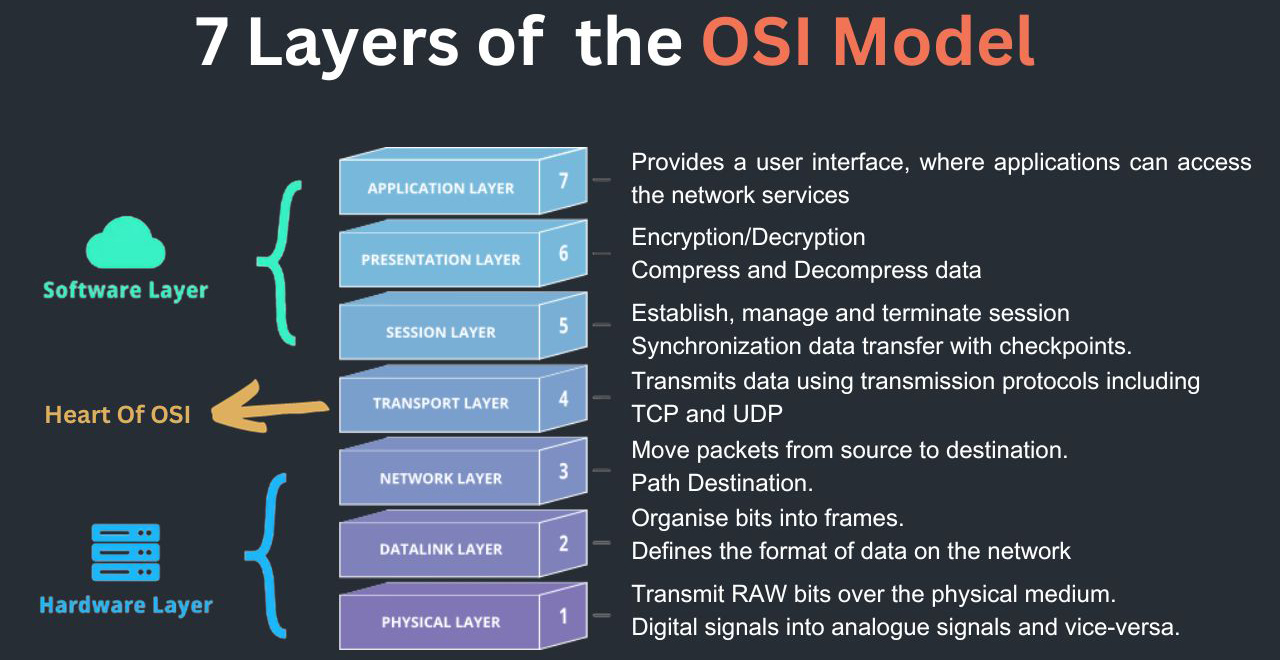
The OSI (Open Systems Interconnection) model is defined by the International Organization for Standardization (ISO) and divides computer networks into seven levels to aid communication between different systems. OSI model provides a standardized architecture for network structure, so that devices from different manufacturers can communicate with each other.
The seven layers of the OSI model
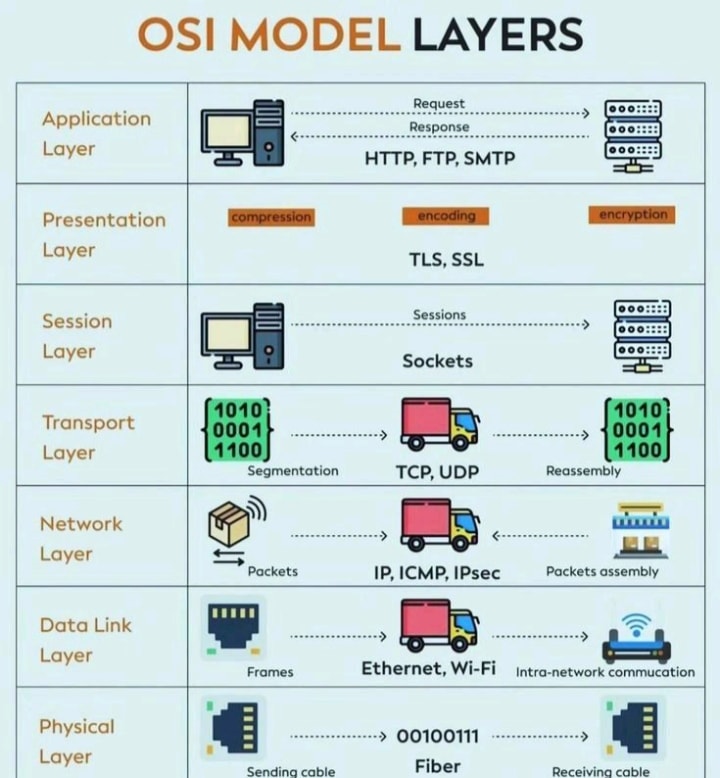
1. Physical Layer
Responsible for transmitting raw bit streams, defines the characteristics of physical media such as cables and wireless signals. Data is transmitted in bits at this layer.
2. Data Link Layer
Data frames are transmitted over the physical signal and are responsible for error detection and flow control. The data is processed in frames.
3. Network Layer
It is responsible for transporting packets between two or more networks, handling routing and logical addressing. Data is processed in packets.
4. Transport Layer
Provides end-to-end data delivery, ensuring data integrity and sequence, including connection directed protocol TCP and connectionless protocol UDP. Data is in units of segments (TCP) or datagrams (UDP).
5. Session Layer
Manage sessions between applications, responsible for session establishment, maintenance, and termination.
6. Presentation Layer
Handle data format conversion, character encoding, and data encryption to ensure that the data can be used correctly by the application layer.
7. Application Layer
It provides users with direct network services, including various applications and services, such as HTTP, FTP, SMTP, etc.
The purpose of each layer of the OSI model and its possible problems
Layer 1: Physical Layer
Purpose: The physical layer is concerned with the characteristics of all physical devices and signals. It is responsible for creating and maintaining the actual connections between devices.
Troubleshooting:
○ Check for damage to cables and connectors.
○ Ensure the proper operation of physical equipment.
○ Confirm that the power supply is normal.
Layer 2: Data Link Layer
Purpose: The data link layer sits on top of the physical layer and is responsible for frame generation and error detection.
Troubleshooting:
○ Possible first layer problems.
○ Connectivity failure between nodes.
○ Network congestion or frame collisions.
Layer 3: Network Layer
Purpose: The network layer is responsible for sending packets to the destination address, handling route selection.
Troubleshooting:
○ Check that the routers and switches are configured correctly.
○ Verify that the IP address is configured correctly.
○ Link-layer errors may affect the working of this layer.
Layer 4: Transport Layer
Purpose: The transport layer ensures the reliable transmission of data and handles the segmentation and reorganization of data.
Troubleshooting:
○ Verify that a certificate (e.g., SSL/TLS) has expired.
○ Check if the firewall blocks the required port.
○ Traffic priority is set correctly.
Layer 5: Session Layer
Purpose: The session layer is responsible for establishing, maintaining and terminating sessions to ensure bidirectional data transfer.
Troubleshooting:
○ Check the status of the server.
○ Verify that the application configuration is correct.
○ Sessions may time out or drop.
Layer 6: Presentation Layer
Purpose: The presentation layer deals with formatting issues of data, including encryption and decryption.
Troubleshooting:
○ Is there a problem with the driver or software?
○ Whether the data format is parsed correctly.
Layer 7: Application Layer
Purpose: The application layer provides direct user services and various applications run on this layer.
Troubleshooting:
○ The application is configured correctly.
○ Whether the user is following the correct course of action.
TCP/IP model and OSI model differences
Although OSI model is the theoretical network communication standard, TCP/IP model is the practically widely used network standard. The TCP/IP model uses a hierarchical structure, but it has only four layers (application layer, transport layer, network layer, and link layer), which correspond to each other as follows:
OSI application layer <--> TCP/IP application layer
OSI transport layer <--> TCP/IP transport layer
OSI network layer <--> TCP/IP network layer
OSI data link layer and physical layer <--> TCP/IP link layer
So, the seven-layer OSI model provides important guidance for the interworking of network devices and systems by clearly dividing all aspects of network communication. Understanding this model not only helps network administrators troubleshooting, but also lays the foundation for the study and in-depth research of network technology. I hope that through this introduction, you can understand and apply the OSI model more deeply.
Post time: Nov-24-2025


