
A three-way technical comparison of Network TAP, SPAN port mirroring and Network Packet Broker. Compare capture fidelity, packet loss risk, filtering, tunnel decapsulation, tool fan-out and cost, and learn which combination fits your Network Monitoring and Network Security architecture.
Three Ways to Copy Traffic, Three Very Different Outcomes
Every visibility program begins with the same question: where does the packet copy come from? Practitioners typically have three options — a Network TAP, a switch SPAN port (also called port mirroring or a mirror session), or a Network Packet Broker deployed downstream of either. These options are often presented as interchangeable, and that framing causes most of the visibility failures seen in production: tool feeds that silently drop packets during peak hours, captures that cannot see inside VXLAN tunnels, and mirror sessions that saturate a switch's internal resources while still under-delivering to monitoring tools.
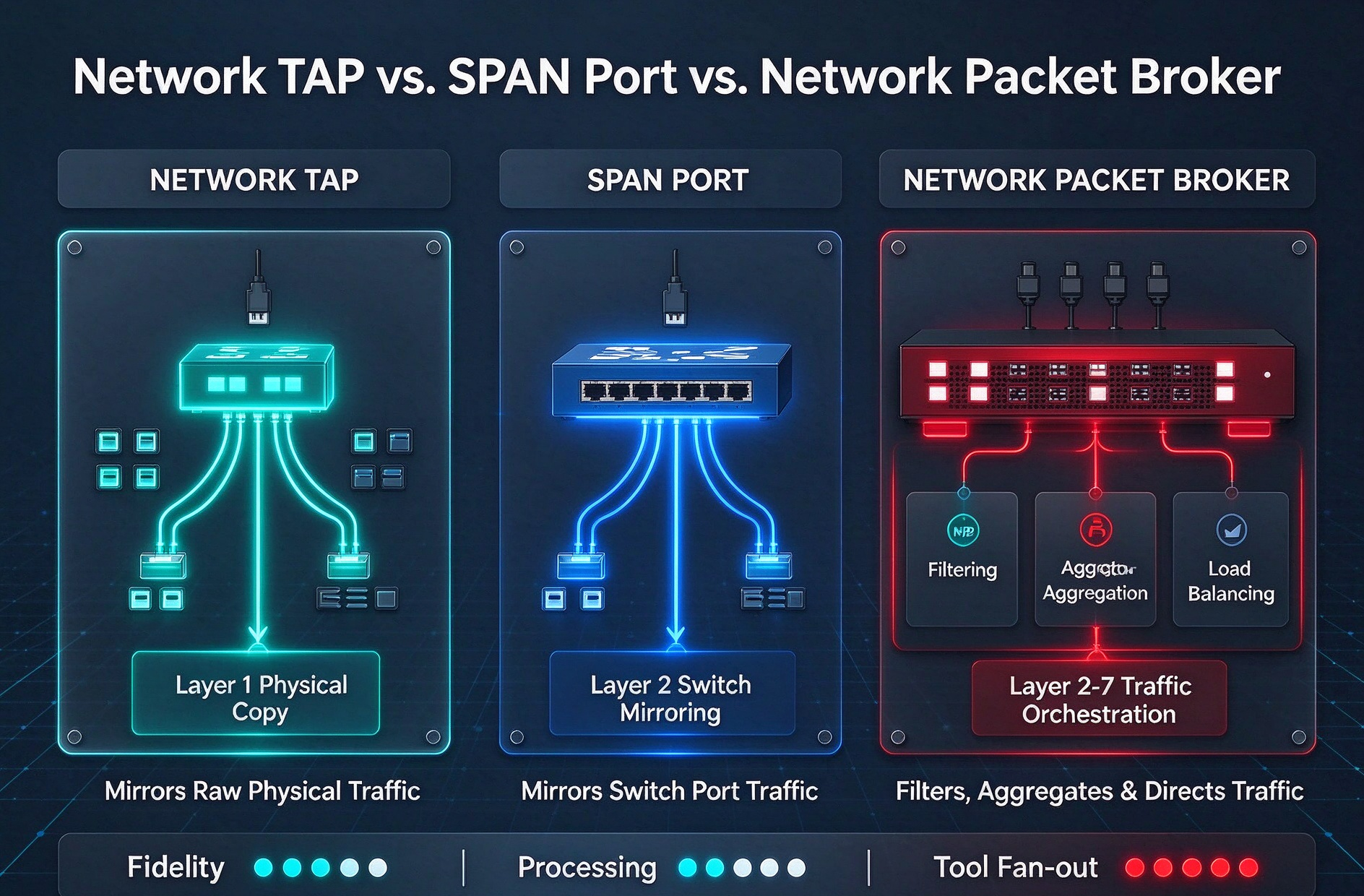
The three methods operate at three different layers and solve three different problems. A TAP is a physical-layer instrument. A SPAN port is a switch feature that consumes switching resources. A packet broker is a dedicated layer-2-to-7 traffic orchestration platform. Selecting among them is not a matter of brand preference but of matching the capture mechanism to the fidelity, scale and processing requirements of the Network Monitoring and Network Security functions it must support.
This article compares all three across the dimensions that actually determine deployment success, then sets out a decision matrix and the combinations that experienced architects converge on.
Defining the Three Capture Methods
Network TAP
A Network TAP is a passive or active device inserted inline on a link between two network elements. It produces a physical copy of the signal — optical splitting in fiber deployments, relay-based bridging in copper — delivering every frame to one or more monitor ports without altering production traffic. Its defining properties are protocol agnosticism, deterministic capture under all load conditions, and no consumption of switch resources. Passive designs continue to pass production traffic even when unpowered, which is why they remain the default at carrier demarcation points and in high-availability trading infrastructure.
SPAN Port
A SPAN port is a switch configuration that duplicates frames from a source port, a group of ports, or an entire VLAN, and forwards the copies to a designated monitor port. It requires no additional hardware and can be enabled in minutes, which makes it the most common capture method in enterprise networks. Its limitations are structural rather than incidental: mirroring is a secondary function of a device whose primary job is forwarding production traffic, and it shares the same internal switching resources, buffering and backplane capacity as that traffic.
Network Packet Broker
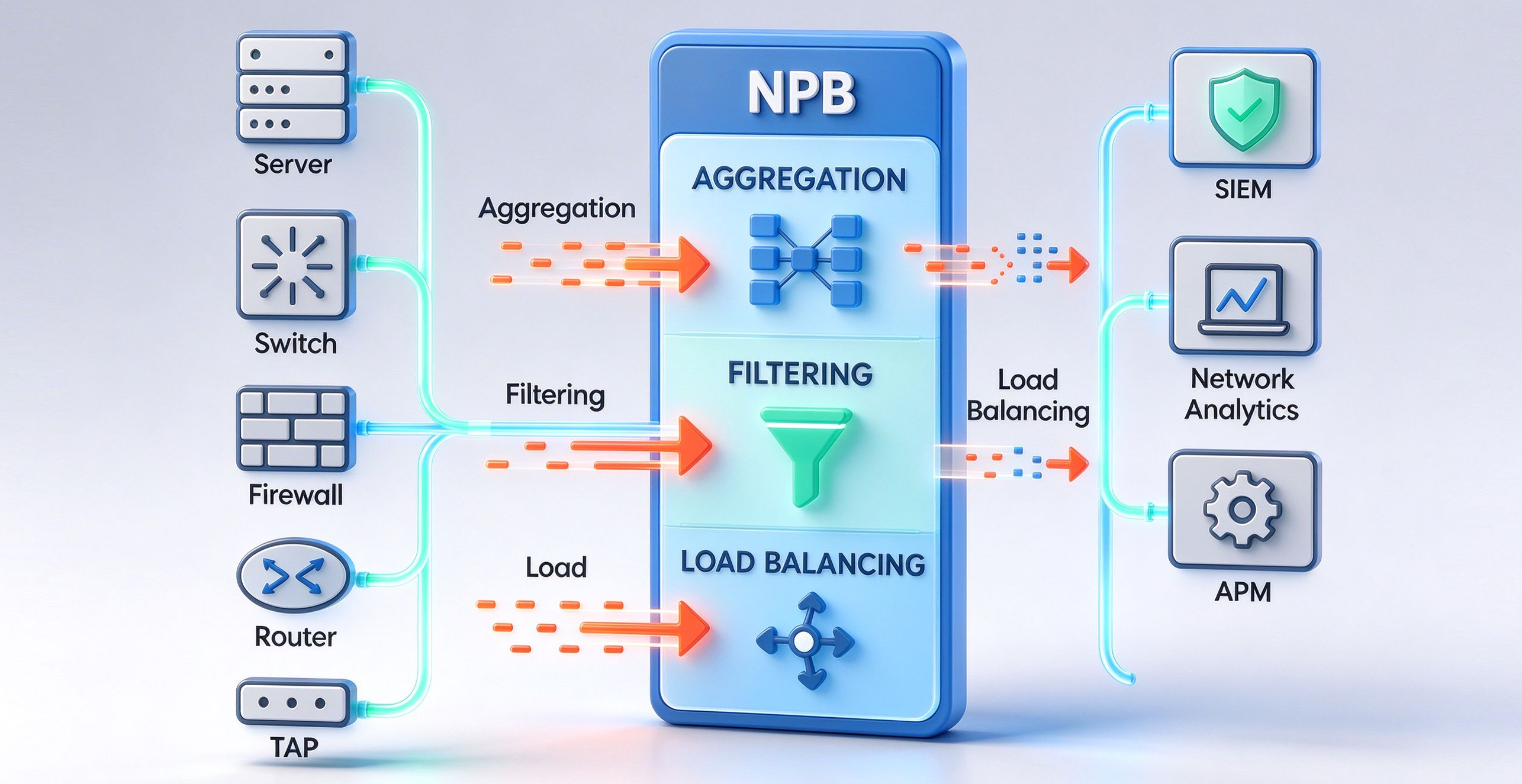
A Network Packet Broker is a dedicated appliance positioned between capture sources — TAPs, SPAN sessions, virtual taps, cloud mirroring endpoints — and monitoring tools. It does not capture traffic itself; it aggregates, filters, deduplicates, decapsulates, slices, timestamps, load-balances and redistributes what it receives. Its value is economic as much as technical: it decouples the number of capture points from the number of consuming tools, so neither dimension forces capital spending on the other.
Three-Way Technical Comparison
| Dimension | Network TAP | SPAN Port | Network Packet Broker |
| Layer of operation | Layer 1 physical | Switch internal forwarding path | Layer 2–7, hardware pipeline |
| Hardware required | Dedicated passive or active unit per link | None — existing switch feature | Dedicated appliance |
| Production risk | None for passive designs; insertion loss to validate | Consumes switch CPU, buffer and backplane resources | None — out-of-band, works on copies |
| Capture fidelity | Deterministic, full line rate, no drops | Best effort — first to drop under congestion | Lossless by design, if correctly sized |
| Timing accuracy | Physical copy, no jitter added | Microburst compression distorts inter-packet timing | Adds nanosecond hardware timestamps |
| Tool fan-out | 1–2 monitor ports; splitters needed per extra tool | Session-count limits per switch; ports consumed | One-to-many and many-to-many by policy |
| Filtering capability | None | Coarse MAC/VLAN filters at best | L2–L7, seven-tuple, custom byte offsets |
| Tunnel traffic | Passes encapsulated frames unchanged | Mirrors outer headers only | Identifies, terminates and strips VXLAN, GRE, MPLS, GTP |
| Encrypted traffic | Cannot decrypt | Cannot decrypt | Optional hardware TLS decryption |
| Deduplication | None | Duplicates common across overlapping sessions | Line-rate dedup, configurable keys |
| Load balancing to tools | None | None | Hash and session-aware weighted balancing |
| Scaling model | One unit per link; cost grows linearly | Constrained by switch port and session limits | Add ports or cascade; tool count decoupled |
| Operational visibility of itself | None | Mirror session counters only | Per-port and per-policy counters, alarms, on-demand PCAP |
What SPAN Ports Do Well, and Where They Break
SPAN remains the correct answer in a specific and legitimate set of cases: short-term troubleshooting, lab and staging environments, low-rate links, and initial visibility pilots where no hardware budget exists. It requires no procurement, no rack space and no cabling, and it can be turned on during an incident within minutes.
Where SPAN breaks is predictable, and it breaks in the same four ways in almost every enterprise:
1. Congestion-driven packet loss. When the aggregate mirrored rate exceeds the monitor port's capacity, or when the switch's internal buffers are contended, the switch discards mirror copies first. The loss occurs precisely during the DDoS surge, backup window or application storm when Network Security telemetry matters most.
2. Microburst distortion. Even without visible loss, buffering compresses microbursts and perturbs inter-packet spacing, invalidating latency and jitter measurements taken from mirrored traffic. Performance teams that baseline on SPAN data routinely misattribute latency to the application.
3. Session and port economics. Each mirror session consumes switch ports and internal resources, and enterprise switches impose hard session limits. Feeding six tools from one monitored segment quickly becomes impossible without consuming production ports.
4. Encapsulation blindness. SPAN faithfully mirrors encapsulated frames, but the monitoring tool still cannot see the inner flow. In VXLAN-heavy fabrics this means the majority of east-west traffic — where lateral movement actually occurs — is mirrored but unreadable.
5. Decision Matrix: Which Combination Fits Which Scenario
In practice the three methods are not mutually exclusive; the question is which combination to standardize on. The following matrix maps common requirements to the defensible choice.
| Requirement | Defensible architecture | Why |
| Ad-hoc incident troubleshooting on one link | SPAN alone | Fastest to enable, no hardware, tolerable loss for short sessions |
| Single high-value link into one forensic recorder | TAP alone | Full fidelity and zero production risk; no fan-out needed |
| Carrier demarcation or contractual neutrality | Passive TAP alone | No powered element inline; protocol-agnostic copy |
| Six or more links feeding three or more tools | TAPs plus NPB | Fidelity at layer 1, policy fan-out at the broker |
| Existing SPAN feeds must serve an expanding tool farm | SPAN plus NPB | Broker absorbs fan-out and filtering; SPAN stays as capture source |
| VXLAN, GRE or GTP fabrics | TAP or SPAN plus NPB | Decapsulation is broker-exclusive; capture alone cannot solve it |
| TLS-dominant traffic requiring inspection | TAP or SPAN plus NPB | Hardware decryption at the broker protects tool CPU |
| 100G core analyzed by 10G-class tools | TAP plus NPB | Session-aware load balancing and slicing preserve tool investment |
| Regulated data egress to third-party analytics | TAP plus NPB | Masking and slicing must occur before egress |
Three Mistakes That Recur in Real Deployments
Mistake 1 — Treating the broker as optional. Teams buy TAPs, connect them directly to tools, and discover at the third tool that they need splitters, at the fifth that insertion loss has eroded the optical budget, and at the sixth that re-cabling is a change-control event. The broker is the component that prevents this linear cost escalation, and it should be sized at the outset, not retrofitted.
Mistake 2 — Replacing all SPAN with TAPs on principle. TAPs are superior on fidelity, but not every link justifies one. Branch uplinks, lab segments and low-rate management networks are adequately served by SPAN feeding a broker, provided the broker's own counters and drop statistics are monitored so that silent loss is detected rather than assumed absent.
Mistake 3 — Sizing the broker for average throughput. A packet broker's value collapses the moment its internal plane is oversubscribed, because it then reproduces the exact failure mode the architecture was built to eliminate. Size for peak aggregate ingress, verify no internal oversubscription on the switching plane, and confirm that filtering, deduplication and decapsulation are hardware-accelerated rather than CPU-bound.
So, The choice between a Network TAP, a SPAN port and a Network Packet Broker is not a choice of one product over another. It is a layering decision: the capture mechanism determines fidelity, the broker determines usability, and the two must be specified together or the architecture will fail at whichever dimension was under-designed.
The defensible default for enterprise and data center fabrics is passive TAPs at strategic links for lossless layer-1 capture, SPAN reserved for links that cannot be tapped and for short-term troubleshooting, and a Network Packet Broker above both to aggregate, deduplicate, decapsulate, filter, timestamp and load-balance traffic into every consuming tool. That combination delivers complete Network Monitoring coverage across encrypted and encapsulated fabrics, sustains Network Security detection fidelity as link speeds rise, and keeps cost scaling with monitored links rather than with tool count.
Post time: Nov-09-2026


