
Learn how a professional Network Packet Broker optimizes end-to-end network monitoring, eliminates traffic blind spots, and strengthens enterprise network security via traffic aggregation, decryption, deduplication and compliance data masking. Reference:
Mylinking ML-NPB-5690: 1.8Tbps 100G Network Packet Broker Delivers Full Network Visibility for Modern Data Center Cybersecurity
1. Introduction: The Growing Visibility Crisis in Modern Enterprise Networks
Digital transformation, hybrid cloud architecture, 10G/40G/100G high-speed uplinks, and widespread encrypted business traffic have created severe blind spots for network security and network monitoring teams across global data centers. Most IT teams initially rely on simple switch SPAN mirror ports or passive optical TAPs to capture traffic, yet these basic tools fail to deliver reliable, lossless observability for modern workloads.
SPAN ports drop packets during traffic spikes, cannot parse overlay tunnel headers such as VXLAN or GRE, flood security tools with redundant duplicate packets, and lack built-in compliance controls for sensitive user data. As cyber threats evolve to hide within encrypted TLS packets and lateral east-west data center flows, incomplete network visibility directly translates to unmitigated breach risk, missed performance faults, and failed regulatory audits.
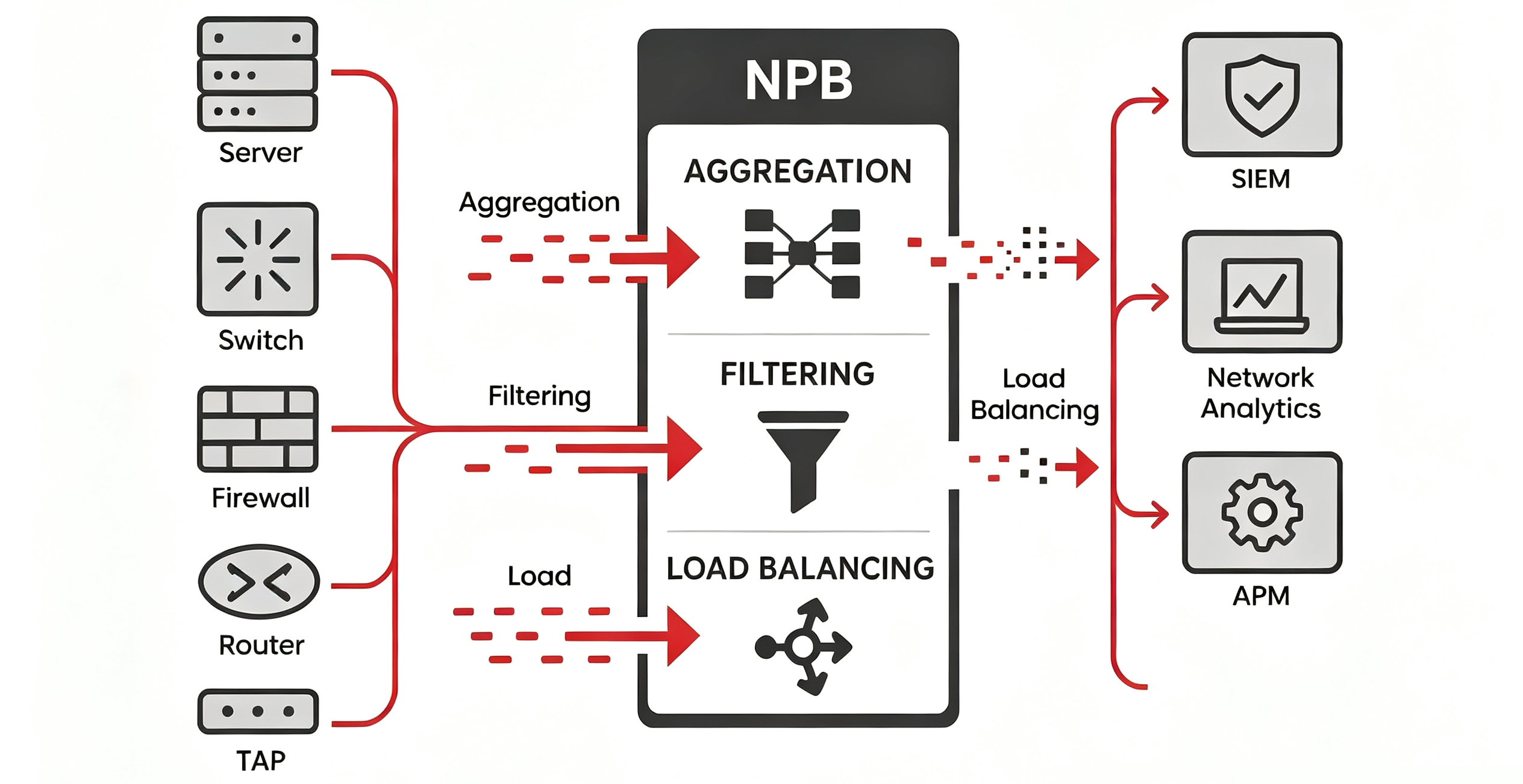
This is where a Network Packet Broker (NPB) becomes an indispensable core layer of enterprise observability infrastructure. As defined by Mylinking’s official technical guide, a Network Packet Broker is a specialized hardware appliance positioned between network TAPs, SPAN ports and downstream analysis tools, tasked with lossless packet capture, intelligent traffic processing, and precise delivery of matched data streams to IDS, NPM, APM, SIEM and forensic systems.
This blog breaks down the core definition, critical functions, real-world use cases, and measurable business value of deploying a Network Packet Broker, with targeted insights for SecOps and NetOps teams prioritizing robust network security and seamless network monitoring.
2. Core Definition: What Is a Network Packet Broker?
A Network Packet Broker acts as a centralized traffic orchestration hub for all network monitoring pipelines. Its dual core identity can be summarized simply:
Packet Collector & Carrier: It captures inline and out-of-band network traffic without packet loss, consolidating fragmented data from distributed switches, routers, firewalls and optical TAPs.
Intelligent Traffic Distributor: It processes raw packets via hardware-accelerated policies and delivers the right subset of traffic to the right security and monitoring tools, eliminating unnecessary data overload and visibility gaps.
Unlike passive splitters that only copy raw traffic without modification, enterprise-grade Network Packet Brokers integrate full L2-L7 packet manipulation capabilities. Every processing function runs at line rate, avoiding throughput bottlenecks even under sustained 100Gbps link loads. For organizations upgrading legacy 1G/10G monitoring infrastructure to 40G and 100G fabrics, a high-performance NPB extends the service life of existing security tools by scaling traffic distribution without costly full-stack hardware replacements.
3. Key Core Functions of a Modern Network Packet Broker
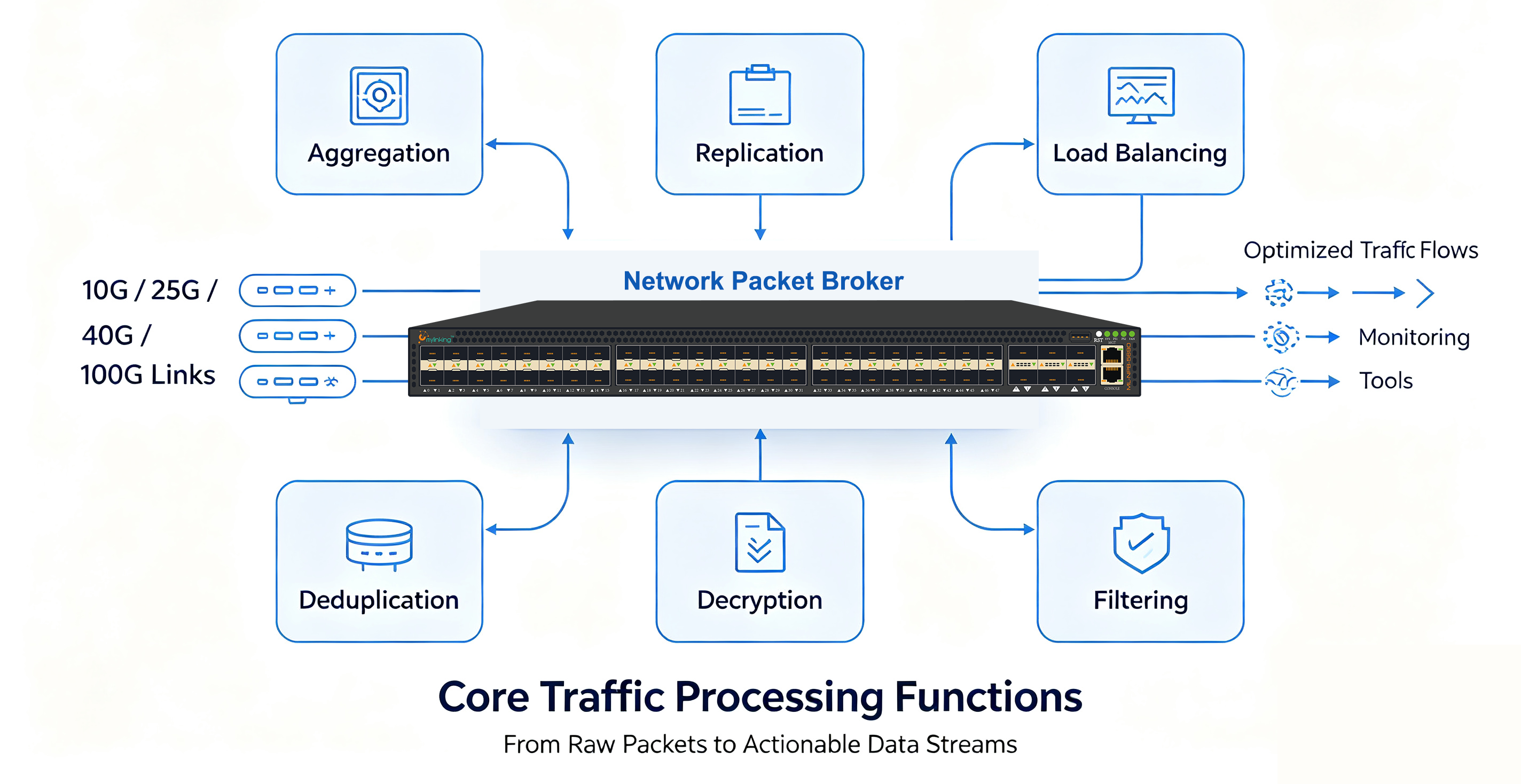
The competitive value of a professional Network Packet Broker lies in its comprehensive suite of built-in traffic processing modules, each designed to boost network monitoring efficiency and harden network security. Below are the mission-critical capabilities validated in Mylinking’s production-grade NPB lineup:
Traffic Aggregation, Replication & Policy-Based Load Balancing
These foundational operations form the backbone of unified network monitoring workflows:
○ Multi-source aggregation: Consolidate mirrored traffic from dozens of discrete SPAN ports and optical TAPs into a single centralized stream, eliminating siloed visibility across multi-rack leaf-spine data center fabrics.
○ Multi-port replication: Copy one ingress traffic flow to multiple destination monitoring ports simultaneously, enabling parallel delivery to threat detection IDS, performance NPM and compliance audit tools without deploying extra TAP hardware.
○ Intelligent load balancing: Distribute high-speed 40G/100G traffic across clusters of low-speed 1G/10G analysis tools using L2-L7 session-aware hash algorithms. This prevents individual security appliances from oversubscription and packet loss, maximizing ROI on existing network monitoring investments.
Redundant Packet Deduplication
Enterprises operating multi-switch mirroring architectures frequently generate massive volumes of identical duplicate packets from overlapping capture points. These redundant packets waste CPU, memory and storage resources on downstream security tools, slowing threat detection and hiding critical abnormal traffic signals.
A Network Packet Broker eliminates duplicate packets based on customizable matching rules (source IP, destination port, TCP sequence numbers and more). Financial and cloud service providers report a 40–60% reduction in total traffic volume delivered to monitoring platforms after enabling deduplication policies, drastically improving network security tool responsiveness under peak load.
Hardware-Accelerated SSL Decryption for Encrypted Threat Visibility
Over 95% of modern internet and enterprise traffic travels via SSL/TLS encryption, which cyber attackers exploit to conceal malware, ransomware lateral movement and data exfiltration activity. Traditional security tools carry heavy CPU overhead when tasked with decrypting massive encrypted streams, leading to crippling performance degradation.
Leading Network Packet Broker solutions offload full SSL decryption to dedicated hardware pipelines. After uploading enterprise inspection certificates, the NPB decrypts HTTPS payloads at line rate and forwards plaintext traffic to IDS and NDR platforms. This core network security feature uncovers hidden attack payloads without sacrificing monitoring tool throughput or introducing packet loss.
Data Masking for Regulatory Compliance
Global compliance frameworks including PCI-DSS, HIPAA and GDPR mandate strict protection of sensitive personally identifiable information (PII), payment card data and protected health information (PHI). Raw unprocessed traffic sent to network monitoring tools exposes regulated data to unauthorized staff and third-party analytics platforms, creating severe compliance liability.
The built-in data masking function of a Network Packet Broker automatically scans packet payloads and overwrites sensitive fields such as credit card numbers, social security IDs and patient medical records with static placeholder values before forwarding data streams. This hardware-native desensitization removes the need for separate traffic scrubbing appliances, streamlining compliance workflows for regulated industries.
Tunnel Header Stripping for Encapsulated Traffic Inspection
Modern virtualized data centers rely heavily on overlay tunneling protocols including VXLAN, GRE, ERSPAN, MPLS and GTP to build multi-tenant cloud fabrics. Most basic monitoring tools cannot parse outer tunnel headers, creating critical blind spots for east-west lateral threat traffic encapsulated inside virtualization layers.
A Network Packet Broker performs hardware-level header stripping to remove VLAN, VXLAN, L3VPN and other tunnel wrappers, exposing the original inner-layer packet for full security analysis. This capability is mandatory for Zero Trust network security strategies, which require complete inspection of every inter-server flow within the data center fabric.
L7 Application Intelligence & Threat Context Analysis
Advanced Network Packet Brokers integrate deep packet inspection (DPI) engines that extend visibility beyond L2-L4 transport layers to full application-layer traffic identification. The platform automatically fingerprints mainstream enterprise protocols including HTTP, FTP, DNS, MySQL, BitTorrent and cloud SaaS traffic, generating rich context-aware metadata for network monitoring and threat hunting.
SecOps teams leverage this application intelligence to detect high-risk behavior such as shadow IT cloud storage transfers, unauthorized peer-to-peer file sharing and application-layer malware attacks. Contextual packet data helps security teams identify Indicators of Compromise (IOCs), map attack vector geographic origins, and trace attacker lateral movement footprints across the entire network.
4. Two Primary Deployment Use Cases: Network Security & Network Monitoring
Network Security Threat Detection & Incident Response
For SOC teams focused on network security, a Network Packet Broker is the foundational infrastructure for reliable threat hunting:
○ Full north-south internet border traffic aggregation to spot external intrusion attempts and DDoS precursors.
○ Decapsulation of VXLAN/GTP tunnel flows to detect lateral ransomware movement between virtual servers.
○ SSL decryption to uncover malware hidden inside encrypted HTTPS business sessions.
○ Data masking to ensure compliance when exporting traffic logs to third-party threat analytics platforms.
○ Deduplication and filtering to reduce noise, enabling security analysts to prioritize high-risk attack traffic without sifting through redundant data.
Without an NPB’s preprocessing capabilities, IDS and NDR tools receive incomplete, overloaded traffic feeds, leading to false negatives, missed breaches and delayed incident response times.
End-to-End Network Monitoring & Performance Troubleshooting
NetOps teams depend on Network Packet Brokers to deliver comprehensive, low-noise data for network monitoring and application performance management:
○ Consolidate multi-link traffic to monitor cross-fabric bandwidth utilization and identify latency bottlenecks.
○ Load-balance high-speed 100G uplink traffic to legacy 10G APM and network performance monitoring tools.
○ Apply policy-based packet slicing to truncate unnecessary payload data, cutting storage and bandwidth costs for long-term traffic archives.
○ Generate standardized flow metadata (NetFlow/IPFIX) for capacity planning, baseline traffic trending and real-time anomaly alerting.
○ Replicate segmented traffic streams to dedicated monitoring tools for separate application, routing and fault diagnostics workflows.
5. Core Business Benefits of Deploying a Network Packet Broker
○ Eliminate Network Visibility Blind Spots: Decrypt encapsulated and encrypted traffic to inspect every north-south and east-west flow, closing security gaps created by SPAN-only monitoring architectures.
○ Extend Existing Tool ROI: Load balancing, deduplication and filtering prevent security and monitoring tool oversubscription, delaying costly hardware upgrades for high-speed 100G network environments.
○ Strengthen Network Security Posture: Hardware SSL decryption and tunnel stripping expose hidden cyber threats, accelerating threat detection and reducing mean time to resolve (MTTR) for security incidents.
○ Simplify Regulatory Compliance: Native data masking functionality fulfills PII protection rules for PCI-DSS, HIPAA and GDPR without additional third-party scrubbing hardware.
○ Cut Operational Complexity: Centralized traffic aggregation consolidates dozens of discrete capture feeds into one managed pipeline, reducing NOC and SOC daily maintenance overhead.
6. Build Unified Visibility with a Professional Network Packet Broker
As network speeds accelerate to 100G and encrypted virtualized traffic becomes the industry standard, basic SPAN mirroring and passive TAPs can no longer support modern network security and network monitoring requirements. A robust Network Packet Broker delivers the critical intelligent traffic processing layer needed to capture, refine and distribute lossless, relevant packet data to every tool in your observability stack.
From SSL decryption and tunnel header stripping to deduplication, data masking and session-aware load balancing, every core feature of a Network Packet Broker is engineered to solve real pain points faced by SecOps and NetOps teams globally. Whether you operate a hyperscale data center, enterprise hybrid cloud environment, or regulated financial/healthcare infrastructure, integrating a high-performance NPB is the most cost-effective way to achieve complete, reliable network visibility and hardened network security.
To explore Mylinking’s full lineup of terabit-grade Network Packet Broker solutions tailored for 10G/25G/40G/100G network monitoring, visit our official technical resource page: https://www.mylinking.com/mylinking-network-packet-brokernpb-ml-npb-5690-product/
Post time: Jul-27-2026


