
Learn how a professional MylinkingTM Network Packet Broker streamlines end-to-end network monitoring workflows, eliminates tool resource waste, reduces packet loss, and maximizes the ROI of your network monitoring and network security infrastructure in high-speed data center environments.
Introduction: The Hidden Efficiency Crisis in Modern Network Monitoring
Modern enterprise networks continue evolving rapidly with 10G, 25G, 40G, and 100G high-speed uplinks, virtual overlay tunnels, hybrid cloud workloads, and massive encrypted traffic flows. To maintain stable Network Monitoring and robust Network Security, most organizations deploy a full stack of analysis tools, including Network Performance Monitors (NPM), Application Performance Monitors (APM), Intrusion Detection Systems (IDS), and forensic auditing platforms. However, most IT and SecOps teams overlook a critical hidden problem: monitoring tools are frequently overloaded, misused, or flooded with invalid traffic, resulting in low efficiency, frequent packet loss, missed anomaly alerts, and unnecessary hardware upgrade costs.
Traditional monitoring architectures rely solely on switch SPAN ports and passive network TAPs for traffic collection. These basic methods deliver unfiltered, unoptimized raw traffic to downstream tools, generating a series of efficiency bottlenecks. Redundant duplicate packets, irrelevant background traffic, oversized full payloads, mismatched interface speeds, and encapsulated tunnel noise continuously consume the CPU, memory, and storage resources of security and monitoring devices. As a result, high-value threat data and performance metrics are often buried in massive invalid traffic, severely compromising Network Security detection accuracy and Network Monitoring reliability.
This is where a professional MylinkingTM Network Packet Broker (NPB) becomes an indispensable core component of modern visibility infrastructure. As a centralized hardware traffic orchestration device, the Network Packet Broker sits between traffic collection points (TAPs, SPAN ports, virtual cloud taps) and analysis tools. It performs hardware-level traffic preprocessing, optimization, and intelligent distribution, fundamentally solving tool efficiency bottlenecks and maximizing the utilization of existing monitoring and security hardware. This article systematically analyzes how a Network Packet Broker optimizes network monitoring tool efficiency from technical principles, core functions, and practical deployment values.
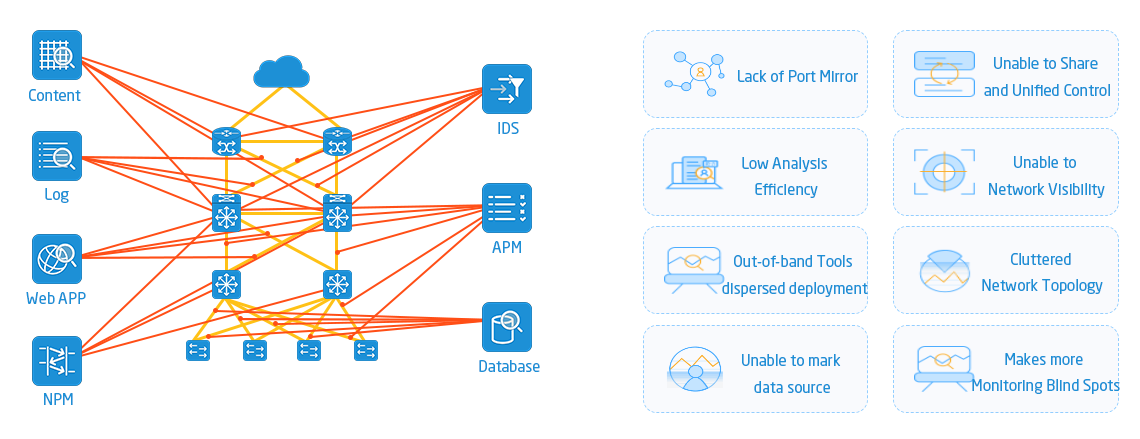
Core Efficiency Bottlenecks of Traditional Network Monitoring Architectures
Before exploring NPB optimization capabilities, it is essential to clarify the root causes of low monitoring tool efficiency in traditional deployment models. These pain points are widespread in small and medium enterprise data centers and large-scale hybrid cloud environments, directly restricting the performance of Network Monitoring and Network Security systems.
1. Tool Overload Caused by Unfiltered Raw Traffic
SPAN and TAP-based traffic collection captures all data flows in the network, including a large number of invalid background packets, broadcast packets, and low-priority business traffic. Monitoring and security tools are forced to process all unfiltered data, leading to full resource occupancy. When traffic spikes occur during business peak hours, tools cannot focus on analyzing key threat traffic and performance data, resulting in delayed analysis, false positives, and even critical packet loss.
2. Resource Waste from Massive Duplicate Packets
In multi-switch and multi-node mirroring scenarios, overlapping collection points generate a large number of duplicate packets. These redundant data streams do not provide any valid monitoring or security value but occupy substantial tool processing bandwidth and storage space. As one of the key optimized features of a modern Network Packet Broker for network optimization, deduplication eliminates such invalid traffic waste and stabilizes long-term monitoring operation. Long-term duplicate traffic accumulation reduces tool operation efficiency and increases the difficulty of subsequent data analysis and fault troubleshooting.
3. Speed and Interface Mismatch Restricting Tool Capabilities
Many enterprises have upgraded their core network to 40G/100G high-speed architecture but still retain mature low-speed 1G/10G monitoring tools. Direct high-speed traffic access causes interface speed negotiation failures or tool overload. Meanwhile, limited physical interfaces of monitoring devices cannot meet the demand for multi-source traffic collection, resulting in idle tool performance and wasted hardware resources.
4. Invalid Payload and Tunnel Noise Interfering with Analysis
Most network performance monitoring scenarios only require L2-L4 header information for bandwidth statistics, latency analysis, and fault location. Full packet payload transmission causes severe bandwidth waste. In addition, virtual network traffic encapsulated by VXLAN, GRE, and MPLS carries redundant tunnel headers. Traditional tools cannot strip these headers, leading to failure to identify inner valid traffic and forming monitoring blind spots.
How MylinkingTM Network Packet Broker Fundamentally Optimizes Monitoring Tool Efficiency?
A professional Network Packet Broker relies on hardware-accelerated processing architecture to implement full-link traffic optimization. It filters noise, deduplicates redundant data, balances traffic pressure, standardizes data formats, and distributes precise valid traffic to corresponding tools, comprehensively improving the operating efficiency of Network Monitoring and Network Security tools without affecting production network traffic.
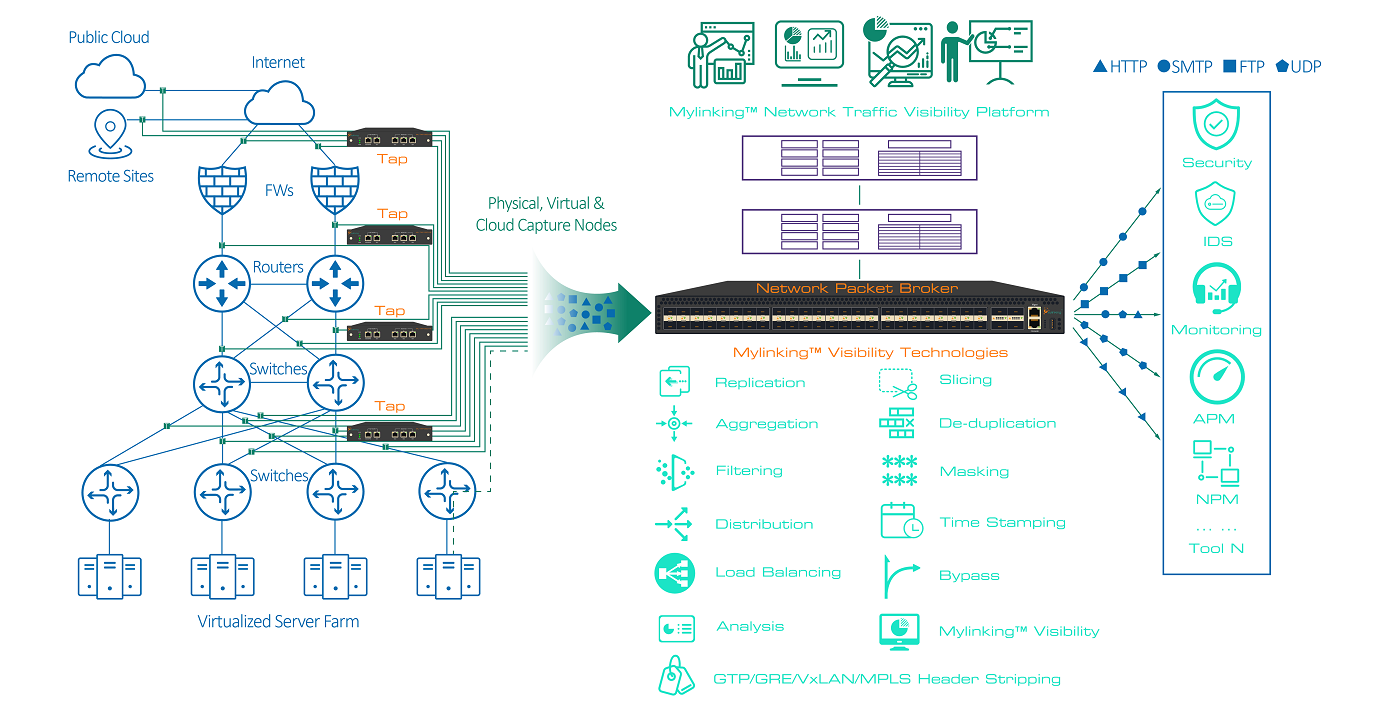
1. Intelligent Traffic Filtering: Shield Invalid Noise and Refine Valid Data
The core premise of improving tool efficiency is reducing invalid data processing. The Network Packet Broker supports flexible multi-dimensional policy filtering based on Ethernet protocols, VLAN tags, IP seven-tuples, TCP flags, and custom 128-byte packet offset fields. Administrators can formulate refined filtering rules according to business scenarios, automatically shielding invalid broadcast traffic, idle background flows, and non-business noise traffic.
For different types of monitoring tools, the NPB delivers customized traffic subsets: forwarding business-related key flows to APM performance analysis tools, sending border access traffic to IDS security detection tools, and isolating compliant business traffic for audit tools. This targeted traffic distribution ensures each tool only processes data matching its functional positioning, avoiding resource occupation by invalid traffic and greatly improving analysis accuracy and real-time performance.
2. Hardware Packet Deduplication: Eliminate Redundant Data Waste
Built-in hardware-level deduplication technology is one of the core efficiency optimization capabilities of the Network Packet Broker. For duplicate packets generated by multi-point mirroring and cross-device collection, the NPB compares packet feature information such as source and destination IPs, port numbers, and TCP sequence numbers at line rate, retaining only unique valid packets and completely removing redundant duplicate data streams.
Practical data shows that NPB deduplication can reduce traffic volume transmitted to monitoring tools by 40%–60%. This optimization drastically reduces tool CPU and storage pressure, eliminates analysis errors and false alerts caused by duplicate data, and enables monitoring and security tools to focus on real network anomalies and threat behaviors, effectively boosting overall Network Security defense capabilities and Network Monitoring precision.
3. Session-Aware Load Balancing: Avoid Tool Overload and Balance Resource Utilization
Unbalanced traffic distribution is a key factor leading to low tool efficiency. The Network Packet Broker supports L2-L7 layer session-aware intelligent load balancing algorithms, which evenly distribute high-speed network traffic across multiple tool interfaces or tool clusters. It effectively solves the overload problem of single monitoring devices and avoids resource idleness of underutilized tool interfaces. Paired with core traffic preprocessing capabilities including filtering, slicing, and decapsulation, this load balancing mechanism builds the complete network visibility foundation for zero-trust data center security.
For legacy low-speed monitoring tools deployed in high-speed 100G network environments, the NPB acts as a professional speed converter and traffic shaper. It shunts and distributes high-bandwidth traffic to adapt to low-speed tool interface specifications, enabling old devices to continue efficient operation without frequent hardware upgrades. This function greatly extends the service life of existing Network Monitoring and Network Security equipment and reduces enterprise IT capital expenditure.
4. Policy-Based Packet Slicing: Reduce Bandwidth and Storage Overhead
Full packet payload transmission is a major cause of excessive tool bandwidth pressure. The Network Packet Broker supports customizable policy-based packet slicing, which can intercept packet data within a fixed byte range (64–1518 bytes) according to monitoring requirements. For daily network bandwidth statistics, latency monitoring, and traffic trend analysis, the NPB only retains core L2-L4 header information and strips redundant application payloads.
This optimization reduces downstream traffic bandwidth consumption by up to 90%, greatly lowering the data storage and transmission pressure of monitoring tools. For high-risk scenarios such as border security detection and threat forensics, administrators can flexibly disable slicing to retain full payload data, ensuring sufficient data support for deep threat analysis. The flexible slicing strategy balances tool efficiency and monitoring comprehensiveness perfectly.
5. Tunnel Header Stripping and Data Standardization: Eliminate Analysis Barriers
Virtualized data center traffic encapsulated by VXLAN, GRE, MPLS, and GTP often cannot be correctly identified and analyzed by traditional monitoring tools. The Network Packet Broker supports hardware-level tunnel decapsulation and header stripping, automatically removing outer tunnel encapsulation information and restoring real inner business traffic.
After NPB standardization processing, traffic data formats are unified, eliminating monitoring blind spots caused by tunnel encapsulation. At the same time, the NPB supports VLAN tag addition, deletion, and replacement, realizing unified traffic format adaptation for different monitoring tools, ensuring consistent and accurate tool analysis results, and avoiding efficiency loss caused by data format mismatch.
Auxiliary NPB Capabilities to Boost Long-Term Monitoring Efficiency
In addition to core traffic optimization functions, multiple extended capabilities of the Network Packet Broker further assist enterprises in improving the long-term operating efficiency of Network Monitoring and Network Security systems, reducing manual operation and maintenance costs, and avoiding efficiency degradation caused by non-traffic factors.
1. Centralized Traffic Aggregation Simplifies Monitoring Architecture
The NPB aggregates traffic from multiple distributed TAPs, SPAN ports, and virtual monitoring nodes into a unified traffic stream, solving the problem of scattered multi-source traffic collection. It avoids the complexity of direct wiring between multiple collection points and multiple tools, simplifies the overall monitoring architecture, reduces manual maintenance workload, and lowers the failure rate of the monitoring system. A streamlined architecture ensures long-term stable and efficient operation of monitoring tools.
2. Precise Timestamping Improves Fault Analysis Efficiency
The Network Packet Broker provides hardware nanosecond-level precise timestamping, synchronizing with NTP servers to mark all captured packets uniformly. In traditional monitoring modes, inconsistent timestamps of traffic data from different nodes lead to difficult event correlation and slow fault location. Unified NPB timestamping helps operation and maintenance personnel quickly sort out traffic event sequences, accurately locate network faults and security threat sources, and greatly shorten the mean time to resolve (MTTR).
3. Offload Advanced Processing to Reduce Tool Burden
The NPB offloads resource-intensive processing tasks such as SSL/TLS decryption and sensitive data masking independently through hardware pipelines. These tasks originally consume massive CPU resources of security tools. After offloading, monitoring and security tools only need to complete data analysis and threat judgment, avoiding performance degradation caused by excessive computing pressure and ensuring continuous efficient operation of tools under long-term high-load conditions.
Practical Business Value: Tool Efficiency Improvement and Cost Reduction
Deploying a Network Packet Broker brings measurable efficiency improvements and economic benefits to enterprise Network Monitoring and Network Security construction. First, it maximizes the utilization rate of existing monitoring hardware, avoids premature elimination of usable equipment, and reduces hardware procurement and upgrade costs. Second, optimized traffic processing eliminates invalid data interference, improves the accuracy of network anomaly detection and threat identification, and reduces operational losses caused by missed and false alerts.
Third, centralized intelligent traffic management reduces manual operation and maintenance workload, improves the overall work efficiency of NetOps and SecOps teams, and shortens the cycle of network fault troubleshooting and security incident response. Finally, standardized and optimized traffic data provides more accurate and comprehensive data support for network capacity planning, business traffic analysis, and security risk assessment, helping enterprises realize refined network operation and maintenance.
So, In the era of high-speed, virtualized, and encrypted enterprise networks, the efficiency of Network Monitoring and Network Security tools determines the overall visibility and defense capability of the network. Traditional SPAN and TAP monitoring architectures can no longer adapt to complex traffic environments, and problems such as tool overload, data redundancy, format mismatch, and resource waste have become key bottlenecks restricting monitoring efficiency.
As the core equipment of modern network visibility infrastructure, the Network Packet Broker optimizes monitoring tool efficiency in an all-round way through traffic filtering, deduplication, load balancing, packet slicing, tunnel decapsulation, and data standardization. It not only solves various pain points of traditional monitoring architectures but also maximizes the ROI of monitoring and security hardware, simplifies operation and maintenance management, and lays a solid foundation for enterprises to build efficient, accurate, and comprehensive network monitoring and security defense systems.
For enterprises pursuing refined network operation, stable monitoring performance, and long-term cost control, deploying a professional Network Packet Broker is the most cost-effective solution to upgrade network visibility and tool operating efficiency. To explore more core functions, real-world deployment scenarios, and security optimization values of NPB, browse our full series of professional blogs covering Network Packet Broker, Network Monitoring, and Network Security optimization solutions for modern data centers.
Post time: Aug-20-2026


