
In the rapidly evolving landscape of enterprise network infrastructure, **Network Monitoring** and **Network Security** have become non-negotiable pillars of business continuity. As organizations scale their operations, adopt hybrid cloud architectures, and handle increasing volumes of sensitive data, the need for reliable, non-intrusive traffic visibility has never been greater. Legacy monitoring methods—such as switch SPAN (Switched Port Analyzer) ports, software-based packet capture tools, or active inline monitoring devices—often fall short, introducing latency, dropping critical packets, or creating single points of failure (SPOFs) that put network integrity at risk. For copper-based Ethernet environments, the **RJ45 Tap**—a specialized type of **Network Tap**—has emerged as the gold standard for accessing network traffic with unparalleled accuracy, reliability, and minimal impact on production operations.
Unlike active monitoring tools that require complex configurations or software agents, **RJ45 Taps** are hardware-based devices designed to physically intercept and copy bi-directional network traffic without altering, delaying, or disrupting the original data flow. Available in both **Passive Network Tap** and **Active Network Tap** configurations, these tools provide IT teams with complete visibility into every packet traversing their networks—including error frames, runt packets, and encrypted traffic—that other monitoring methods often miss. This comprehensive guide explores the top 10 technical and operational benefits of integrating **RJ45 Taps** into your **Network Monitoring** and **Network Security** strategy; while highlighting why they outperform traditional alternatives and how they support scalable, secure network operations.
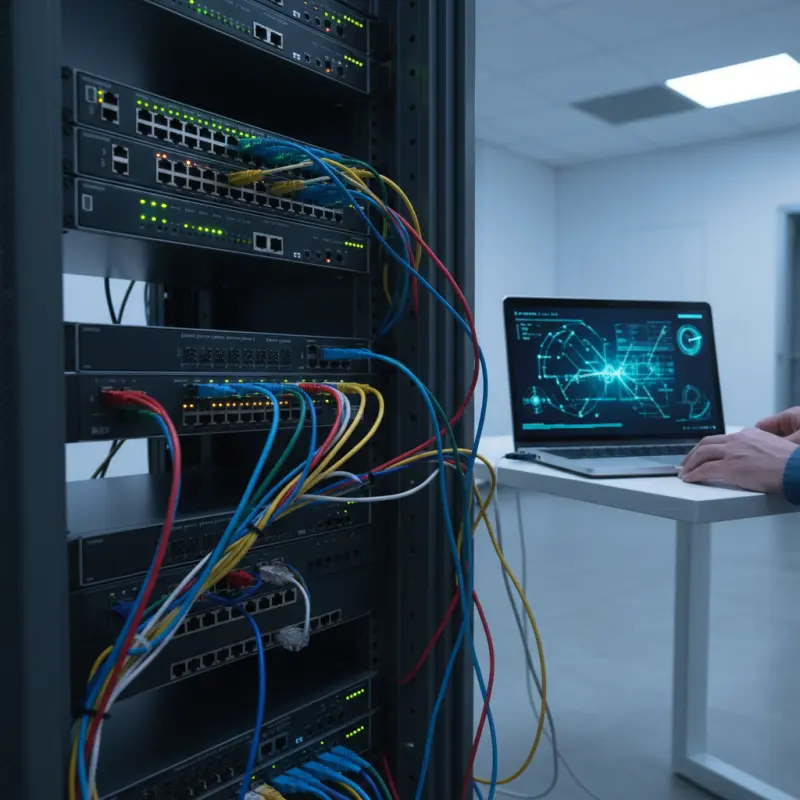
What Is an RJ45 Network Tap? A Technical Overview
Before diving into the core benefits, it’s critical to understand the technical foundation of an **RJ45 Tap** and how it differs from other **Network Tap** solutions. An **RJ45 Tap** is a Layer 1 (physical layer) hardware device that is inserted inline between two network nodes—such as switches, routers, firewalls, servers, or access points—in copper-based Ethernet networks (10/100/1000BASE-T). Its primary function is to create an exact, unaltered copy of all bi-directional traffic passing between the two nodes, which is then sent to monitoring tools (e.g., IDS, IPS, SIEM, NPM, APM) for analysis.
Key technical characteristics of **RJ45 Taps** include:
(1) No IP or MAC addressing: Unlike network switches or routers, **RJ45 Taps** are invisible to connected devices, meaning they cannot be targeted by attackers or interfere with network protocols (e.g., ARP, DHCP, STP).
(2) Bi-directional traffic capture: They copy both inbound and outbound traffic, ensuring complete visibility into data flows between network nodes.
(3) Two primary configurations:
○ Passive Network Tap: A power-free device that uses physical signal splitting to copy traffic. It operates entirely at the physical layer, introducing zero latency and offering maximum reliability for critical links.
○ Active Network Tap: A powered device that regenerates traffic signals, supporting longer cable runs (up to 100 meters for 1000BASE-T) and advanced features like traffic aggregation, PoE pass-through, and signal amplification. Ideal for enterprise and data center environments with complex, high-density networks.
(4) Fail-open design: Most enterprise-grade **RJ45 Taps** feature a fail-open mechanism, ensuring that if the tap loses power or malfunctions, the original network link remains intact—eliminating the tap as a potential SPOF.
By operating at the physical layer, **RJ45 Taps** bypass the limitations of software-based or switch-integrated monitoring tools, delivering consistent, reliable visibility that is critical for effective **Network Monitoring** and **Network Security**.
Top 10 Benefits of RJ45 Taps for Network Monitoring & Security
The adoption of **RJ45 Taps** has grown rapidly among enterprises, managed service providers (MSPs), and data centers—driven by their ability to solve core pain points in traditional monitoring. Below are the 10 most impactful benefits, supported by technical details, industry data, and real-world use cases.
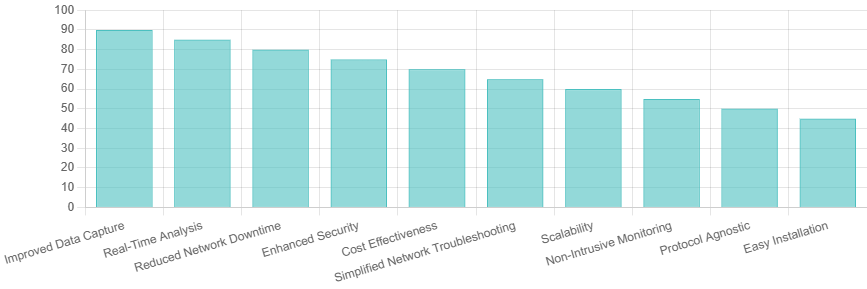
1. Zero-Disruption Network Monitoring: Protect Critical Operations
The most significant advantage of **RJ45 Taps** is their ability to monitor network traffic without any impact on production operations. Unlike SPAN ports, which rely on switch CPU resources and often drop packets under heavy load, or inline monitoring tools that can introduce latency or fail closed, **RJ45 Taps** operate independently of the network’s data path. When inserted between two nodes, the tap copies traffic to monitoring ports while allowing the original data to flow unimpeded—even during tap installation, maintenance, or power loss.
According to a report by the International Data Corporation (IDC), effective non-intrusive monitoring can reduce network downtime by up to 50%—a critical metric for organizations where even a minute of downtime can cost thousands of dollars. For example, in a financial services data center, an **RJ45 Tap** deployed between a core switch and a firewall allows IT teams to monitor for data exfiltration or unauthorized access without disrupting transaction processing. This zero-disruption capability makes **RJ45 Taps** ideal for critical network links, including those supporting VoIP, video conferencing, and real-time transaction systems.
2. 100% Complete & Accurate Packet Capture: Eliminate Monitoring Blind Spots
For **Network Security** and performance troubleshooting, the accuracy and completeness of packet capture are non-negotiable. Traditional monitoring methods like SPAN ports often drop critical packets—including error frames, runt packets, and corrupted frames—because switches prioritize production traffic over mirrored traffic. This creates blind spots that can hide security threats (e.g., malware, brute-force attacks) or performance issues (e.g., packet loss, retransmissions).
**RJ45 Taps** solve this by capturing every single packet that passes through the network link—regardless of packet size, error status, or protocol. This includes:
CRC errors and frame check sequence (FCS) errors, which can indicate physical layer issues (e.g., faulty cables, damaged ports). Runt frames (packets smaller than 64 bytes) and giant frames (packets larger than 1518 bytes), which may signal misconfigurations or malicious activity. Encrypted traffic (e.g., SSL/TLS, IPsec), which can be forwarded to decryption tools for deep analysis without altering the original encrypted flow.
This 100% packet capture fidelity is essential for compliance with regulations like PCI DSS, HIPAA, and GDPR, which require organizations to maintain detailed logs of network traffic for auditing and forensics. For example, in the event of a data breach, an **RJ45 Tap**’s complete packet capture allows security teams to reconstruct the attack path, identify the source of the breach, and prevent future incidents.
3. Enhanced Network Security: Mitigate Threats Without Adding Risk
**Network Security** is a top priority for organizations of all sizes, and **RJ45 Taps** play a critical role in strengthening security posture without introducing new vulnerabilities. Unlike active monitoring tools or software agents, **RJ45 Taps** have no IP address, MAC address, or configuration interface—making them invisible to attackers. This means they cannot be targeted, hacked, or used as a entry point into the network, unlike switches or routers that are often targeted in cyberattacks.
Additionally, **RJ45 Taps** enable continuous, 24/7 **Network Security** monitoring by feeding unaltered traffic to security tools like IDS (Intrusion Detection Systems), IPS (Intrusion Prevention Systems), and SIEM (Security Information and Event Management) platforms. This allows security teams to detect anomalies in real time, including:
Lateral movement of attackers within the network. Unauthorized data exfiltration to external IP addresses. Brute-force attacks on servers or network devices. Malicious traffic patterns associated with ransomware, phishing, or DDoS attacks.
For example, an **Active Network Tap** deployed in a retail environment can monitor traffic between point-of-sale (POS) systems and the core network, alerting security teams to any attempts to steal credit card data. By providing passive, non-intrusive visibility, **RJ45 Taps** enhance security without disrupting customer transactions or exposing sensitive data to additional risk.
4. Zero Latency & Real-Time Visibility: Optimize Performance for Critical Applications
In modern networks, even minimal latency can degrade the performance of real-time applications like VoIP, video conferencing, and cloud-based services. Traditional monitoring tools—such as inline IPS or software-based packet capture—often introduce latency by processing or modifying traffic before forwarding it, leading to poor user experience and reduced application performance.
**RJ45 Taps** eliminate this issue by operating at the physical layer, with **Passive Network Tap** models introducing zero latency and **Active Network Tap** models adding only negligible nanosecond-scale delay (far below the threshold that impacts application performance). This ensures that IT teams can monitor traffic in real time while maintaining the integrity of critical applications.
Real-time visibility is also critical for performance troubleshooting. With an **RJ45 Tap**, engineers can measure key performance metrics—such as jitter, packet loss, and round-trip time—with pinpoint accuracy, allowing them to identify and resolve bottlenecks before they impact users. For example, in a healthcare environment, an **RJ45 Tap** monitoring traffic between medical devices and electronic health record (EHR) systems can help IT teams detect latency issues that could delay patient care.
5. Streamlined Troubleshooting & Reduced MTTR
Network downtime and performance issues can cost organizations significant time and money, making rapid troubleshooting a top priority for IT teams. Traditional monitoring methods often make troubleshooting difficult due to incomplete packet capture, inconsistent data, or complex configurations. **RJ45 Taps** simplify troubleshooting by providing complete, consistent visibility into network traffic, allowing engineers to quickly isolate the root cause of issues.
For example, if users report slow application performance, an **RJ45 Tap** can capture all traffic to and from the affected application server, revealing whether the issue is due to packet loss, latency, misconfigured routing, or a problem with the application itself. Because the tap captures every packet, even intermittent issues (e.g., those that occur only during peak traffic) are easier to diagnose—reducing mean time to resolve (MTTR) and minimizing the impact on users.
A study by Network Security Insights found that organizations using **Network Taps** reduced MTTR by an average of 35% compared to those relying on SPAN ports or software-based tools. This efficiency not only saves IT teams time but also reduces the financial impact of network outages and performance issues.
6. Fail-Safe, Fail-Open Reliability: Eliminate Single Points of Failure
Enterprise networks cannot afford to have monitoring tools become a liability. Traditional inline monitoring devices—such as IPS or firewalls—often fail closed, meaning that if the device malfunctions or loses power, the network link is down, causing downtime. This creates a critical SPOF that puts business continuity at risk.
**RJ45 Taps** address this with a fail-open design, which ensures that if the tap loses power, malfunctions, or is removed, the original network link remains fully operational. This is achieved through a physical bypass mechanism that diverts traffic directly between the two network nodes when the tap is not active. For critical network links—such as those connecting a data center to the internet or linking core switches—this fail-open reliability is essential to maintaining business continuity.
Enterprise-grade **Active Network Tap** models also include additional reliability features, such as redundant power supplies and signal regeneration, ensuring that the tap remains operational even in harsh environments (e.g., data centers with high temperatures or power fluctuations).
7. Plug-and-Play Deployment: Simplify IT Operations
IT teams are often stretched thin, with limited time to manage complex monitoring configurations. **RJ45 Taps** are designed for simple, zero-configuration deployment—making them accessible even to junior IT staff. Unlike SPAN ports, which require complex switch configuration (e.g., VLAN mapping, ACLs, port mirroring), **RJ45 Taps** are truly plug-and-play:
(1) Disconnect the Ethernet cable between two network nodes.
(2) Connect one end of the cable to the “IN” port on the **RJ45 Tap**.
(3) Connect the other end of the cable to the “OUT” port on the tap.
(4) Connect monitoring tools to the “MON” ports on the tap.
No software installation, IP configuration, or switch changes are required. This simplifies deployment, reduces training costs, and minimizes the risk of human error. For organizations with distributed networks (e.g., multiple branch offices), this plug-and-play functionality allows IT teams to deploy **RJ45 Taps** remotely without needing on-site technical expertise.
8. Vendor Neutrality & Broad Compatibility
Modern enterprise networks often use equipment from multiple vendors—such as Cisco switches, Palo Alto firewalls, HPE servers, and Aruba access points. Traditional monitoring tools may be vendor-specific, limiting compatibility and creating silos in **Network Monitoring** and **Network Security**.
**RJ45 Taps** are standards-based and vendor-neutral, meaning they work seamlessly with any Ethernet-compatible equipment. They support 10/100/1000BASE-T copper links and integrate with all major monitoring tools, including:
IDS/IPS platforms (e.g., Snort, Suricata, Palo Alto Networks). NPM/APM tools (e.g., SolarWinds, PRTG, Datadog). SIEM solutions (e.g., Splunk, LogRhythm, IBM QRadar). Forensic analysis tools (e.g., Wireshark, tcpdump).
This vendor neutrality ensures that organizations can leverage their existing monitoring infrastructure while adding the reliability and accuracy of **RJ45 Taps**. It also provides flexibility for future upgrades, as organizations can switch vendors or add new tools without replacing their tap hardware.
9. Scalability for Growing Networks
As organizations grow, their network needs evolve—with more nodes, higher bandwidth, and additional monitoring requirements. Traditional monitoring solutions often require a complete redesign to scale, leading to increased costs and downtime. **RJ45 Taps** are highly scalable, allowing organizations to expand their monitoring capabilities incrementally without disrupting existing infrastructure.
Key scalability features of **RJ45 Taps** include: Support for multi-tool monitoring: A single **RJ45 Tap** can feed traffic to multiple monitoring tools (e.g., IDS, NPM, SIEM) simultaneously, eliminating the need for multiple taps per link. Modular design: **Active Network Tap** models often feature modular ports, allowing organizations to add additional monitoring ports as needed. Compatibility with link aggregation: For high-bandwidth links (e.g., 10GBASE-T), **RJ45 Taps** can be deployed in pairs to monitor aggregated links, ensuring complete visibility into all traffic.
For example, a growing e-commerce company can deploy additional **RJ45 Taps** as it adds new web servers and database nodes, ensuring that all traffic is monitored without requiring a complete network redesign. This scalability makes **RJ45 Taps** a future-proof investment for organizations looking to expand their network infrastructure.
10. Superior Cost Efficiency: Reduce Total Cost of Ownership (TCO)
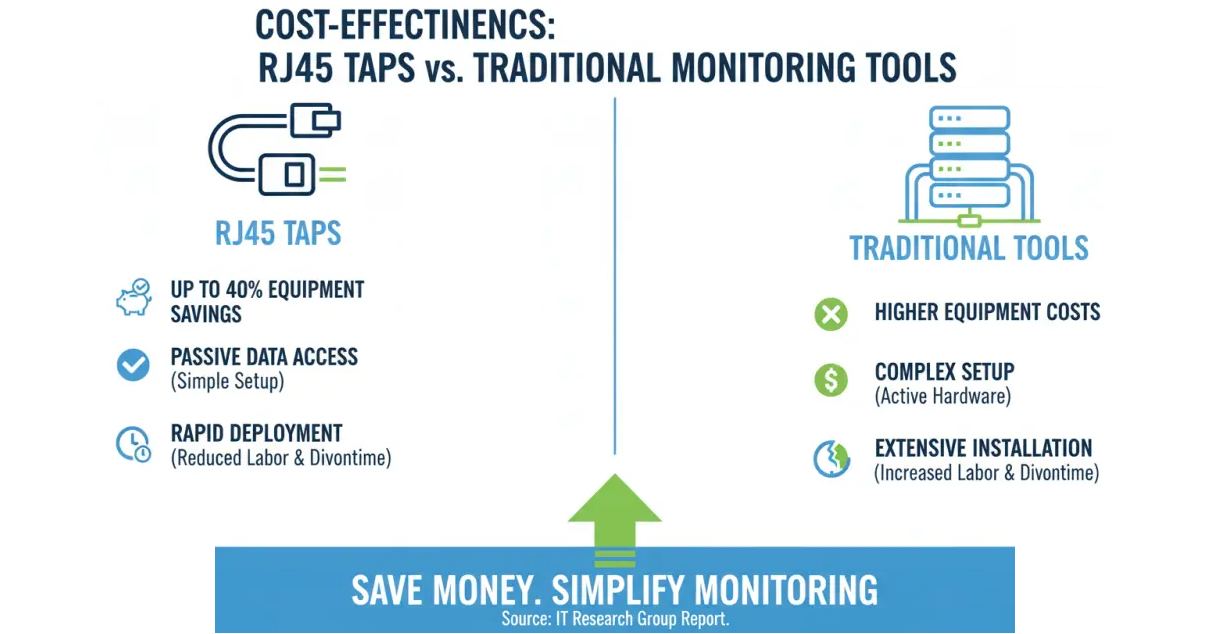
While **RJ45 Taps** are a hardware investment, they deliver significant long-term cost savings compared to traditional monitoring tools. According to a report by the IT Research Group, organizations can reduce monitoring costs by 25%–40% by replacing SPAN ports and complex active monitoring tools with **Network Taps**.
Key cost-saving benefits include:
No recurring licensing fees: Unlike software-based monitoring tools, **RJ45 Taps** are a one-time purchase with no annual licensing or subscription costs. Reduced switch CPU overhead: SPAN ports consume valuable switch CPU resources, which can lead to performance issues and the need for more expensive switches. **RJ45 Taps** offload monitoring traffic from switches, extending their lifespan and reducing hardware costs. Lower maintenance costs: **RJ45 Taps** require minimal maintenance, with no software updates, patches, or configuration changes needed. This reduces the workload for IT teams and lowers operational costs. Reduced downtime costs: By enabling early detection of issues and minimizing downtime, **RJ45 Taps** help organizations avoid the financial impact of network outages.
For example, a medium-sized enterprise using SPAN ports might spend thousands of dollars annually on switch upgrades and software licenses. By switching to **RJ45 Taps**, the organization can eliminate these recurring costs while improving monitoring accuracy and reliability.
Active Network Tap vs. Passive Network Tap: Which Is Right for Your Environment?
Choosing between a **Passive Network Tap** and an **Active Network Tap** depends on your network environment, requirements, and budget. Below is a detailed comparison to help you make an informed decision:
| Feature | Passive Network Tap | Active Network Tap |
| Power Requirement | No power needed (passive signal splitting) | Requires power (for signal regeneration, amplification) |
| Latency | Zero latency (physical layer operation) | Negligible (nanosecond-scale delay) |
| Cable Length Support | Short to medium (up to 30 meters for 1000BASE-T) | Longer (up to 100 meters for 1000BASE-T) |
| Advanced Features | None (basic packet capture only) | Traffic aggregation, PoE pass-through, signal amplification, remote monitoring |
| Reliability | Highest (no power failure risk) | High (fail-open design, redundant power options available) |
| Cost | Lower (no power supply or advanced electronics) | Higher (power supply, advanced features) |
| Ideal Use Case | Critical short-reach links (e.g., server-to-switch), compliance/forensics | Enterprise/data center networks, long-reach links, high-density monitoring |
For most enterprise environments, an **Active Network Tap** offers the best balance of reliability, functionality, and scalability. However, **Passive Network Tap** models are ideal for critical links where power failure is a concern (e.g., emergency systems, industrial control networks).
Why RJ45 Taps Outperform SPAN Port Mirroring
Many organizations start with SPAN port mirroring due to its perceived cost savings, but quickly migrate to **RJ45 Taps** due to inherent limitations. Below is a detailed comparison of **RJ45 Taps** and SPAN ports, highlighting why taps are the superior choice for **Network Monitoring** and **Network Security**:
| Feature | RJ45 Network Tap | SPAN Port Mirroring |
| Packet Loss | None (captures 100% of packets) | Common under load (switches prioritize production traffic) |
| Latency | Zero (passive) or negligible (active) | Variable (depends on switch CPU load) |
| Error Frames | Captured (critical for troubleshooting) | Usually dropped (switches filter out error frames) |
| Configuration | Zero configuration (plug-and-play) | Complex (requires VLAN mapping, ACLs, port mirroring setup) |
| Security | Invisible to attackers (no IP/MAC address) | Visible (configurable via switch, potential attack target) |
| Network Impact | None (independent of production traffic) | Uses switch CPU resources (can degrade switch performance) |
| Reliability | Fail-open (no SPOF) | Fail-closed risk (switch failure can disrupt monitoring) |
| Scalability | High (supports multi-tool monitoring, modular expansion) | Limited (switch has finite SPAN ports, CPU constraints) |
Ideal Use Cases for RJ45 Taps
**RJ45 Taps** are versatile and can be deployed in a wide range of environments to support **Network Monitoring** and **Network Security**. Below are the most common use cases:
1. Security Monitoring & Threat Hunting
Deploy **RJ45 Taps** at key network entry/exit points (e.g., internet gateway, firewall) to feed traffic to IDS/IPS and SIEM tools. This enables continuous threat detection, including malware, phishing, and data exfiltration.
2. Network Performance Monitoring (NPM) & Application Performance Monitoring (APM)
Use **RJ45 Taps** to monitor traffic between servers, switches, and end users, providing insights into latency, jitter, packet loss, and application response time. This helps IT teams optimize performance for critical applications.
3. Compliance & Forensics
**RJ45 Taps** capture 100% of traffic, making them ideal for compliance with regulations like PCI DSS, HIPAA, and GDPR. In the event of a breach, the complete packet capture allows for detailed forensic analysis.
4. Data Center & Server Farm Visibility
Deploy **Active Network Tap** models in data centers to monitor east-west traffic (server-to-server) and north-south traffic (data center to internet). This provides visibility into virtualized environments and cloud workloads.
5. VoIP & Unified Communications (UC) Quality Assurance
**RJ45 Taps** monitor VoIP traffic to measure jitter, delay, and packet loss—critical for maintaining call quality. This helps IT teams resolve issues before they impact users.
6. Branch Office Monitoring
Use plug-and-play **RJ45 Taps** to monitor branch office networks, providing centralized visibility into traffic without requiring on-site technical expertise.
Conclusion
**RJ45 Taps** are an essential tool for modern **Network Monitoring** and **Network Security**, offering zero-disruption visibility, 100% packet capture accuracy, enhanced security, and long-term cost savings. Whether you choose a **Passive Network Tap** for maximum reliability or an **Active Network Tap** for enterprise-grade functionality, these devices solve the core pain points of traditional monitoring methods—eliminating blind spots, reducing downtime, and simplifying IT operations.
In an era where network threats are becoming more sophisticated and downtime is increasingly costly, **RJ45 Taps** provide the reliable, non-intrusive visibility that organizations need to protect their critical assets, optimize performance, and ensure compliance. For any organization serious about **Network Security** and **Network Monitoring**, **RJ45 Taps** are no longer an option—they are a necessity.
Keywords of this Article
Network Tap, Active Network Tap, RJ45 Tap, Network Security, Network Monitoring, Passive Network Tap, Ethernet Tap, Network Visibility, Packet Capture, IDS Monitoring, SPAN Port Alternative, Network Troubleshooting, Enterprise Network Monitoring, Data Center Tap, Copper Network Tap
The related Active RJ45 Network Taps for your reference:
Mylinking™ Network Tap ML-TAP-0501 5*GE 10/100/1000M BASE-T, Max 5Gbps
Mylinking™ Network Tap ML-TAP-2401B 16*GE 10/100/1000M BASE-T plus 8*GE SFP, Max 24Gbps, Bypass
Post time: May-07-2026


