
Discover why a professional Network Packet Broker is mandatory for reliable network monitoring and robust network security. Solve traffic overload, visibility blind spots, tool port shortages & compliance risks with centralized NPB traffic orchestration.
The Critical Limitations of SPAN/TAP-Only Monitoring
As enterprise data centers scale to 10G, 40G and 100G high-speed fabrics, hybrid cloud workloads, virtual overlay networks and encrypted business traffic create massive blind spots for NetOps and SecOps teams tasked with network monitoring and network security defense. Most organizations initially rely solely on switch SPAN mirror ports and passive optical TAPs to capture traffic for IDS, NPM, APM, SIEM and forensic analysis tools, yet this fragmented architecture delivers unreliable, incomplete observability that directly raises security risk and operational overhead.
SPAN ports consume valuable switch hardware resources, drop packets under peak throughput, cannot parse VXLAN/GRE/MPLS tunnel encapsulation, and flood downstream security tools with redundant duplicate packets. Direct TAP-to-tool wiring creates messy, hard-to-manage physical cabling topologies, introduces multiple single points of failure, and wastes limited available ports on expensive monitoring appliances. When security tools receive unfiltered raw traffic, they waste CPU, memory and storage processing irrelevant flows, often missing critical threat indicators amid data overload.
A Network Packet Broker (NPB) solves these fundamental observability flaws by acting as a centralized, hardware-accelerated traffic orchestration middlebox deployed between capture nodes (TAPs, SPAN ports, virtual cloud taps) and all downstream network monitoring and network security tools. Unlike standard network switches, NPBs only manipulate mirrored out-of-band traffic based on user-defined policies without altering production business data flows. It aggregates, cleanses, optimizes and distributes precisely matched packet streams to every analysis tool, closing visibility gaps while maximizing existing hardware investment value.
This technical blog breaks down the urgent business and security reasons to deploy a Network Packet Broker, drawing on Mylinking’s official technical documentation to explain core pain points, key functional advantages, deployment architectures and measurable operational improvements for modern data center environments.
Key Pain Points Without a Network Packet Broker
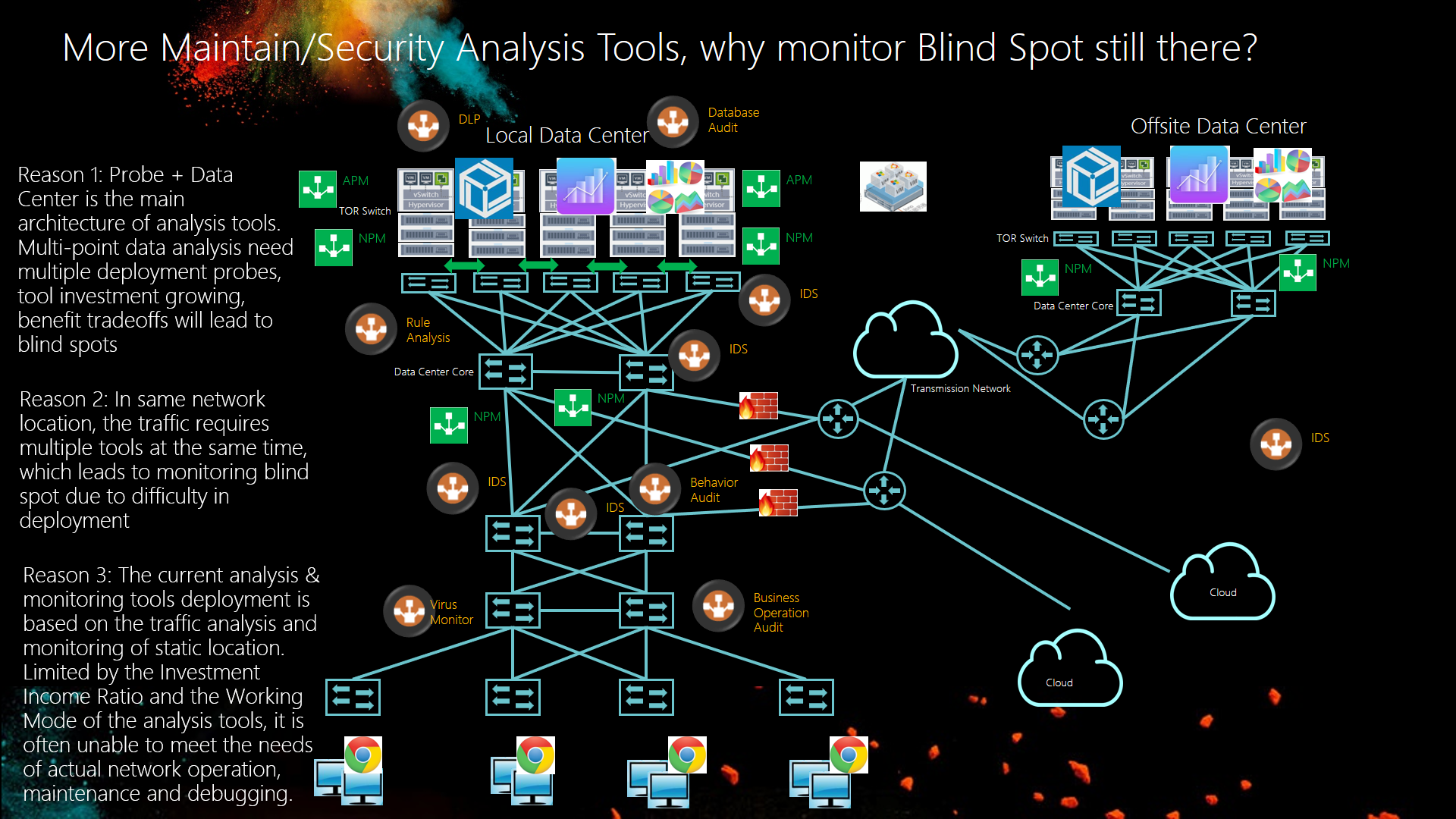
Operating network monitoring and network security stacks without a dedicated Network Packet Broker creates six interconnected, costly operational and security challenges that compound as network bandwidth and complexity grow:
1. Fragmented, Unscalable Traffic Capture Topology
Direct wiring from every switch SPAN and optical TAP to separate monitoring tools generates chaotic cabling layouts. Each new server rack, router or firewall requires additional mirror ports and physical fiber runs, increasing the number of potential failure points and raising routine maintenance workloads for NOC teams. SPAN port oversubscription further impairs production switch performance when too many mirror sessions run simultaneously.
2. Monitoring Tool Port Shortage & Underutilization
Security and performance analysis appliances come with a fixed number of physical interfaces, most of which remain underutilized when receiving traffic from only one or two capture sources. Without traffic aggregation, organizations must purchase extra monitoring hardware simply to accommodate multi-source mirrored traffic, drastically inflating capital expenditure. Many legacy tools also feature only low-speed 1G copper ports, unable to natively terminate 10G/40G fiber uplink traffic from modern core switches.
3. Uncontrolled Traffic Overload & Redundant Duplicate Packets
Cross-switch mirroring generates identical duplicate packets captured at overlapping network segments. These redundant data streams flood IDS, NDR and network monitoring tools, consuming processing resources without delivering actionable threat or performance insights. During traffic spikes, overloaded tools drop high-priority packets, hiding lateral movement malware, DDoS precursors and critical application latency faults.
4. Encapsulated Tunnel Traffic Blind Spots
Modern virtualized data centers and multi-tenant cloud fabrics rely on VXLAN, GRE, GTP and MPLS overlay tunneling protocols to segment workloads. Basic SPAN and TAP feeds deliver full encapsulated packets, yet most standalone monitoring tools lack hardware acceleration to strip outer tunnel headers, leaving east-west inter-server threat traffic completely invisible to SecOps teams. This creates severe Zero Trust security compliance failures, as teams cannot fully inspect all internal network flows.
5. Compliance Risk From Unfiltered Sensitive Payload Data
Raw mirrored traffic carries unredacted Personally Identifiable Information (PII), payment card data and Protected Health Information (PHI). Sending unprocessed full payloads to third-party analytics or internal network monitoring tools violates PCI-DSS, HIPAA, GDPR and SOX data protection regulations, exposing organizations to regulatory fines and data breach liability.
6. Lack of Standardized Cross-Network Timing For Forensics
Without centralized hardware timestamping at capture, packet logs from disparate switches, routers and security tools carry inconsistent system timestamps. When security incidents or network outages occur, analysts cannot accurately correlate traffic events across the full fabric, drastically extending mean time to resolve (MTTR) for both network performance faults and cyber attack response.
Core Deployment Scenarios That Demand a Network Packet Broker
Organizations must deploy a Network Packet Broker if their network monitoring and network security strategy falls into any of these common enterprise scenarios outlined in Mylinking’s technical guide:
1. Multi-source unified traffic collection: Teams need to capture mirrored traffic from dozens of distributed switches, firewalls, routers, server farms and remote site gateways, but lack a centralized aggregation hub to consolidate all feeds. Multiple independent TAP deployments introduce redundant failure points and management complexity.
2. Multi-tool parallel traffic delivery: The same captured network flows require simultaneous delivery to separate security and monitoring tools, including IDS threat detection, NPM performance tracking, APM application diagnostics and compliance audit platforms. Direct SPAN replication wastes limited switch mirror ports.
3. Legacy low-speed tool compatibility: The core data center has upgraded to 10G/40G/100G uplinks, yet existing security monitoring appliances only support 1G copper interfaces and cannot natively ingest high-speed fiber traffic without intermediate conversion and traffic shaping.
4. Virtualized/cloud fabric monitoring: The environment leverages VXLAN, MPLS or GTP overlay networks, requiring automated tunnel header stripping to inspect encapsulated internal traffic for lateral threat movement.
5. Regulated industry data capture: Financial, healthcare and government networks must desensitize sensitive payload data before forwarding traffic to network monitoring platforms to meet mandatory data privacy compliance standards.
6. Large-scale traffic forensics: Security teams need precise nanosecond timestamping across all captured packets to reconstruct attack chains and cross-reference event logs from multiple network segments during incident response investigations.
How Network Packet Broker Optimizes Network Monitoring Tool Efficiency
A Network Packet Broker fundamentally transforms network monitoring workflows by eliminating wasteful data processing and extending the service lifespan of existing analysis hardware through six core optimization mechanisms:
1. Multi-Source Traffic Aggregation
The NPB consolidates dozens of discrete SPAN and TAP traffic feeds into unified filtered streams, maximizing utilization of every physical port on downstream monitoring tools. Instead of one capture source occupying an entire appliance interface, aggregated multi-link traffic fully saturates available bandwidth capacity, removing the need for costly additional tool deployments.
2. Session-Aware Load Balancing
For high-speed 10G/40G/100G core traffic, the NPB distributes flows evenly across clusters of low-speed monitoring appliances using L2-L7 session-based hash algorithms. This prevents individual tools from hitting throughput limits and dropping critical packets during peak business hours, while enabling organizations to retain legacy 1G/10G monitoring hardware long after core network upgrades. The NPB also acts as a native media converter, bridging fiber capture links to copper-only monitoring tool interfaces without separate transceiver hardware.
3. Policy-Based Packet Slicing
Most network monitoring use cases only require L2-L4 header metadata for bandwidth trending and latency analysis, with no need for full application payload capture. The NPB slices raw packets to configurable lengths (64–1518 bytes) per monitoring policy, discarding unnecessary payload data and cutting downstream bandwidth and storage consumption by up to 90%. Full packet capture remains configurable exclusively for high-risk internet border and DMZ traffic requiring deep forensic inspection.
4. Automated Packet Deduplication
Hardware-accelerated deduplication eliminates redundant identical packets collected from overlapping mirror segments, reducing total traffic volume sent to network monitoring tools by 40–60%. With fewer redundant flows to process, NPM and APM platforms generate cleaner, more accurate performance metrics and reduce false positive alerts caused by duplicate traffic noise.
5. Targeted Traffic Filtering
Administrators build granular filtering rules based on Ethernet type, VLAN tags, IP seven-tuple, TCP flags and custom 128-byte packet offset fields. The NPB forwards only traffic relevant to each dedicated monitoring tool—for example, routing only business application flows to APM systems and discarding irrelevant broadcast or background IoT traffic—removing unnecessary processing load from performance analysis appliances.
6. Centralized Timestamping & Flow Export
Built-in hardware nanosecond timestamping synchronized to enterprise NTP servers standardizes timing metadata across all captured packets, enabling accurate cross-fabric traffic correlation for network fault troubleshooting. The NPB also generates standardized NetFlow/IPFIX flow records for capacity planning dashboards, removing the need for flow generation processing on resource-constrained monitoring tools.
How Network Packet Broker Reinforces End-to-End Network Security?
Beyond network monitoring performance gains, a Network Packet Broker forms the foundational visibility layer for comprehensive network security defense, addressing critical blind spots that leave enterprise fabrics vulnerable to data breaches and lateral malware spread:
1. Tunnel Header Stripping for Encapsulated Threat Inspection
Hardware-level decapsulation strips VXLAN, GRE, ERSPAN, MPLS and GTP outer tunnel headers before forwarding inner packet data to IDS/NDR security tools. This uncovers hidden east-west attack traffic within virtual multi-tenant fabrics, fulfilling Zero Trust architecture requirements to inspect every internal server-to-server flow. Custom user-defined header stripping rules also support proprietary niche encapsulation protocols without firmware upgrades.
2. Hardware-Accelerated SSL Decryption
Over 95% of modern enterprise internet traffic travels via TLS encryption, which attackers exploit to conceal ransomware, data exfiltration and command-and-control communications. The NPB offloads resource-intensive SSL/TLS decryption to dedicated hardware pipelines, decrypting HTTPS payloads at line rate and forwarding plaintext traffic to threat detection tools. This avoids crippling CPU bottlenecks on expensive security appliances and eliminates encrypted traffic security blind spots.
3. Policy-Driven Sensitive Data Masking
Native data masking functionality overwrites PII, payment card numbers and protected health records within packet payloads before traffic is delivered to network monitoring and security analysis platforms. This hardware-native desensitization eliminates the need for standalone traffic scrubbing appliances and satisfies global regulatory compliance rules for data privacy, mitigating breach liability risks for regulated industries.
4. Intelligent Traffic Replication for Multi-Layer Security Stacks
The NPB replicates filtered high-risk traffic streams to parallel security tools simultaneously: full internet border flows to intrusion detection systems, payment VLAN traffic to DLP compliance platforms, and remote user VPN flows to behavioral threat analytics tools. Every security appliance receives only the threat-relevant traffic it requires, maximizing threat detection accuracy while reducing unnecessary data noise.
5. Deep Application Layer Protocol Identification
Integrated DPI engines fingerprint hundreds of enterprise application protocols (HTTP, DNS, MySQL, BitTorrent, cloud SaaS services) and generate layer-7 traffic metadata for SecOps teams. This application intelligence enables early detection of shadow IT file transfers, unauthorized peer-to-peer communications and application-layer malware attacks that signature-only security tools fail to identify.
Core Built-In NPB Capabilities That Fix Network Visibility Gaps
All Mylinking enterprise-grade Network Packet Broker models integrate these hardware-accelerated core features to unify network monitoring and network security workflows:
1. Traffic aggregation, multi-port replication and session-aware load balancing
2. L2-L7 flexible packet filtering and custom 128-byte offset matching
3. Tunnel decapsulation (VXLAN/GRE/MPLS/GTP/ERSPAN) and VLAN tag manipulation
4. Packet deduplication, policy-based slicing and sensitive data masking
5. Nanosecond precision hardware timestamping synchronized with NTP
6. Hardware SSL/TLS decryption for encrypted threat visibility
7. NetFlow V9/IPFIX flow record generation for capacity analytics
8. Port breakout and single-fiber transmission for cost-effective tap deployment
9. Dual redundant hot-swappable power supplies for 24/7 data center reliability
10. Unified multi-access management: CLI console, HTTP web UI, SNMP, SYSLOG and RADIUS authentication
Side-by-Side Architecture: Network Without NPB vs Network With Mylinking NPB
Architecture 1: Network Without Network Packet Broker
As visualized in Mylinking’s reference topology diagram, direct SPAN/TAP-to-tool wiring creates a disorganized siloed visibility fabric:
○ Separate fiber runs connect every switch and firewall mirror port to individual IDS, NPM, APM and compliance tools
○ Massive duplicate packet volume from overlapping mirror segments overloads security appliances
○ Encapsulated VXLAN/GRE tunnel traffic remains uninspected by downstream tools
○ Limited tool ports require purchasing extra monitoring hardware for multi-source capture
○ Unredacted sensitive payload data creates regulatory compliance risk
○ Inconsistent packet timestamps delay incident response and fault troubleshooting
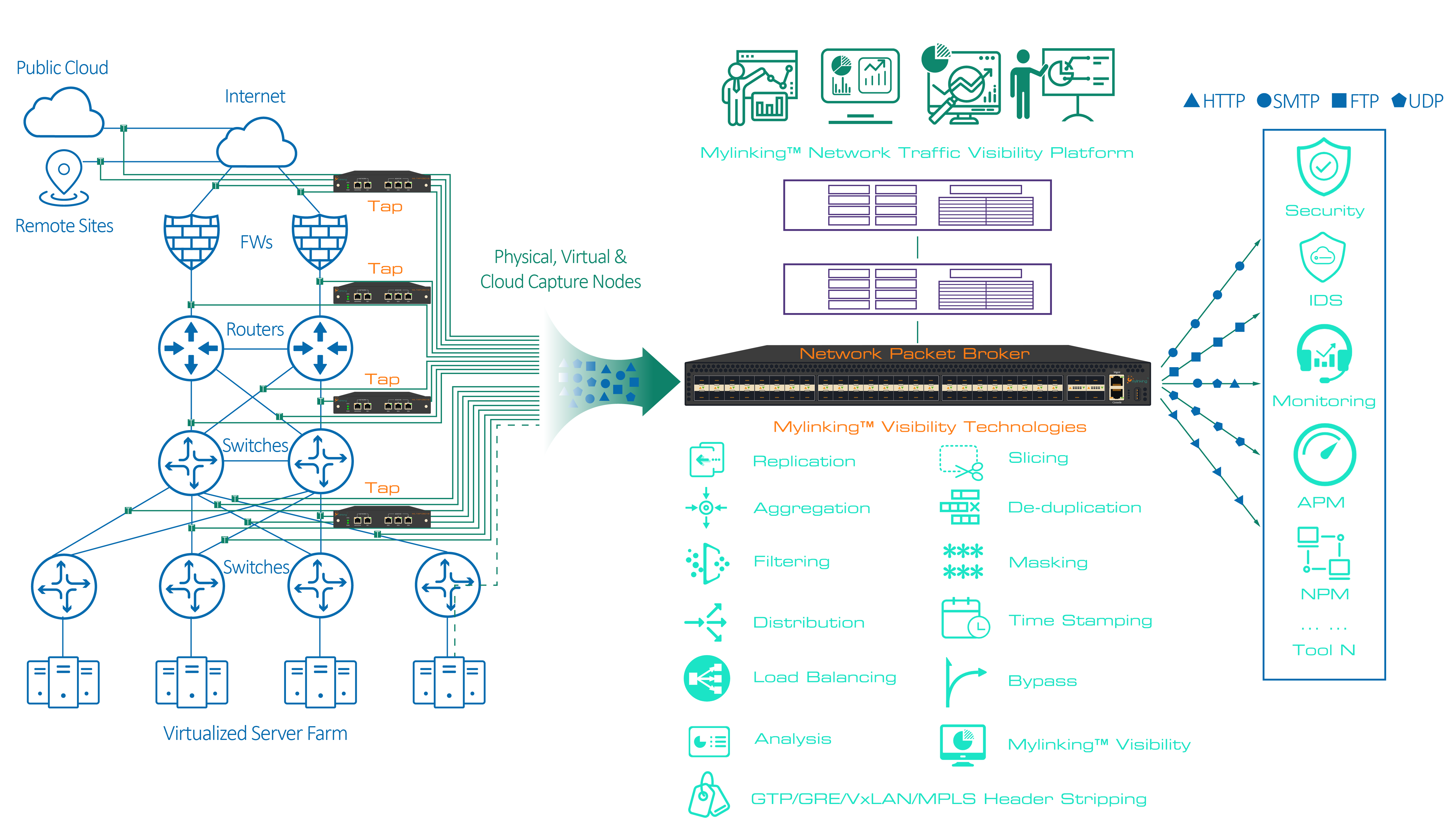
Architecture 2: Network Optimized With Mylinking Network Packet Broker
The centralized NPB deployment consolidates all traffic capture workflows into a single visibility hub:
○ All physical TAP, switch SPAN and virtual cloud capture feeds connect directly to the NPB’s high-speed ingress ports
○ The NPB executes aggregation, deduplication, filtering, decapsulation and data masking via hardware pipelines
○ Clean, tool-specific traffic streams are distributed via load balancing to every network monitoring and network security appliance
○ Tunnel headers are stripped, SSL traffic decrypted and sensitive data masked before egress
○ Nanosecond standardized timestamps are embedded on all packets for unified forensic analysis
○ Port breakout and single-fiber support reduce overall fiber cabling capital costs
Tangible Business ROI of Deploying a Network Packet Broker
1. Extend existing monitoring tool lifecycle: Load balancing, slicing and aggregation eliminate immediate hardware upgrade requirements for legacy low-speed security appliances, cutting capital expenditure by 30–50%.
2. Reduce security incident MTTR: Complete tunnel/encrypted traffic visibility and standardized timestamp correlation cut threat investigation time by more than half for SecOps teams.
3. Lower storage and bandwidth overhead: Deduplication and packet slicing reduce total traffic volume sent to monitoring platforms, lowering cloud archive and inter-data-center transfer costs.
4. Minimize regulatory compliance risk: Native data masking removes the need for third-party scrubbing hardware and ensures traffic capture workflows align with PCI-DSS, HIPAA and GDPR mandates.
5. Cut data center rack space and cabling costs: Centralized aggregation eliminates dozens of redundant fiber runs and auxiliary visibility appliances, reducing physical infrastructure overhead.
6. Eliminate production switch performance impact: Consolidated mirror capture via NPB reduces SPAN port utilization on core switches, preventing mirror session-related packet loss on production business traffic.
Build Complete Visibility With Mylinking Network Packet Broker
Modern network monitoring and network security programs cannot deliver reliable threat detection or performance troubleshooting without a dedicated Network Packet Broker as their central visibility orchestration layer. SPAN and passive TAP-only deployments create costly traffic overload, uninspected encapsulated blind spots, tool port shortages, compliance vulnerabilities and fragmented traffic topologies that degrade both NetOps and SecOps efficiency.
Mylinking enterprise-grade Network Packet Broker hardware addresses every core visibility pain point through fully hardware-accelerated traffic processing functions: aggregation, deduplication, filtering, tunnel decapsulation, SSL decryption, packet slicing and compliance-focused data masking. By centralizing all traffic capture preprocessing in a single compact rackmount appliance, organizations unlock full end-to-end network visibility across north-south internet border flows and east-west virtual fabric traffic, maximizing ROI on existing monitoring and security tool investments while strengthening overall cyber defense posture.
For full Network Packet Brokers solution consultation, visit Mylinking’s official resource page: https://www.mylinking.com/network-packet-broker/
Post time: Aug-06-2026


